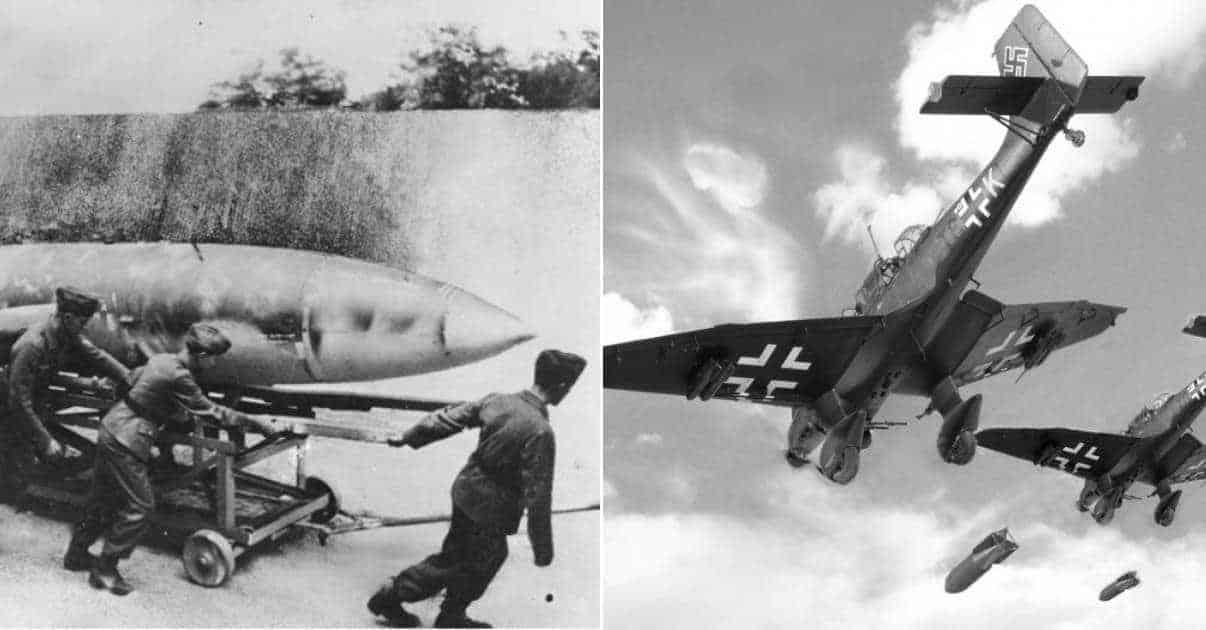
In the runup to WWII and during the conflict, combatants raced to outdo each other in designing, producing, and deploying increasingly innovative and deadly instruments of war. The competition was fierce, and for much of this period, German scientists and designers seemed to have a decided edge in coming up with brilliant new ways to wreak mayhem. Indeed, the Nazis demonstrated an alarming tendency to think outside the box to come up with deadly technological innovations. Even more alarming was their ability to quickly transform those sinister brainstorms into practical designs, then rush them through production and get them into the hands of their warriors.
Luckily for humanity, the Nazis fell short when it came to the war’s greatest technological innovation of all: unlocking the secrets of the atom and producing atomic weapons. Contrary to myth, Nazi atomic physicists and scientists never came close to developing nukes – something for which mankind should be eternally grateful. But in many other fields, German scientists were frightfully innovative, and uncannily good at designing and pioneering new weapons technologies. Some of them were busts and dead ends, but others went on to revolutionize not only warfare, but the trajectory of humanity’s future, and perhaps the very fate of our species.

Following are ten innovate or secret technologies developed by the Nazis.

The World’s First Operational Production Helicopters
In the runup to WWII, and during the conflict, the Nazis had the world’s most advanced helicopter technology, and took the global lead in design and development. They built the world’s first practical helicopter, and the first helicopter production line. One of the pioneering test pilots was Hanna Reitsch, Germany’s most famous female aviator and test pilot, and a dedicated Nazi. She first rose to fame by flying a helicopter around Berlin’s Great Hall – history’s first indoors helicopter flight.
Test flights convinced the German military that helicopters were viable instruments of war. The result was the Focke-Achegilis Fa 223 Drache (“Dragon”), which first flew in August of 1940, and entered production in 1941. It had a 40 foot long fuselage, powered by a 1000 horse power radial engine, hooked to a pair of 39 foot 3 bladed rotors on either side of the fuselage. It could cruise at 110 m.p.h., and reach an altitude of 23,000 feet. It could also haul a 2200 lbs load to an altitude of 8000 feet, while cruising at 75 m.p.h.
The Nazis also built a light helicopter, the single seat Flettner Fl 282 Kolibri (“Hummingbird”), which first flew in 1941 and entered production in 1942. The Kolibri’s fuselage was made of steel tubes, over which fabric was stretched, and it came with a fixed 3 wheel tricycle undercarriage. The newer Fl 282 was a more reliable machine than the pioneering Fa 223, requiring maintenance only once every 400 operational hours, compared to the Fa 223’s need for an overhaul every 25 hours.
The German navy also built small, portable helicopters, to be carried aboard ship and flown for short range reconnaissance. After the war, captured German helicopters were shipped to the US for testing. The Flettner rotor design formed the basis for what would become the world’s first gas turbine helicopter in 1951, in a version of the American K-225 helicopter.


