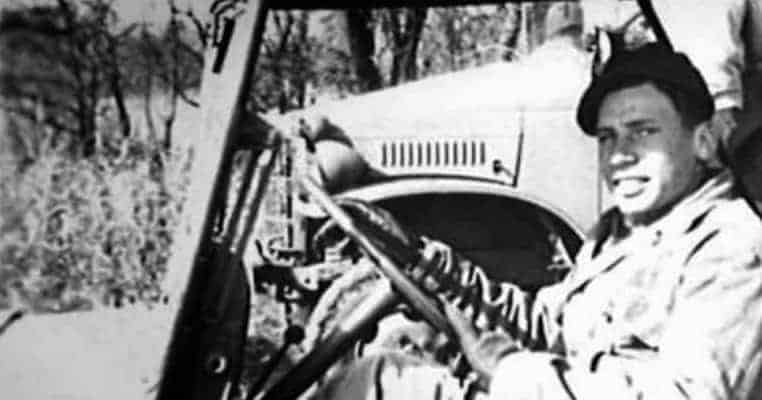
Mel Brooks, the Warrior

Like many American Jews, Brooks was extra fired up to fight the Nazis but was also well aware of the extra risks faced by Jews if captured by the enemy. As he put it: “My brother Lenny was an engineer gunner in a B-17, and in his 35th or 36th mission, his Flying Fortress B-17 was hit, and they all bailed out, and they landed in Austria. He knew he had an ‘H’ [on his dog tags, for ‘Hebrew’] and he had heard rumors that the Germans were taking Jewish troops and sending them to concentration camps. So on his way down, while still in his parachute, he ripped [his dog tags] off. “
He scored high in the Army’s aptitude and IQ testing and wound up in the Army Specialized Training Program (ASTP). There, he was sent to learn important skills such as engineering, and some skills that were of dubious value in 1944, such as horseback riding and fencing. He did not get to complete ASTP, however, because the combat arms complained of the program’s absurdity, and that it deprived them of the brightest recruits. ASTP was duly terminated, and Brooks was sent to Fort Sill, Oklahoma, where he received training better suited to the needs of the war effort, as an artillery observer.
Sent to Europe in 1944, Brooks’ qualifications that got him into ASTP marked him out as a soldier of high intelligence. So his first assignment was as a forward artillery observer – a job that requires quick thinking on the fly. He was then assigned to a combat engineer unit, the 1104th Engineer Combat Battalion (ECB), attached to the 78th Infantry Division. Combat engineers often went out ahead of the main assaults, to clear out obstacles for follow on troops.

Brooks’ unit used demolitions to blast a way clear for the main forces, repaired bridges destroyed by the Germans in a bid to slow the Allied advance, built bridges from scratch, helped lay out and construct field fortifications, and otherwise offered whatever support they could. The combat engineers often did their work under the enemy’s noses, while subjected to artillery raining down on them, and German snipers doing their best to pick them off.
The 1104th ECB became the first unit to throw a bridge across the Roer River, and later on, it built bridges across the Rhine. Brooks’ tasks included clearing minefields and defusing land mines. It was a hairy job, that was made even hairier when he had to do it while exposed to enemy fire. As Brooks described it to Conan O’Brien on his show: “You take a bayonet, and you look for mines – planted mines. And they could blow a tank, I mean they’re big. … You find them, unearth them … if it could blow up a tank, it could certainly take away a Jew in no time“. On at least five occasions, Brooks’ unit had to down their tools and pick up rifles to fight as infantrymen, and took casualties while doing so. He also fought in the Battle of the Bulge during the winter of 1944-1945.


