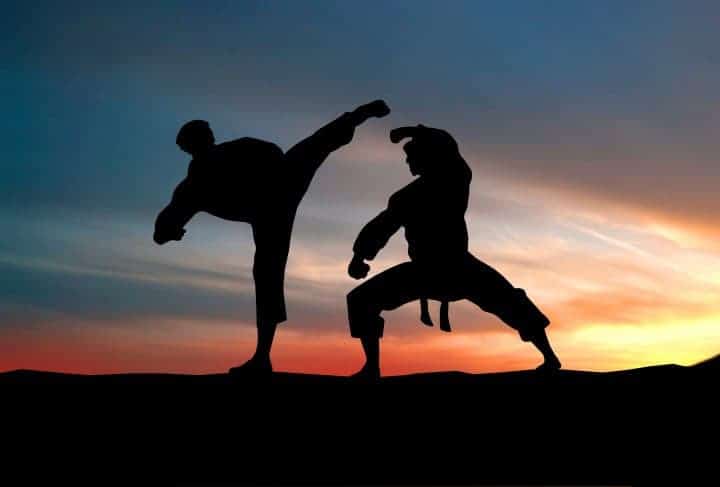

6 – Karate (14th century)
“Some young enthusiasts of karate believe that it can be learned only from instructors in a dojo, but such men are mere technicians, not true karateka. There is a Buddhist saying that “any place can be a dojo,” and that is a saying that anyone who wants to follow the way of karate must never forget. Karate-do is not only the acquisition of certain defensive skills but also the mastering of the arts of being a good and honest member of society.” Gichin Funakoshi on the purposes of Karate
Karate is a Japanese martial art, but it might more properly be called an Okinawan martial art. Okinawa is found well to the south of the main islands of Japan and was, until the mid 19th Century, separate from the Japanese nation. Sandwiched between Japan and China, influences on Okinawan culture came from both, as well as indigenous aspects: karate is thus a fusion of various Chinese martial arts, developed in isolation from modern Japan but the filtered into the wider world via Japan.
The “te” in karate comes from the original Okinawan style, which was split between different cities, different clans and different schools within the thousand-mile long chain of islands. It wasn’t until Gichin Funakoshi, an Okinawan master, travelled to Japan in the 1910s that the style began to take hold outside of the island. Funakoshi had learned the ancient arts of Okinawa as a child and developed his own hybrid, which became known as Shotokan karate, the style that is most popular today.
His style took hold quickly, especially once he had changed the name from “Chinese Hand” to “Empty Hand”, written differently but pronounced the same in Japanese. The name had originated during a period in the Ryuku Islands, of which Okinawa is a part, in which Chinese was in vogue, but he decided to change it to assist with popularisation in Japan. He also added the suffix “do”, meaning “way” (see also Aikido, Judo and Kendo), and the name had suddenly changed from “Chinese martial art” to “The Way of the Empty Hand”, the name by which it is often known today.
He built the style up through universities and gained recognition as a Japanese martial art in 1933. It was a perfect time for karate to find popularity: Japan was sending migrants around the world and they brought karate with them, leading to schools forming in neighbouring countries such as Korea and China (which was at the time under Japanese occupation) as well as further afield in the United States, Canada and Europe.
Later, as the United States occupied Japan in the wake of the Second World War, huge troop numbers were stationed on Okinawa. Even to this day, Okinawa is the centre of the American military presence in Japan, and many of those who have found themselves there have fallen in love with the local martial art. As a result, America took to karate in a huge way, with it becoming almost synonymous with Japanese martial arts for many there. The fad for Asian culture that took hold of many in the late 1970s, centred around martial arts movies such as The Karate Kid series, grew the sport massively and by the 1980s, there were karate tournaments and dojos everywhere across the country.
The growth of competitive karate – something to which Gichin Funakoshi was always opposed – has been considerable and in 2016, the sport was voted into the Olympic Games for the very first time. As the next games will be held in Tokyo, perhaps it can be seen as a homecoming for one of Japan’s most enduring martial arts. Of course, it is not the first Japanese martial art to feature in the Olympics: the first, and arguably most popular, is Judo – about which we will talk next.


