
De Haviland Mosquito
Nicknamed “The Wooden Wonder” because it was constructed almost entirely of wood, the twin-engine Mosquito was one of the most versatile and successful airplanes of WWII. It almost never get off the drawing board, as its basic concept of a bomber bereft of defensive weapons, relying instead on speed and agility to avoid and escape danger rather than fight it off, went against conventional wisdom at a time when bombers bristling with machine guns to fend off fighters was the norm. The Mosquito was the anti-Fortress, and it took significant cajoling to win the Air Ministry’s grudging approval, and only after it was repeatedly emphasized that wood was one of the few abundant resources in wartime Britain, so a mostly wooden plane would have little adverse impact on the production of other aircraft the Ministry deemed a higher priority, because it would not compete with them for precious stocks of metals and alloys.
The Mosquito was tested for the first time in November 1940, and prototypes demonstrated that they could outrun a Spitfire. It entered production the following year, and proved a smashing success. Mosquitoes began service as photo-reconnaissance airplanes, in which task they were served well by a speed and agility that allowed them to evade or outrun German interceptors. Having demonstrated that they could survive over hostile skies, Mosquitoes were soon employed in direct combat in a variety of roles.
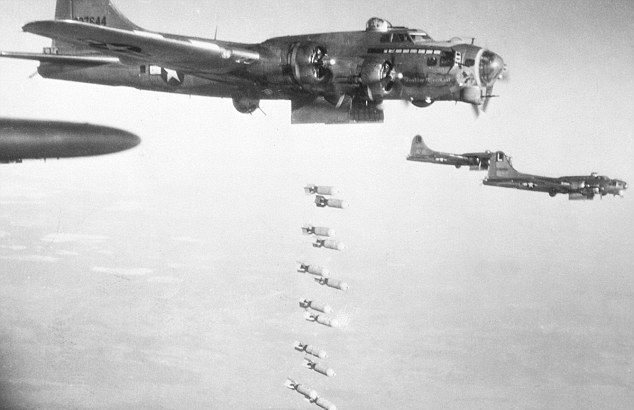
Their bombload of 4000 lbs was only slightly less than the 4500 lbs typically carried by B-17s, but Mosquitoes could deliver their bombload with greater precision. They carried out pin-point attacks on targets throughout Nazi-occupied Europe, conducted night-time raids on Luftwaffe airfields, served as Pathfinders ahead of the nighttime bomber streams by marking out the target areas with colored incendiaries, carried out nighttime nuisance bombings, and flew special operations raids such as precision attacks on Gestapo and German intelligence facilities, and smashing the walls of Nazi prisons to facilitate jailbreaks. Mosquitoes also served successfully as fighters, night bombers, in anti-submarine and anti-shipping roles, and as a fast transport for high-value cargoes.
Perhaps the greatest compliment given the Mosquitoes came from Luftwaffe chief Herman Goering while addressing German manufacturers in 1943: “It makes me furious when I see the Mosquito. I turn green and yellow with envy. The British, who can afford aluminium better than we can, knock together a beautiful wooden aircraft that every piano factory over there is building, and they give it a speed which they have now increased yet again. What do you make of that?”


