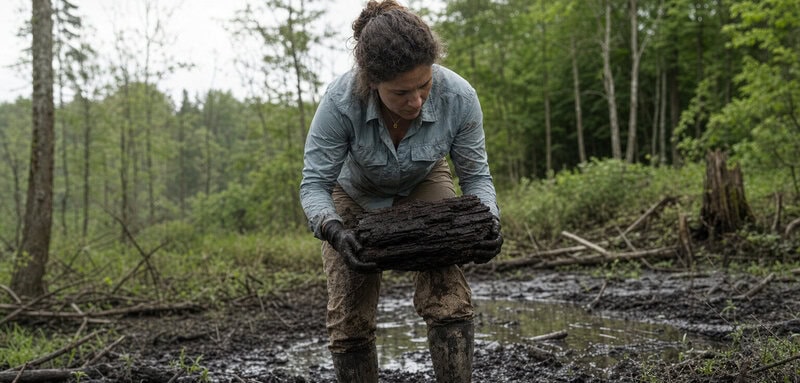
Dr. Sara Jarman felt her boot sink before she heard it — that particular sucking groan of northwest Ohio black muck claiming anything it can get — and when she finally wrenched her foot free, she stood for a moment looking at the dark seam of compressed organic material the mud had exposed at the edge of her boot hole. It was the wrong kind of soil to be in the wrong kind of place, if you believed the old story about Ohio’s wetlands: that they were empty, that people had always gone around them, that the swamp was a void between the real places where history happened.
The Swamp That Settlers Called Impassable — and Ancient Peoples Called Home
The Great Black Swamp once stretched across roughly 1,500 square miles of northwest Ohio, a sodden wilderness of sedge meadow, standing timber, and slow black water so dense and disorienting that 19th-century European settlers famously called it impassable. They drained it anyway — in roughly a decade of relentless tile-ditching and clear-cutting during the mid-to-late 1800s, one of the most dramatic landscape transformations in American history — and what replaced it was some of the most productive farmland on the continent. The swamp, it seemed, had been an obstacle. An interruption. A nothing waiting to become something.
What Dr. Jarman and her colleagues at Ohio University are now finding — in a first-of-its-kind archaeological research project funded by the Stream and Wetlands Foundation — suggests that assessment was almost perfectly backward. The swamp was not a void. It was an address, with thousands of years of occupants who knew exactly how to live inside it, move through it, and build their worlds around it.
The Archaeology Nobody Thought to Do
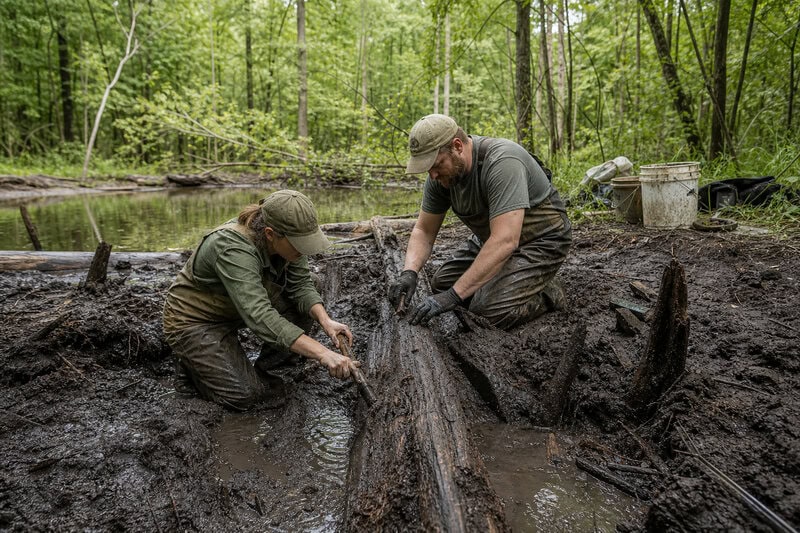
For generations, Ohio archaeology concentrated on dry uplands: the great Hopewell earthwork complexes, hilltop enclosures, riverside village sites where plows reliably turned up sherds and projectile points. The wetlands, by contrast, were written off as marginal — perhaps visited seasonally for fish and waterfowl, but not genuinely inhabited, not strategically important, not worth the considerable technical difficulty of excavating waterlogged sediment. There was a certain circular logic at work, the kind that tends to go unexamined for a very long time: we don’t dig the swamps because we don’t think anything is there, and we don’t think anything is there because we’ve never dug the swamps.
The technical barriers were real. Waterlogged sediment coring requires specialist equipment. Conservation of waterlogged organic finds — wood, fiber, leather, plant material — demands immediate treatment once the material leaves its saturated environment; exposed to open air, objects that survived three thousand years underground can begin to crumble within hours. Dr. Jarman has compared the logistics to running a small field hospital alongside a dig, with the added complexity that the patient is a wooden tool and the prognosis without intervention is poor.
Yet wetland sites across North America have repeatedly demonstrated that the difficulty is worth it. Florida’s Little Salt Spring, the Hoko River sites in the Pacific Northwest, the waterlogged deposits of the upper Midwest — all have produced organic materials invisible in the dry archaeological record: dugout canoes, woven baskets, cordage, human remains with soft tissue intact, pollen and seed assemblages that reconstruct ancient plant economies in granular detail. Anoxic, oxygen-poor sediments suppress the bacterial decay that destroys organics on upland sites, turning waterlogged peat into an accidental archive of everything that dry archaeology cannot see. Dr. Jarman’s question was deceptively straightforward: what if someone simply applied those lessons to Ohio’s ancient wetlands? What if, for the first time, someone actually looked?
The Funder That Extended Its Mandate
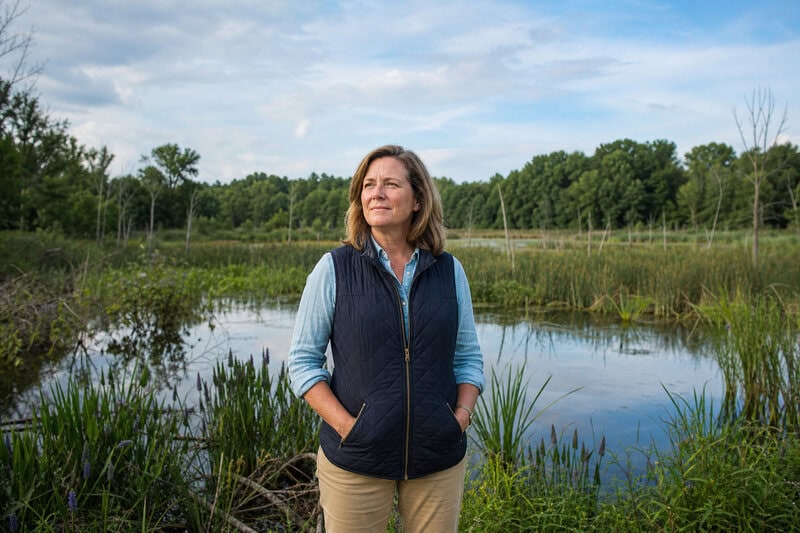
The organization that made it possible to look is not a traditional archaeological grant agency. The Stream and Wetlands Foundation — formerly known as the Ohio Wetlands Foundation — specializes in compensatory mitigation for impacts to aquatic resources: the financial and ecological mechanism that offsets damage done to wetlands when development projects drain or fill them. Its core business is ecological restoration and preservation, not cultural history.
Which makes its decision to fund Ohio University’s archaeological research project all the more striking. By channeling support toward an excavation of human prehistory in wetland landscapes, the foundation is extending its mandate in an unexpected direction — asking not just what wetlands are worth ecologically, but what they meant to human cultures across millennia before anyone thought to drain them. As the foundation has described it, it is “excited to support important archaeological research being undertaken by professors and students at Ohio University,” a phrasing that acknowledges the project’s unusual position at the intersection of environmental mitigation and humanistic inquiry.
Ohio University professors and students are co-investigators on the project, which means the research doubles as a training ground. The next generation of wetland archaeologists in Ohio is being built, literally, inside the fieldwork itself — learning coring methodology, waterlogged-finds conservation, and LiDAR interpretation not from a textbook but from the mud.
Who Lived in the Swamp? Tracing Millennia of Presence
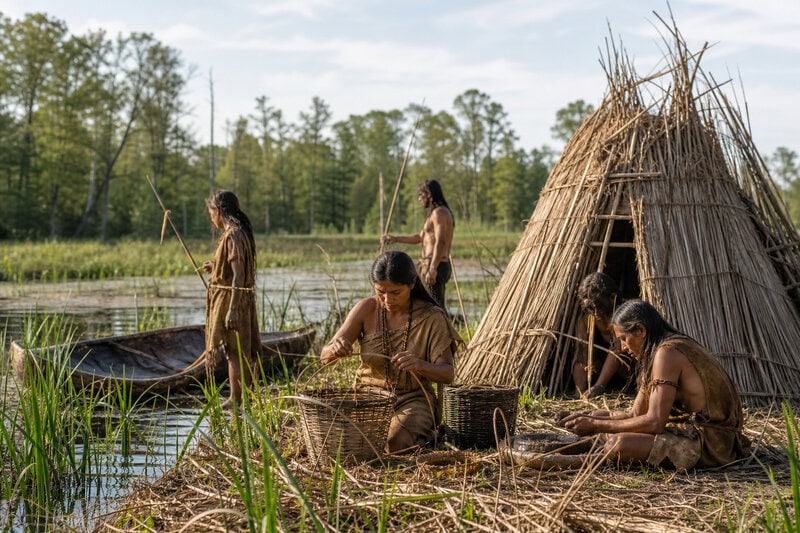
To understand what Dr. Jarman’s team is looking for, it helps to know what the broader Great Lakes and Ohio Valley record already suggests. Human presence near wetland margins in this region extends back to the Paleoindian period — roughly 13,000 to 10,000 years ago — when receding glaciers left behind a mosaic of ponds, bogs, and slow-moving rivers rich with megafauna and migratory waterfowl. These were not casual visitors. By the Archaic period, running from approximately 8000 to 1000 BCE, wetland-edge camps across the Midwest show dense concentrations of fish and bird bone, wild plant processing residue, and in some regions, dugout canoe fragments — the material signature of people who built entire seasonal economies around water and had been doing so for thousands of years.
Ohio’s Hopewell culture, flourishing roughly from 100 BCE to 500 CE, constructed some of the most elaborate earthwork complexes in pre-contact North America, many of them positioned near river floodplains. The Ohio University project is now asking whether wetland corridors — canoe routes threading through the Great Black Swamp’s interconnected waterways — served as the literal roads connecting those ceremonial sites across hundreds of miles. The Great Black Swamp sits at the western edge of a natural geographic funnel between the Great Lakes and the Ohio River, a position that would have made its waterways among the most strategically valuable travel routes in pre-contact eastern North America. Copper from Lake Superior, marine shell from the Gulf Coast, chert from distant quarries: the trade goods that show up in Hopewell burials had to travel somehow. The swamp, in this reading, was not the obstacle between the network — it was part of the network’s infrastructure.
It is worth pausing on that for a moment. The landscape that 19th-century settlers found so hostile that they spent a decade destroying it may have been, for the preceding ten thousand years, one of the great travel corridors of a continent.
What the Mud Remembers: The Science of Reading Ancient Wetlands
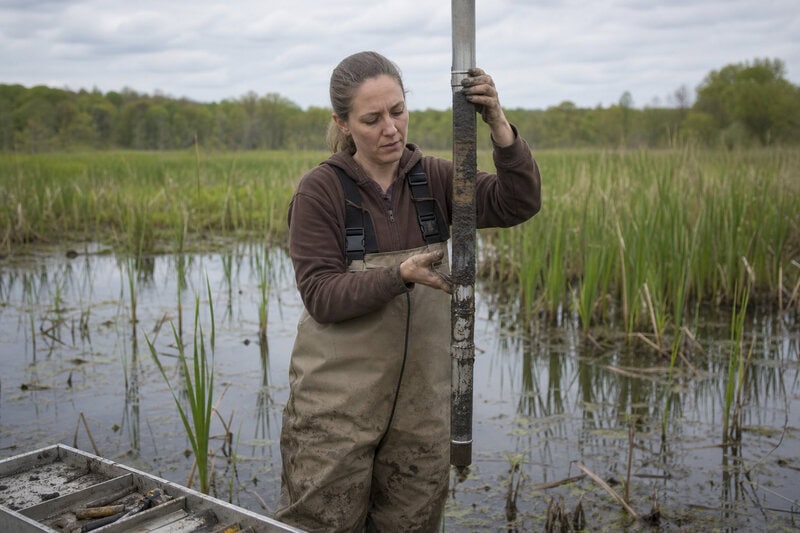
Dr. Jarman’s team is deploying several interlocking methods to test these ideas. Sediment coring allows researchers to read landscape change layer by layer — each stratum of pollen, charcoal, and organic debris is a chapter in the environmental biography of a site, allowing the team to reconstruct what the wetland actually looked like during specific periods of human occupation rather than projecting modern conditions backward. LiDAR aerial survey, which digitally strips away modern vegetation to reveal subtle topographic features at the surface, is turning up ridges, berms, and what appear to be midden deposits hidden beneath swamp vegetation that no ground-level survey would have detected.
The anoxic sediment that makes wetland excavation logistically challenging is also the reason the effort is scientifically invaluable. Organic materials sealed in waterlogged peat can survive for thousands of years in conditions that would reduce the same objects to nothing within decades on a dry upland site. What Dr. Jarman’s team may eventually pull from the black muck of northwest Ohio — wooden implements, woven fiber, plant remains, perhaps structural evidence of built environments — could represent a category of evidence for Ohio prehistoric settlements that simply does not exist anywhere else in the state’s archaeological record.
The waterlogged-finds conservation challenge remains real and shapes every hour of fieldwork. The moment saturated organic material meets open air, a clock starts ticking, and the team’s field protocols have been designed accordingly — with conservation supplies staged at the trench edge before the first core is lifted. It is the reason Dr. Jarman’s field-hospital comparison is not rhetorical flourish but operational description.
Rewriting Ohio’s Pre-Contact History
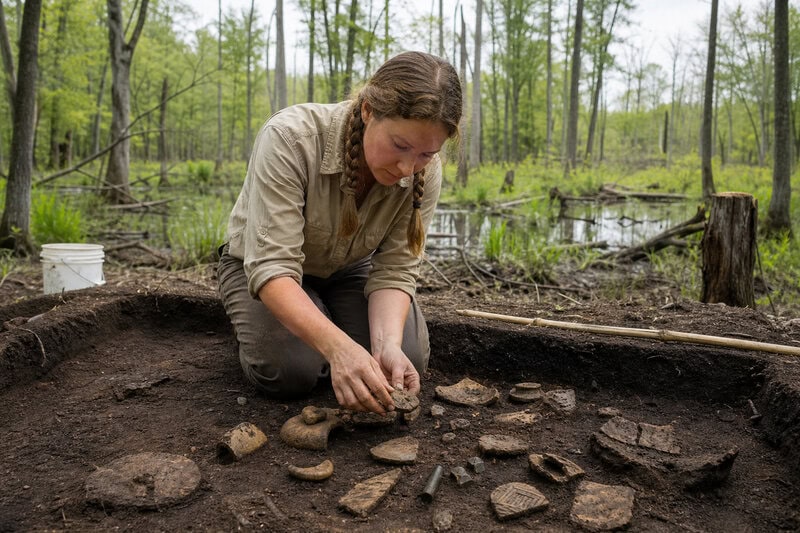
The implications of the Ohio University research extend well past the borders of the Great Black Swamp. If the project’s systematic survey and excavation confirm that Ohio’s ancient wetlands were corridors, settlement zones, and ceremonial landscapes rather than marginal barriers, it would reframe the standard picture of pre-contact Native American Ohio from a collection of isolated upland communities to something far more interconnected — nodes in a continent-spanning network whose main roads happened to be rivers and swamps.
That reframing matters not only for academic prehistory but for how the state understands the deep human history embedded in its remaining wetland landscapes. Sites currently protected for ecological reasons may turn out to shelter archaeological significance that existing protection frameworks were never designed to recognize. The two categories of value — ecological and cultural — may, in the end, be inseparable.
Beyond Ohio: What the Project Could Change
Dr. Jarman has indicated plans to publish the team’s coring and survey methodology as an open-access toolkit, a deliberate move to allow under-resourced universities in other wetland regions to replicate the approach without starting from scratch. The project is also in early conversation with tribal nations whose ancestral ties to Ohio connect them to whatever the excavations reveal — a collaboration that could bring Indigenous landscape knowledge to bear on the interpretation of the finds, enriching what the mud alone can say.
The results are also expected to carry direct policy weight. If significant archaeological sites are buried beneath Ohio’s remaining wetlands, compensatory mitigation frameworks — the very mechanism the Stream and Wetlands Foundation was built to administer — may need to incorporate cultural-resource assessment as a standard step before mitigation credits are issued. The funder, in other words, may find that its investment in the past reshapes the way it manages the future. An organization that set out to protect wetland ecology may end up helping to protect wetland memory.
Dr. Jarman pulled her boot from the muck and kept working. Somewhere beneath her feet, sealed in oxygen-poor darkness, the archive waited — wooden, fibrous, improbably intact, full of people history had not yet thought to look for. The Great Black Swamp took millennia to build, millennia to fill with human life, and roughly a decade to drain. Reading what remains of it, one careful core at a time, may be the most consequential archaeological project Ohio has ever undertaken — and it begins, as the best history so often does, with someone simply deciding to look in the place everyone else walked around.