
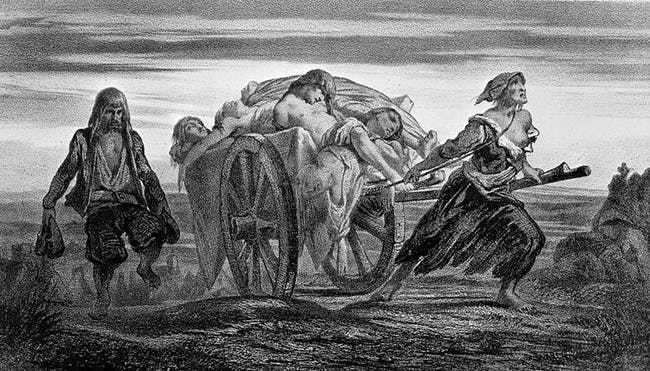
12. Body Collecting was Extremely Dangerous
While they certainly had no understanding of this at the time, we know now that the Black Death was transmitted by the bacteria Yersinia pestis which was carried by fleas. The pneumonic course of the disease could also cause transmission directly between people through aerosolized droplets. Despite not knowing the science at the time, people were able to clearly observe that the virus was spreading rapidly and sometimes appeared to spread among people.
Another concept they lacked at the time but were able to observe was that of fomites. Fomites are nonliving items that are capable of transmitting infections by carrying infectious material. In the case of the Black Death, fomites from the septicemic course of the plague could infect the living. This made the entire body of deceased plague victims possible vectors of disease. While highly exaggerated, a story from Boccaccio’s Decameron claiming that two pigs rooted around in a plague victim’s clothing and immediately fell dead illustrates the general principle of a fomite in disease transmission.
The gravediggers and body movers during the plague would have doubtless come in contact with soiled clothing that contained disease material as well as the diseased fluids of the corpses themselves. While they would like to have misattributed the dangers of their occupation to the foul smells, or miasmas, surrounding the bodies, they were likely aware of just how dangerous their jobs were.


