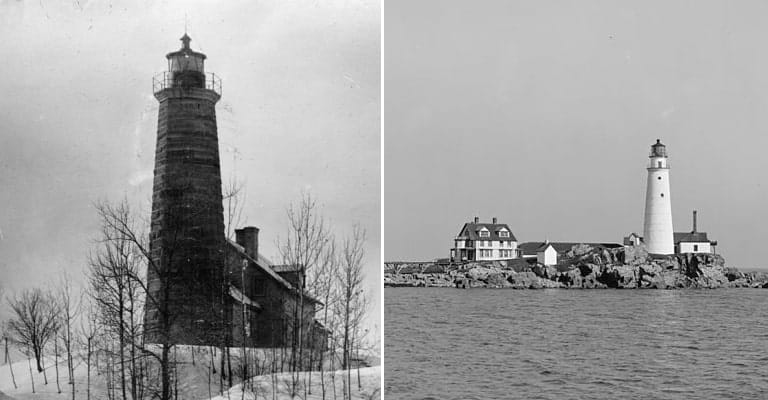

9. Lighthouses were built on shoals to replace lightships in the Great Lakes
Lightships are vessels which are anchored off shoals and rocks which pose hazards to navigation, though they are themselves frequently hazardous to the sailors which crew them. In severe storms, lightships can drag their anchors, endangering both the crew within them and other ships, since they become out of position and can mislead other vessels. Lightships are not as tall as lighthouses, which means the beacon cannot be seen as far away as those erected on towers. Between 1870 and the turn of the twentieth century, engineers working for the Lighthouse Board began building lighthouses on the Great Lakes in shoals and upon rocky beds to mark them, allowing mariners to avoid the dangers they presented. One such lighthouse was Spectacle Reef Light, the most expensive ever built on the Great Lakes, under some of the most difficult conditions.
Construction was seasonal, with work only being accomplished in the warmer months, on a site where numerous ships had been lost during storms. A crib was built in a shipyard, towed to the site and submerged, creating a working area to build a cofferdam, in which the foundation was built. The construction took place in five month periods over four years. The tower was constructed of stone and bolted to the rock upon which it rests with three-foot long wrought iron bolts. Winter weather damaged the tower, delaying new construction each season until the damage could be repaired. The design of the tower and foundation proved so successful the Lighthouse Board adopted it for other projects, allowing them to reuse the specially developed equipment. The light was fully automated in 1972 and remains an aid to navigation on Lake Huron more than a century and a quarter after it was commissioned.


