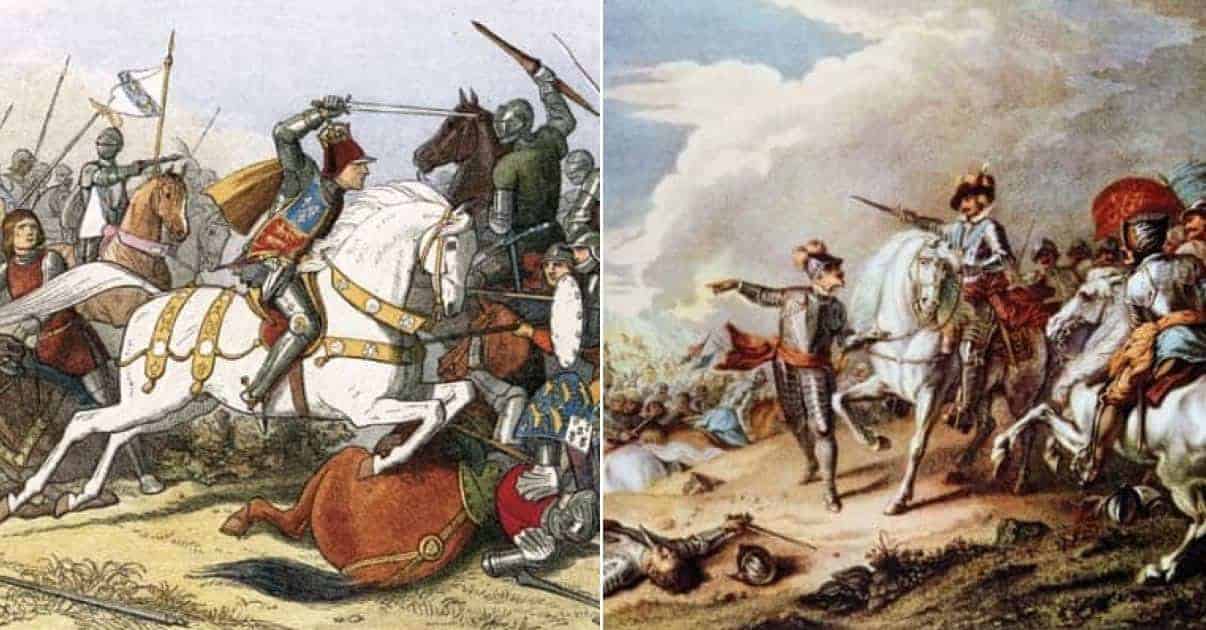

3 – The Anarchy, 1135-54
The Anarchy, you’ll be surprised to hear, was fairly anarchic. Yet again it was the result of a succession crisis: when you read British history and see how much sovereigns like Elizabeth I tended to worry about their lack of an appropriate heir, now you can understand why those fears were so well founded. Absolute monarchies with power vested in the King or Queen by God himself are inclined to reward those who have a direct successor planned and to punish those who do not. With so much power centred on one single individual and such a low life expectancy as existed in the Middle Ages, there were always opportunities for sharks to circle when everything went horribly wrong. The Anarchy might be the biggest example of this, with sharks circling everywhere and resulting in everyone fighting everyone for a near twenty year period, all over England and northern France.
Obviously, that would be quite a lot to fit into one article, so the basic gist of the Anarchy was as follows: Henry I, William the Conqueror’s grandson, was due to pass the crown on to his son, William Adelin. Unfortunately, William died in 1120 in a drunken boating accident (no, really) and thus the King designated his daughter Matilda as the next in line and forced all of his Barons and Lords to swear and oath to support her once she became Queen. Of course, when Henry died and Matilda took over, everyone went back on their word and instead chose Henry’s nephew, Stephen of Blois, to come over from France and take up the reins.
Having snaked their man to the throne, the Barons turned on each other and, sensing an opportunity, rebellions began in Wales and the Scots invaded from the north. Matilda was a powerful enough woman herself – she had previously been Holy Roman Empress and ostensibly the queen of Germany – and along with her half-brother, Robert of Gloucester, invaded England in 1139. After an attritional war, Matilda ended up with control over the majority of the South West, Stephen controlled the South East (and crucially, London) while rebel barons held sway in much of the north.
Warfare in the 1100s was characterised by sieges and few open battles. Forces would attempt to slowly progress from castle to castle using the same core of well-trained and armed knights, assisted by locally-raised infantry. Many of the knights had fought in the Crusades and were experienced, but the lower ranks tended to be less effective. The castles that had been built since the Norman invasion were very strong and basically impregnable to such a force, so most sensible commanders felt it far more practical to engage in long sieges in the hope of starving out the defenders.
At one point Stephen actually managed to trap Matilda inside Arundel Castle, but thought his chances of actually breaking in were close to zero and thus allowed Matilda to leave. To this day, it is not known why he let is major rival walk out: some think that he thought Robert was actually the leader of the enemy rather than his cousin, others hold that he feared that Robert would attack him elsewhere if he centred all his forces on a long siege. There is, of course, the idea that he did not want to harm a woman under the mediaeval laws of chivalry, too, and Matilda was his cousin after all.
It would come to back to bite Stephen. He was eventually defeated at the Battle of Lincoln in 1141 and captured by Robert of Gloucester. Matilda made plans to be crowned Queen in London, but the people of the city rose up and rejected her. England had one king in prison and a queen that nobody accepted: then Robert was also captured as Matilda was defeated at Winchester by Stephen’s wife, also called Matilda. Both sides agreed to swap their captured leaders and a long stalemate set in.
The Anarchy would come to an end with something of a whimper. Barons started signing peace treaties with each other and Stephen and Matilda, both aware that war was incredibly expensive, decided that perhaps peace was a more sensible option. The Second Crusade was called in 1147 and many knights wished to go, further reducing the willingness of many to fight. In the end, Stephen signed a peace treaty with Henry, Matilda’s son, ensuring that he would take over the throne of England when Stephen died. Henry would be the next “proper” King, and he and his wife, Eleanor of Aquitaine, would spread the dominions to encompass all of modern day England, most of Wales and Ireland and the entire western side of France, while his Plantagenet line would hold the throne until 1485.


