
Much of the Vietnam War Was Fought in a Pot and Heroin Induced Haze
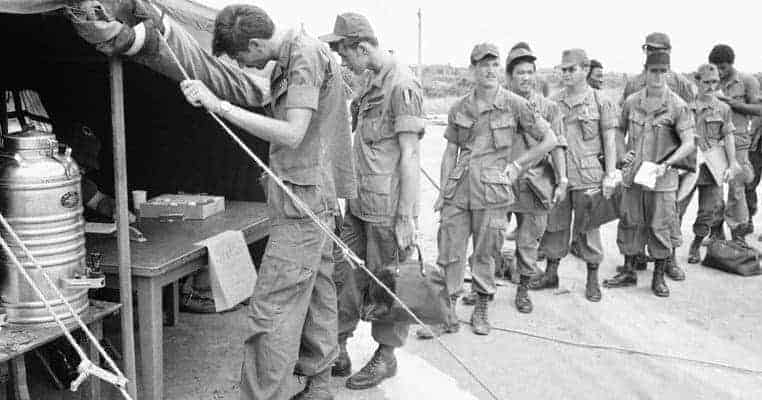
Until 1969, the only drug widely available to American troops in Vietnam was marijuana. But starting in 1969, heroin became widely available. It was cheap, and of such a high level of purity that servicemen could get high smoking heroin mixed with tobacco. That made it more appealing to those who would have been reluctant to inject the drug. By 1971, almost half of US Army enlistees in Vietnam had tried heroin, and of those, about half were exhibiting signs of addiction.
In May of 1971, US Congressmen Morgan Murphy of Illinois and Robert Steele of Connecticut went to Vietnam on a fact-finding mission, which uncovered disturbing news: 15% of American servicemen in Vietnam were heroin addicts. Even more military personnel in the theater were recreational users of heroin, marijuana, and other drugs. Worse, the addiction epidemic was spreading from Vietnam to other US military installations around the world, with the American garrison in West Germany being particularly hard hit.
The armed forces were trying to handle the growing epidemic with a mixture of military discipline and penalties, combined with a limited amnesty. Military personnel caught using or possessing drugs were subject to court martial and dishonorable discharge. On the other hand, those who voluntarily sought help would be offered an “amnesty” and a brief stint of treatment. As statistics revealed, that approach was a dismal failure: during the previous year and a half, heroin use had skyrocketed.
The idea that so many servicemen were addicted to heroin horrified the American public, as the drug was widely perceived at the time as the most addictive narcotic ever produced, and one whose addiction was nearly impossible to escape. In response, President Nixon created the Special Action Office of Drug Abuse Prevention. He also ordered further research on military personnel addiction, which revealed that Congressmen Murphy and Steele had been mistaken in their figures. Instead of 15%, the true figure for self-identifying addicts in Vietnam was actually 20%.
This took place against a backdrop in which the US was attempting to negotiate an exit from the Vietnam War, while drawing down its troops. About 1000 servicemen were being sent back home each day, where most were discharged soon thereafter back into civilian life. If the addiction figures were true, it meant that hundreds of active heroin addicts were being released into the US each week, and such an influx of addicts was bound to create serious social problems.
So psychologists drafted a plan for the president that entailed radical changes in how the military dealt with addiction. Instead of relying on court-martial, the emphasis should be on treatment. And rather than rely on addicts to self-report their drug use in the hope of “amnesty”, widespread urine testing throughout the services should be employed to detect heroin use. Under the new policy, US servicemen in Vietnam who tested positive for heroin were kept in theater under treatment until they dried out, before being allowed to return home. There, they were subjected to further treatment in VA facilities. It was a vast improvement over what had gone before, and the relapse rate among those who underwent such treatment was a relatively low 5%. The problem was not finally contained until years later, after the US had finally withdrawn completely from Vietnam.


