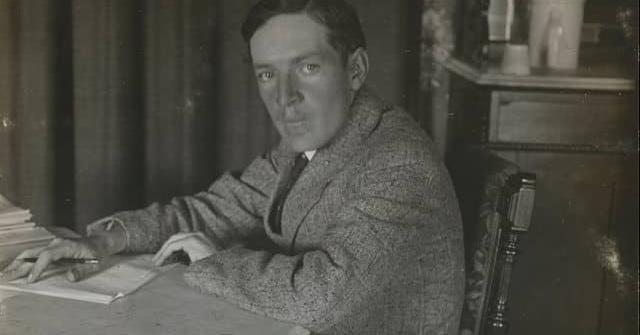

Charles Edward Russell
In his autobiography, Lincoln Steffens wrote of Charles Edward Russell, “He was the most earnest, emotional, and gifted of the muckrakers…His face looked as if he had suffered from the facts he saw and reported.” Russell was one of the first to take on the Beef Trust which was later savaged by Sinclair’s The Jungle. Russell’s report on the Beef Trust revealed that although technology had significantly reduced the cost of beef production the members of the Beef Trust had manipulated prices and shipments to keep the cost of beef to the consumer artificially high, increasing their profits and political power through donations to officials.
Russell later did a similar expose on the nation’s tobacco industry, in which tobacco farmers were exploited by the producers of cigars and the increasingly popular cigarettes. The expose also exposed the exploitation of laborers in the factories. Russell examined and reported on the scandalous operation of the state prison system in Georgia, in Everybody’s Magazine, and in 1914 presented an article entitled How Business Controls News, which reported on how the large businesses and trusts controlled what was printed in newspapers and magazines.
Unlike most of the writers and reporters who were lumped together as muckrakers, most of whom despised the term and the way that it placed them all in a single category which could be dismissed out of hand, Russell was proud of the term. “Looking back,” he wrote, “it seems to me clear that the muckraking magazine was the greatest single power that ever appeared in this country.” As with many of the muckrakers, Russell was an avowed socialist claiming that among other things, socialism offered the “righting of the centuries of wrong the producers have suffered, the dawn of a genuine democracy, peace instead of war…”
During the muckraking period William Randolph Hearst owned Cosmopolitan Magazine, and Hearst employed Russell to produce several articles for his publication. Russell took on the rising American aristocracy among the wealthy elite in an article titled The Growth of Caste in America, and produced several series for Hearst, while simultaneously writing for other magazines and publications. Russell also produced numerous books, including his autobiography Bare Hands and Stone Walls in 1933. Russell was hugely popular during the muckraking period among the general readerships of the magazines, but reviled by the business and political interests he exposed.
In 1909 Russell became a founding member of the National Association for the Advancement of Colored People, in response to the preceding year’s Springfield, Illinois race riots. Russell remained associated with the organization for the remainder of his life as a member of the board. He twice ran for Governor of New York, once for Senator from New York, and once for Mayor of New York, but his unabashed socialist views and party membership prevented him from winning election. In 1917 he supported the American entry into World War I, for which he was expelled from the Socialist Party which opposed the war. He died in Washington in 1941.


