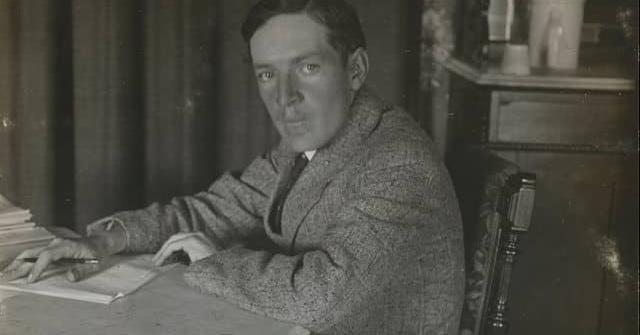

Henry Reuterdahl
Henry Reuterdahl was a Swedish painter and sketch artist who came to the United States to create illustrations at the Chicago World’s Fair in 1893. Following the exposition he remained in the United States and began a long association with the United States Navy during the Spanish-American War. He was a naval reserve officer and a contributor to Jane’s Fighting Ships, as well as an author of several articles about nautical topics. He also developed a personal friendship with William Simms, a young naval officer who eventually rose to command the American naval forces in British waters during the First World War.
In the early twentieth century Simms saw the need for many improvements in the Navy’s operation and training based on his personal observations of European fleets. These suggested innovations, in particular in gunnery training, were routinely absorbed by the naval bureaucracy and failed to be incorporated in the fleet. Simms finally took the highly unusual step of a junior officer going over the heads of his superiors and addressing the President of the United States, Theodore Roosevelt, directly. Roosevelt, a former undersecretary of the Navy, agreed with several of them, and ordered them implemented. Simms and Reuterdahl frequently discussed privately the inflexibility of the Navy’s management.
Roosevelt requested that Reuterdahl accompany the Great White Fleet in its circumnavigation of the globe beginning in 1907, to document it in both word and art. Reuterdahl agreed. The fleet was already at sea in January 1908 when an article written by Reuterdahl appeared in McLure’s Magazine which sharply criticized the manner in which the US Navy was run. It criticized the design of the ship’s being built, calling many of them obsolete, and described the nature of the way in which the Navy was run as being the foundation of the failing to build and maintain an up to date fleet. According to Reuterdahl, the navy’s bureaucracy compelled it to mismanagement.
Reuterdahl left the Great White Fleet in Peru after learning of an illness in his family, causing newspapers and magazines to speculate that he had been removed as a result of the article. The article itself caused a sensation across the country, fed by the large amount of tax money spent on the fleet and set aside for future shipbuilding programs. The article also called for the implementation of a system of advancement based on merit and seniority, rather than the existing system of advancement based on seniority alone. They were virtually the same arguments which had long been endorsed by Simms, and Congress ordered an investigation.
The investigation opened in 1908, and after five years of hearings and testimony from naval officers, ship designers, and shipbuilding contractors, the Department of the Navy was directed to initiate reforms in a reorganization of the entire department. Reuterdahl remained connected with the Navy and during the First World War became the official artist for the Navy Department, serving as the head of the poster bureau. He was instrumental in the development of many of the iconic recruiting posters prepared by the US Navy during the war. He died in an insane asylum in 1925, and was buried with military honors at Arlington National Cemetery.


