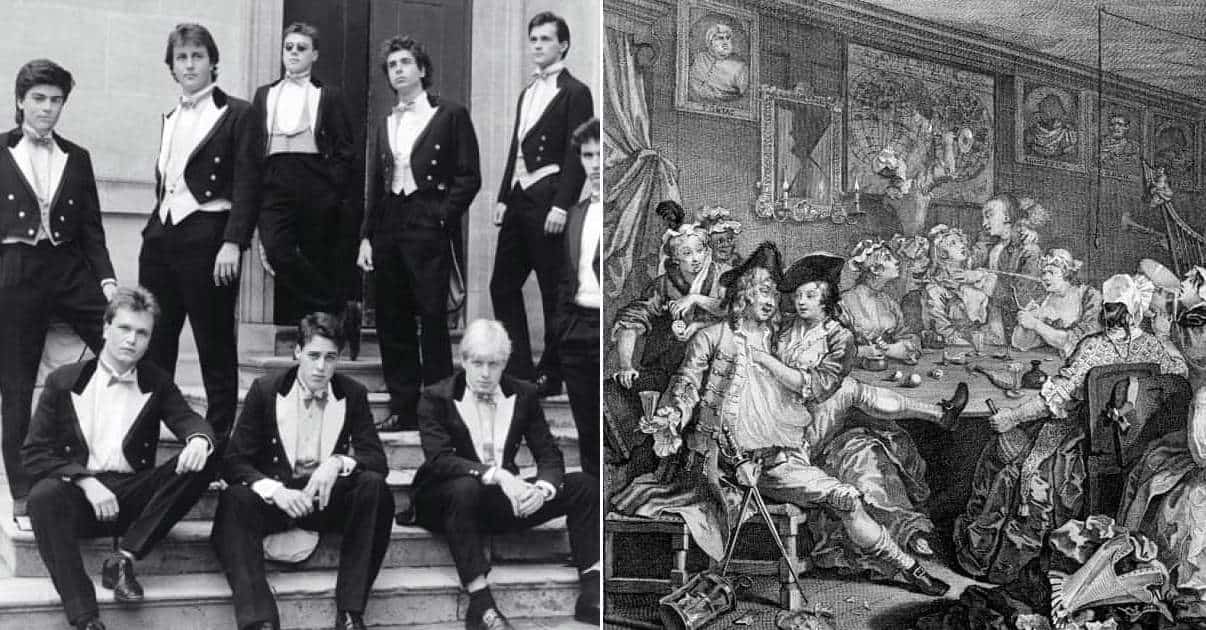

Royal Alumni
For most people, filling their university days with fighting, drinking, and vandalism would not spell a bright future. However, if you have the privilege of being in line to become an unelected head of state, youthful recklessness matters very little. In the list of Bullingdon members we find no fewer than four individuals who went on to become kings. Although the most recent clutch of university-aged princes of Great Britain have avoided Oxford altogether, time was when it was inevitable that their ancestors would be obliged to attend either Oxford or Cambridge as was deemed proper for the upper classes.
Two British monarchs, Edward VII and Edward VIII, were elected as members of the Buller. Edward VII (1841-1910) was the eldest son of Queen Victoria, and matriculated at Christ Church in 1858. As a member of the Bullingdon, he was intimate with Sir Frederick Johnstone and Viscount Henry Chaplin. Johnstone was notorious for philandering throughout his life but, together with Chaplin, he served as a Conservative politician and remained intimate with the eventual King. There were fears that young Edward was being distracted by the pursuit of pleasure, especially hunting, and he was sent to Trinity Hall, Cambridge, in 1861.
More is known about the extent of Edward VIII’s involvement with the Bullingdon. The New York Times reported in June 1913 that Queen Mary had sent a telegram demanding his immediate resignation from the club after he attended a ‘blind’ (an impromptu night out after a fox hunt) despite promising that we would not. Although the paper does not reveal exactly what Edward did on the blind in question beyond that he ‘succumbed to temptation’, it does offer the recent story of Buller men swimming to the Magdalen deer park, stealing a stag, and driving it up the High Street.
Edward VIII is most famous as the only King of Britain to abdicate, but we can trace suspiciously Buller-esque behaviour throughout his life. After proving a lazy student at Magdalen and leaving with no academic qualifications, Edward’s affairs with married women and reckless socialising worried both his father and the prime minister. Though he undertook many foreign commissions for his father, Edward was a white supremacist who wrote openly of his disgust for other races, and a suspected Nazi sympathiser. Succumbing to political pressure, he reigned for less than a year, before scandalously abdicating with Wallis Simpson, an American divorcee.
The four foreign royals who were members of the Bullingdon are Rama VI of Siam, Frederick IX of Denmark, Prince Leopold Duke of Albany, and Prince Paul of Yugoslavia. There are few records of these royals’ time in the Bullingdon, although Rama’s well-known homosexuality was an embarrassment to his early-twentieth-century subjects, if not to more enlightened modern minds, and Prince Paul had several affairs with high-profile men and was known as a self-indulgent art collector. The haemophiliac Leopold’s fondness for secret societies was also evident in his active Freemasonry, serving Provincial Grand Master of Oxford until his death in 1884.


