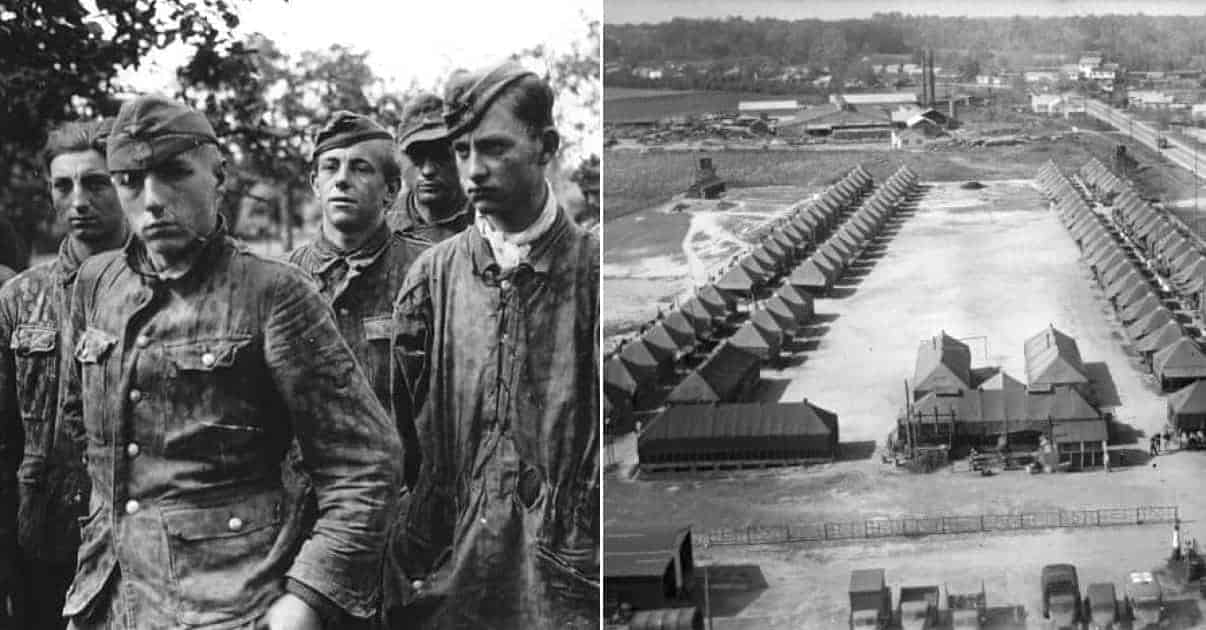

Security for Axis prisoners
Prisoners of all the warring powers attempted to escape their captors during the Second World War, leading to harsh reprisals by the Germans and Russians when the escapers were recaptured. For the prisoners on the European continent the possibility of reaching neutral Switzerland, Sweden, or Spain beckoned, and evading German security was possible, but not likely. For the German and Italian prisoners in the United States, Canada to the north and Mexico to the south were both hostile nations. There was a possibility of hiding in the large German and Italian neighborhoods of many American cities, but the likelihood of getting home was remote.
Nonetheless there were escape attempts, including large breakouts, and some were as ingenious as the more famous British, French, and American escapes from the prison camps of Europe. About 2,200 attempted escapes were conducted by the Germans. None of the escaping prisoners made it back to Germany or Italy, and most were captured within a few hours or days, when hunger and exposure to the elements made the comforts of the camp seem a more reasonable alternative. Many escapees simply turned themselves in by knocking on a door and announcing themselves as what they were. The possibility of German escapees was discussed in newspaper and magazine articles, including what citizens should watch for and report.
One such article written by FBI director J. Edgar Hoover was discovered by a German sergeant, Reinhold Pabel in his camp library. Pabel carried the article with him when he departed Camp Grant, just outside Rockford Illinois early in 1945. Pabel found the article helpful as a guide, by following what the article informed readers what to watch for, he effectively left behind no trail to follow. He changed his name to Phil Brick, hid in Chicago, and when he was finally found he was married, with one child and another on the way. It was 1953. He was sent to West Germany but allowed to return to the United States and the bookstore he had been running when found.
The Germans held a mass breakout, through an ingeniously located and built tunnel, in Camp Papago, in Arizona. The German prisoners were officers and sailors from U-boats who dug a nearly 180 foot tunnel, hiding the dirt by spreading it across a volleyball court they were building as a diversion. Twenty-five officers and sailors escaped, but all were recaptured. The Germans made their escape in the wee hours of Christmas Eve 1944. The last escapee was arrested on the morning of January 28, 1945, in Phoenix, Arizona. Nobody was injured during the escape and other than some stolen clothes there was no loss of property.
There were no harsh reprisals against the escaping prisoners when they were returned to American custody. Punishments were under the authority of the different camp commanders and unless there had been damage to or theft of civilian property most commanders contented themselves with solitary confinement on bread and water for a number of days equal to the number of days the prisoner had been absent. Where there was damage or theft restitution was demanded of the prisoner. The number of German escape attempts was just under one percent of the German prison population, about half that of the Italians.


