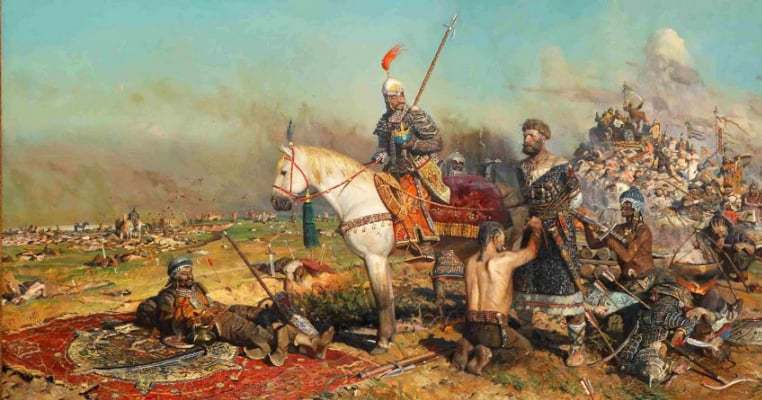

Centralization and Absolutist Rule Under Ivan the Terrible
Ivan IV, also known as Ivan the Terrible (1530 – 1584), was Grand Prince of Muscovy from 1533 to 1547, after which he declared himself “Tsar of all the Russias” – a title adopted by all subsequent Russian monarchs. He created a centralized government, overthrew the last vestiges of Mongol influence, subjugated the neighboring nomadic Khanates, and greatly expanded Russia’s borders. He was also an insanely cruel despot, who subjected his people to a decades-long reign of terror.
Ivan ascended the throne at age three, and his mother ruled Russia as regent. However, she died when he was seven, and a power struggle erupted between competing boyars, or Russian nobles. The child Ivan found himself defenseless, and was mistreated and abused by boyars in his own palace. That left its mark on the future Tsar, who began venting his hopeless frustrations by torturing small animals.
By the time he came of age and took control of the government, Ivan was a paranoid and angry young man, who distrusted people in general, and detested the boyar class in particular. He created a legal system known as Sudebnik, with clearly defined laws and harsh penalties, that reined in official corruption. Ivan also instituted a system known as the oprichnina in the 1560s that amounted to a reign of terror, and inaugurated the absolute monarchy that was to be Russia’s hallmark for centuries to come. With a special police force, the Oprichniki, he kicked off a wave of persecutions that targeted the boyars and spread from there in ever greater ripples that soon covered all his lands.
His most infamous act of cruelty occurred in 1570, when the city of Novgorod defied him. Ivan marched on it in the dead of winter, and after seizing it, went on an orgy of violent depravity. He began with Novgorod’s clergy, whom he ordered flogged from dawn until dusk, for days on end, until they each paid a 20 ruble fine. Hundreds died, and afterwards, he ordered the survivors executed.
The population fared no better: Ivan ordered the leading citizens tortured, along with their families. Men were executed, and women and children were bound and thrown into a nearby river, where they were trapped under the ice as soldiers patrolled the area, wielding hooks and spears to push down any who surfaced. By the time Ivan was finally sated, over 60,000 had perished.
Even his family was not spared his fits of uncontrollable rage. In 1581, he struck his pregnant daughter-in-law when he saw her wearing clothes that he deemed too revealing, causing her to miscarry. When his son and heir, Ivan Ivanovich, protested, the Tsar smashed his head in with his scepter, causing a fatal wound that killed him within days. Ivan the Terrible followed his son three years later, dying from a stroke while playing chess.


