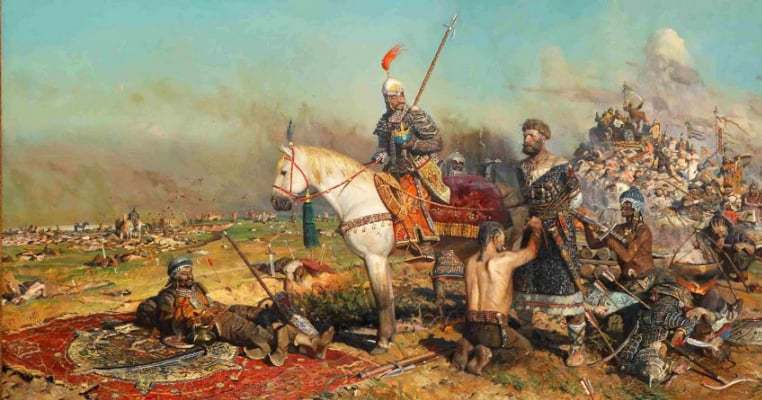

The End of Rurik’s Line, and the Chaos of the ‘Time of Troubles’
Ivan the Terrible fathered five sons, but as his long reign drew to a close, he only had two adult sons still living, but in 1581, he killed one of them in a fit of rage. It was doubly unfortunate because the murdered son, his heir Ivan Ivanovich, was the capable son. The Tsar’s surviving adult son, who succeeded to the throne in 1584 as Feodor I, was a pious man, but also a feebleminded one.
Predictably, the mentally deficient Feodor turned out to be a poor ruler. The realm was governed on Feodor’s behalf by his brother-in-law, Boris Godunov, acting as regent for the feebleminded Tsar. Feodor failed to produce an heir, and his death in 1598 brought the line of Rurik to an end. He was succeeded by his brother-in-law, but Godunov proved less successful as a Tsar than he had been as a regent, and his reign ushered in a chaotic period known as the “Time of Troubles” (1598 – 1613).
It was not Godunov’s fault: a 1600 eruption of the Huayaputina volcano in faraway Peru wreaked havoc on global climate, leading to extremely poor Russian harvests from 1601 to 1603. The result was a massive famine that killed about 2 million Russians – a third of the population. The widespread hardship caused correspondingly widespread turmoil and political instability.
To add to the chaos, a pretender emerged in the neighboring Polish-Lithuanian Commonwealth, claiming to be Ivan the Terrible’s son Dmitri, who had actually been stabbed to death as a child in 1591. The pretender was backed by the Poles, who saw him as a means for regaining lost lands and influence in Russia. So they supported him and an army of Russian exiles, Poles, Lithuanians, and Cossacks, who invaded Russia in 1603.
Things got worse still when Godunov, while dealing with all those problems, suddenly died in 1605. The false Dmitri had enough support from Russian nobles to seize Moscow upon Godunov’s death, but his triumph proved short-lived. Dmitri was murdered within a year, and thousands of his followers were massacred in an uprising by Vasily Shuysky, who then claimed the throne as Tsar Vasili IV.
The death of the false Dmitri disappointed his Polish puppet masters, but not for long. Undaunted, they produced yet another imposter, also claiming to be Ivan the Terrible’s son Dmitri, who challenged the new Tsar Vasili IV. Matters descended into a three-way fight between Tsar Vasili, the new false Dmitri, and the Polish king’s son, Vladislav. All three failed in their quest, however, when the Polish king Sigismund III took Moscow for himself.
By 1611, Russia was on the brink. The throne was empty while the boyars quarreled amongst themselves; Swedes occupied Novgorod and Poles occupied Moscow; Russian Orthodoxy was about to get replaced by the invading Poles’ Roman Catholicism; and the south was being devastated by massive Tatar raids.
Things finally turned around when Kuzma Minin, a powerful Novgorod merchant, along with a Rurikid nobleman named Dmitri Pozharsky, raised forces to push back the Poles from Moscow. The internal chaos and strife finally came to an end in 1613, when a Grand National Assembly elected Michael Romanov, a son of the Grand Patriarch of Moscow, as Tsar Michael I. Michael established the Romanov Dynasty, which would rule until the forced abdication of Tsar Nicholas II in the Russian Revolution of 1917.


