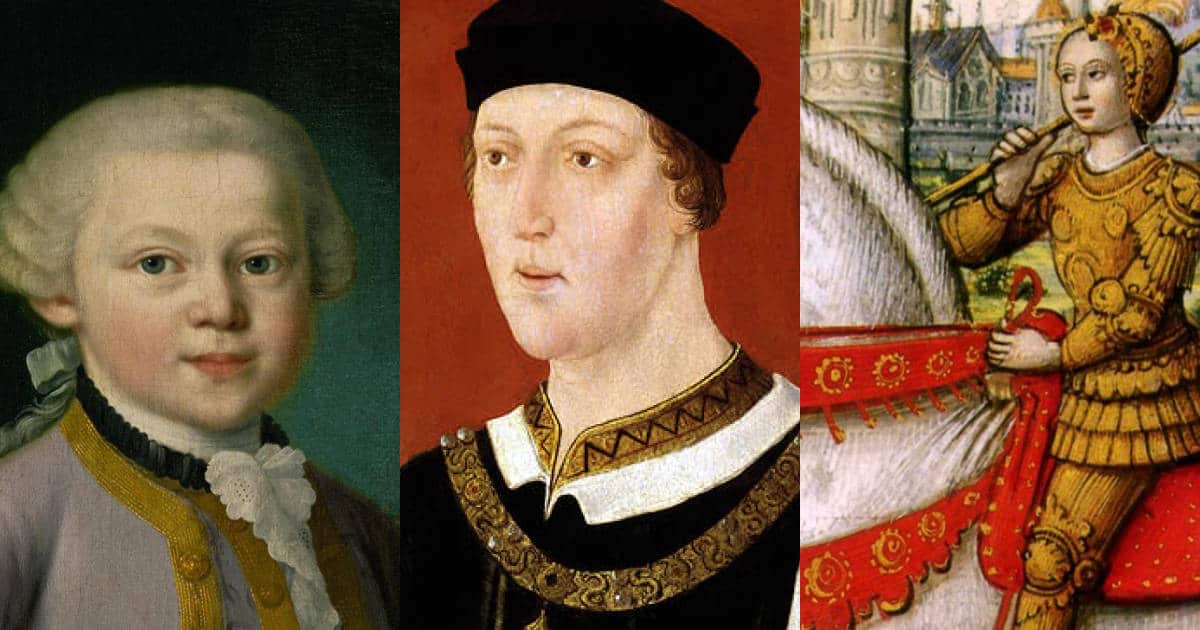

17. King Henry VI was England’s ‘Boy King’, who came to power during one of the most troubled points in his country’s history
King Henry VI of England will forever be known as the ‘Boy King’. He was just nine months old when his father, Henry V died in December 1421. Since he only had one son and heir, the crown passed to him, despite the fact he couldn’t even walk or talk. Of course, a regency council was formed to rule in his stead. However, as a young boy, Henry became increasingly involved in politics, even if he never did have the temperament to be an absolute monarch, especially at such a turbulent point in English history.
According to most accounts, Henry was a shy and retiring teen. While some young monarchs were ruthless bullies and tyrants, he was quite the opposite. In fact, he hated conflict and was completely averse to warfare and violence. As such, though he came of age at the age of 16 – thereby becoming probably the most powerful man in all of Europe while still in his teens – he soon allowed himself to be dominated by the more vocal and assertive members of his inner court. Above all, while the young king wanted to bring an end to the 100 Years War, his closest advisors urged him to keep on fighting, with disastrous consequences.
Henry’s lack of aggression also had consequences at home. His kingdom started falling apart under him. The nobility became fractured, ultimately resulting in the War of the Roses, in which his own cousin, Richard of the House of York, claimed the throne for himself. By the 1420s, when Henry was still in his 30s, he was suffering from mental breakdowns. He was deposed by his rival in 1461 and thrown into the Tower of London. His own son and heir was killed and then Henry himself was murdered, most probably on the orders of Richard.
William Shakespeare wrote a trilogy of plays about Henry VI’s life and reign. In them, the monarch is depicted as too young, weak and naïve for the throne. He is – quite accurately – shown as being weak-willed and too easily dominated, both by his nobles and his own wife, Margaret. But still, he founded several of England’s most famous education institutions, including Eton College and King’s College, Cambridge, ensuring his legacy endures to this day.


