
An Epic Charge, and Epic Blunder
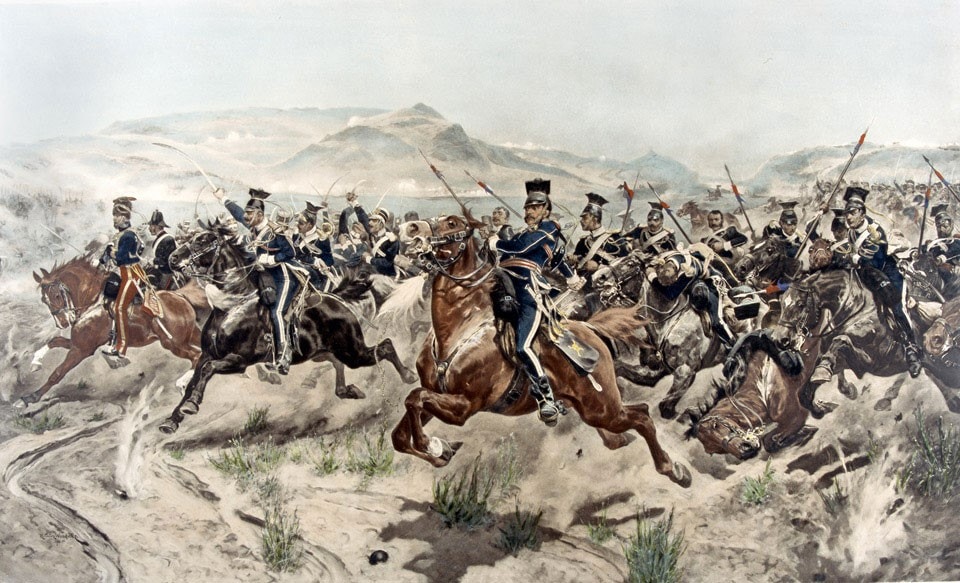
Lord Lucan sought clarification about just what “guns” Lord Raglan referred to. So he asked the messenger who had delivered the British commander in chief’s orders. That worthy, a high strung Captain Nolan, made a dramatic gesture with his arm. It encompassed not just the Causeway Heights, whose guns Raglan wanted recaptured but that were not visible to Lucan, but also the guns at the far end of the valley, that Lucan could see. So Lucan ordered Lord Cardigan to lead his Light Brigade to attack the guns at the valley’s end, with the Heavy Brigade to follow in support. Soon after the charge began, Captain Nolan seems to have realized that the cavalry was after the wrong guns. He galloped to the head of the Light Brigade, but before he could point out the blunder, an artillery shell exploded in front of his horse and killed him.

The Light Brigade, 607 cavalrymen strong, continued its charge into what came to be known as the Valley of Death. It was shredded as it advanced a mile to the guns. As Alfred Lord Tennyson, Britain’s poet laureate put it in Charge of the Light Brigade: “Cannon to right of them, Cannon to left of them, Cannon in front of them volleyed and thundered. Stormed at with shot and shell, Boldly they rode and well, Into the jaws of Death, Into the mouth of hell, Rode the six hundred.” Incredibly, the British cavalrymen actually reached the guns, and fought a brief battle there against incredible odds, before they were forced to withdraw. Of the 607 men who made the charge, 118 were killed outright, 127 were wounded, and about 60 were taken prisoner. When the Light Brigade regrouped upon its return, there were only 195 men left with horses.


