Beneath a quiet stretch of Coming Street in Charleston, South Carolina, the ground holds more than soil — it holds people, thousands of them, unnamed and largely unacknowledged, buried during the centuries when human beings were bought and sold a few blocks from the harbor. Before a single construction crew arrives to build a college dormitory on that ground, a community stopped, gathered, and refused to let the dead be forgotten a second time.
Charleston’s Buried History: Who Lies Beneath 106 Coming Street
Charleston was one of the principal ports of entry for enslaved Africans brought to North America, a fact etched into the city’s economy, its architecture, and, it turns out, its earth. The land at 106 Coming Street is believed to hold the remains of thousands of people — likely enslaved individuals and free Black residents — interred during the colonial and antebellum eras, at a time when death offered no more dignity than life had.
Urban expansion did what it so often does: it paved, built, and moved on. African American burial grounds across Charleston and throughout the American South were gradually buried under streets, lots, and institutions, their existence obscured not always by accident but sometimes by deliberate erasure — a second disappearance visited upon people who had already been stripped of almost everything.
A National Pattern: Forgotten Black Burial Grounds Beneath American Cities
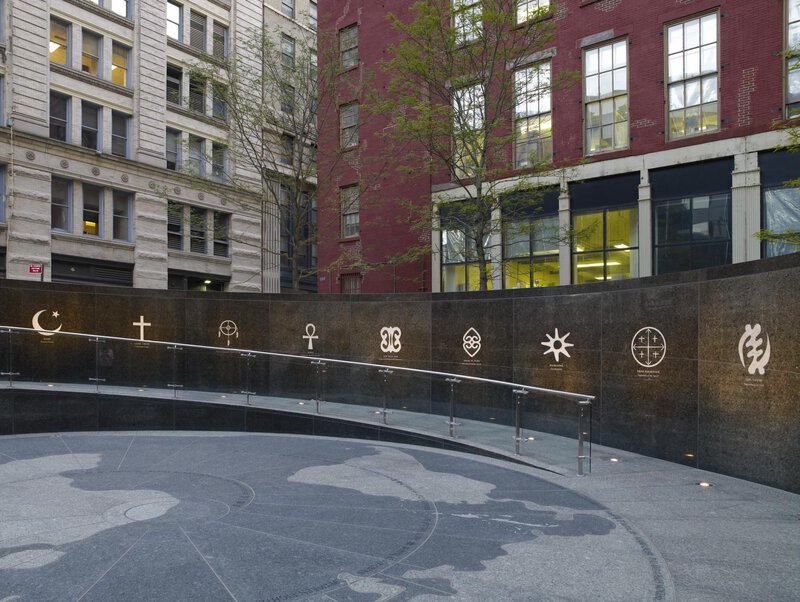
The story of 106 Coming Street is not an isolated one. When construction workers in lower Manhattan encountered wooden coffins in 1991, they had stumbled onto the African Burial Ground — a site holding the remains of hundreds of enslaved and free Black New Yorkers, hidden under office buildings for nearly three centuries. Similar reckonings have unfolded in Richmond, Louisville, Atlanta, and dozens of other cities where forgotten Black cemeteries were legally seized, rezoned, or simply built over during the 19th and 20th centuries, at a time when Black communities held neither the political power nor the legal standing to stop it.
The absence of formal documentation makes the full scale of enslaved people buried under American cities impossible to measure. That invisibility is itself a wound — and it is precisely why archaeological work on ancestral burial sites carries both scientific and moral urgency. Every unmarked grave that surfaces rewrites, in bone and soil, a history that was never supposed to be recovered.
The College of Charleston’s Dormitory Plan Brings the Burial History Into Focus
When the College of Charleston designated 106 Coming Street as the future site of a new freshman residence hall, it triggered something beyond a standard construction timeline. South Carolina law and federal guidelines require developers — including public institutions — to assess and address human remains discovered during pre-construction surveys, and the prospect of breaking ground at this particular address brought the buried history of the property into sudden, urgent focus.
For the surrounding community, the announcement of a dormitory on that land was not simply a facilities story. It was a reckoning. The ground beneath the planned building had a past that predated the college, the street, and most of the city’s existing structures — and the question of how to honor that past before pouring a foundation would not wait.
Historical Research and Community Advocacy Shape the Response
Historical research and archaeological surveys indicated that the Coming Street location was associated with burial activity linked to Charleston’s African American community, fitting a pattern that urban archaeology in the city has surfaced before. Charleston has a documented record of Black burial sites being absorbed into commercial and institutional development over the decades, and the identification of this site became part of a larger regional reckoning with what the city has built — and what it has buried.
Community advocates and descendants’ groups pushed for the burial history to be formally acknowledged before any ground was broken. Their insistence reflected something deeper than procedural due diligence: it was a demand that the people interred at 106 Coming Street be recognized as people, not as an archaeological complication to be managed on the way to a ribbon cutting.
The College Announces a Commemorative Gathering Five Days Before the Event
Five days before the gathering, the College of Charleston publicly announced a commemorative gathering at 106 Coming Street, framing it as a community-centered occasion open to people of all backgrounds. The institution’s willingness to host the ceremony before archaeological work commenced signaled at least a formal commitment to letting remembrance lead — to treating the site as sacred ground before treating it as a construction site.
The short window between announcement and event was itself telling. Archaeological work was close. The ceremony was not a distant gesture of goodwill; it was scheduled precisely because the window to honor the dead before the digging began was narrow and closing.
‘Ancestors Unknown but Not Forgotten’: The October 24 Gathering Opens
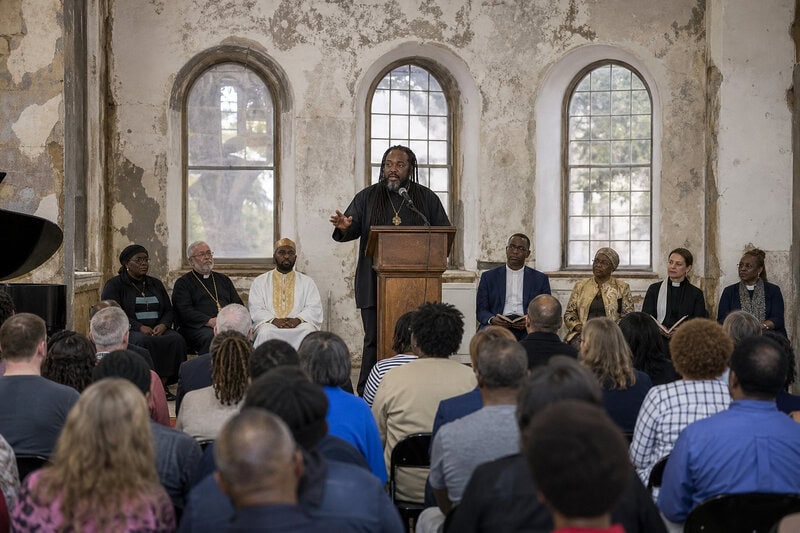
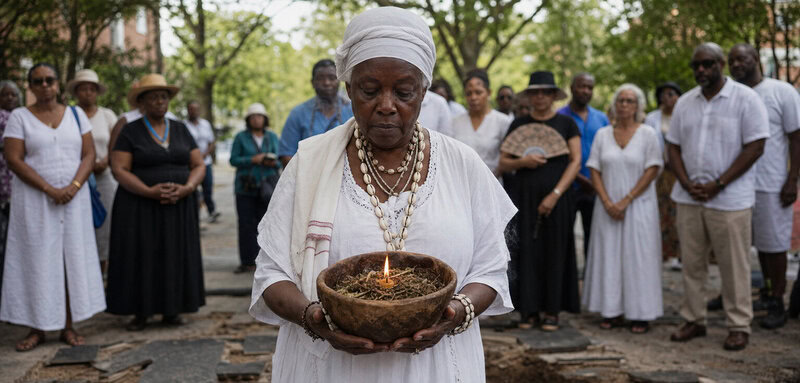
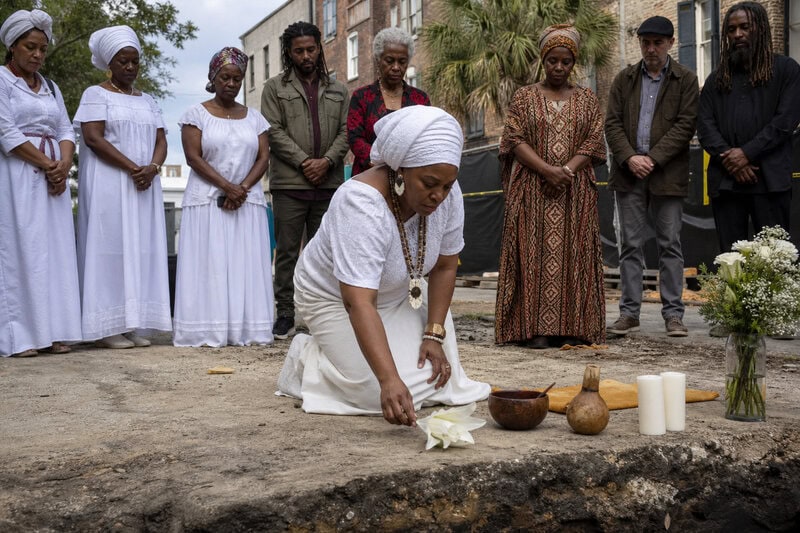
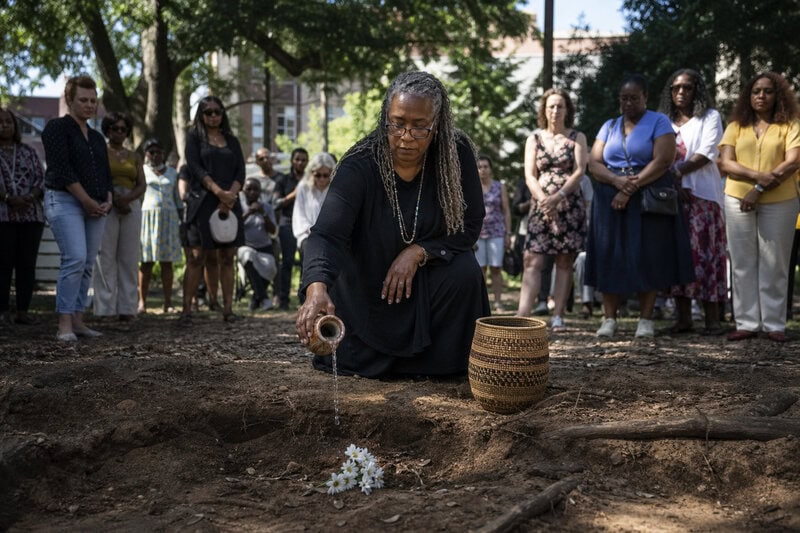
At ten o’clock on a Saturday morning, the interfaith gathering officially titled “A Celebration of Ancestors Unknown but Not Forgotten” opened at 106 Coming Street. The title was a deliberate act of reclamation — a refusal to let the erasure of individual names erase the fact of individual lives. “Unknown” acknowledged the historical violence that stripped people of their identities. “Not Forgotten” insisted that the community would supply what slavery had stolen.
Conducting the ceremony in daylight, on a public street, made it visible to the broader Charleston community in a way a private, indoor event would not have been. This was mourning conducted in the open — an invitation and, in some ways, a statement.
An Interfaith, Multiracial Crowd Gathers on the Site
The gathering drew participants of different faiths, races, and ages, making it a rare moment of broadly shared public mourning for the victims of American slavery. Interfaith participation — clergy and community members arriving from across religious traditions — gave the ceremony the character of a sacred acknowledgment rather than a civic formality. It was not a press event that happened to include a prayer; it was a prayer that happened to take place in public.
The diversity of the crowd also reflected something shifting in American public awareness around African American burial ground archaeology and the moral weight of building over ancestral land. These gatherings used to be demanded almost entirely by the communities most directly affected. Increasingly, they draw a wider circle of people who understand that the erasure of one community’s dead diminishes everyone’s claim to an honest history.
Thousands of Unnamed Dead Acknowledged Beneath a Future Dormitory’s Footprint
The event descriptions noted that thousands of people are believed to be buried at the 106 Coming Street site — a figure that, if confirmed by the archaeology ahead, would rank it among the most significant urban burial discoveries in the American Southeast. The scale is difficult to hold in the mind: thousands of lives compressed into a parcel of land now slated to house college freshmen, lost to history so completely that their existence must be inferred from records they never appeared in.
Saying that number aloud at a public gathering, before a single shovel broke ground, was both a political and a spiritual act. It put the institution and the city on notice: this ground is not empty, the dead here are not nothing, and the archaeological work that follows carries an obligation to the people it will unearth.
The Commemoration as Prologue to the Archaeological Work Ahead
The October 24 gathering was explicitly positioned as a prologue to the archaeological work set to begin at the site — a human ceremony preceding a scientific one. Archaeological work on ancestral burial sites raises layered questions that go far beyond field methodology: Who controls the excavation? By what standards are remains treated? Where do they go when the analysis is complete? Who speaks for people who left no documents and no identifiable descendants? The interfaith gathering placed those questions at the center of public conversation before the archaeologists had even arrived.
By establishing a visible community stake in the outcome, the ceremony created a form of accountability that will follow the dig. The work ahead will proceed under public scrutiny, with a community that has already gathered in grief and expectation — and that will be watching to see whether the science honors what the ceremony promised.
Charleston Joins the National Reckoning Over Ancestral Burial Ground
From the African Burial Ground National Monument in lower Manhattan to the Freedmen’s Cemetery in Dallas, the sites where enslaved and free Black Americans were buried have increasingly become focal points for historical reckoning, legal contests, and community-led acts of remembrance. These are not merely local stories. They are chapters in a national argument about what American cities owe to the people whose labor and suffering built them — and whose bodies were left in the ground beneath them.
The gathering at 106 Coming Street places Charleston in that lineage, among the American cities being compelled to confront what lies beneath their streets and to answer, honestly, who put it there. As urban archaeology continues to surface evidence of forgotten Black cemeteries across the country, events like this one carry a clear signal: communities are demanding that remembrance come before the bulldozers, not after.
What happens next at 106 Coming Street — in the soil, in the historical record, in the classrooms eventually built above it — will be measured against the promise made on a Saturday morning in October, when a crowd gathered to say, out loud, that the people buried there were real, and that they matter still.