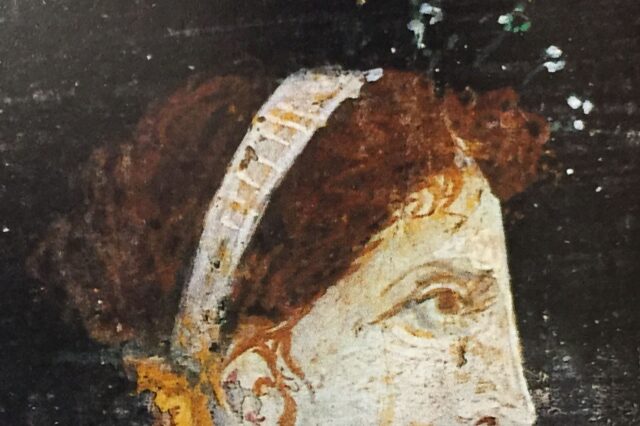
Pick up a coin minted in Alexandria around 40 BCE, turn it over in your hand, and the face staring back at you will stop you cold — not because it is beautiful in any way you were taught to expect, but because it is so startlingly, defiantly specific: a sharply hooked aquiline nose curving decisively downward, a chin jutting forward to meet it, and a crown of tight curly waves that no Hollywood costume department ever thought to copy.
The Coin That Rewrites the Story
When 19th-century scholars first began cataloguing Cleopatra’s surviving coin portraits in earnest, a small and telling debate broke out among them: some genuinely questioned whether these strong-featured profiles depicted a woman at all. That confusion, embarrassing in retrospect, is one of the more revealing accidents in the history of archaeology. It tells us exactly how far the actual evidence had already drifted from what the world assumed it knew.
Cleopatra VII almost certainly approved every die that struck her image. In the ancient world, coin portraits were instruments of statecraft — closer to a royal decree than a photograph — which means that aquiline nose and that jutting chin were not accidents of an indifferent die-cutter. They were deliberate, authorised, and repeated across decades. The gap between what Cleopatra chose to show the world and what Hollywood later decided she looked like is not, in other words, a problem of lost evidence. The evidence has been sitting in museum drawers for centuries. We simply stopped looking at it.
What the Coins Actually Show — Feature by Feature

Numismatists who have spent careers examining Cleopatra’s surviving coin portraits return, again and again, to the same dominant features. No two coins are quite alike, but across many of them, the most prominent characteristics are an aquiline nose and a jutting chin — together giving her profile the look of classical Hellenistic authority rather than the soft symmetry that later centuries would associate with feminine beauty.
Her hair is equally instructive. On the coins, Cleopatra wears her curly hair not in the smooth, centre-parted style that Hollywood and a century of costume dramas have repeated until it became received wisdom, but in tight, dense waves that read as full-volumed and emphatically un-cinematic. It is a small detail, and yet it is precisely the kind of small detail that nobody would invent, which is why it matters.
The variation across the coins is itself a form of evidence. Die-cutters varied the sharpness of the nose, the angle of the chin, the density of the curls — suggesting that Cleopatra’s portrait programme was spread across multiple mints and multiple artistic fashions throughout her reign. And yet through all that variation, those same dominant features persist as if they were non-negotiable, the minimum requirement for a valid portrait of the queen. She was not issuing a snapshot. She was managing a brand, with all the strategic consistency that implies.
The Marble Witness: Berlin’s Bust and What It Corroborates

Away from coins, the most widely accepted sculptural candidate for Cleopatra’s likeness sits today in Berlin’s Altes Museum, rendered in cool white marble. Britannica’s account of the bust describes features that read almost as a deliberate rebuttal to every casting decision Hollywood ever made: almond-shaped eyes, a prominent nose, softly modulated features, full cheeks, and a small chin — a face that is composed and individualised rather than idealised into abstraction.
The marble and the coins do not perfectly agree — the bust’s chin is notably small where the coin profile juts forward — but both images diverge in the same fundamental direction away from the symmetrically perfect, serenely beautiful face that cinema attached to her name. What they share is specificity. This is a face that belongs to one particular woman, with one particular history, not a goddess-template assembled to flatter an audience.
It is worth pausing on a fact that ought to be more famous than it is: a variety of images of Cleopatra exist in sculpture, but there is no definitive picture of the queen. Every surviving portrait is a candidate, not a certainty. For one of antiquity’s most written-about rulers — a woman whose name has never once left public conversation in two thousand years — that is a remarkable and quietly humbling admission.
Why She Looked the Way She Chose to Look

To understand Cleopatra’s coin portraits, you have to understand the woman who commissioned them. Cleopatra VII was the first ruler of her Ptolemaic dynasty — Greeks who had governed Egypt for nearly three centuries after one of Alexander the Great’s generals, Ptolemy, claimed the kingdom in 305 BCE — to bother learning the Egyptian language. She spoke nine languages in total, administered an economy anchored to the Nile, and negotiated as a peer with the most powerful men in Rome. She understood, more acutely than any predecessor, that image was policy.
On coins destined for Greek-speaking audiences, she projected Hellenistic royal gravitas. On temple walls in Upper Egypt, she appeared in the traditional guise of a pharaoh making offerings to Egyptian gods. The aquiline nose and strong chin on her coins were entirely consistent with the Ptolemaic dynasty’s established portrait conventions — a visual shorthand for legitimate Greek royal lineage, the face of someone rooted in a three-hundred-year dynasty rather than an upstart queen seeking approval. She was curating continuity, not concealing something she was ashamed of.
The ancient sources understood this clearly, even if later centuries forgot it. Plutarch, writing roughly a century after Cleopatra’s death, was explicit that her overwhelming personal power derived not from physical perfection but from her voice, her formidable intelligence, and her mastery of languages — he presents these as her true instruments of influence, the real source of her hold over those who encountered her. Reading her coin portraits as propaganda rather than candid likeness reframes the entire question: she was not showing you what she looked like. She was showing you what she needed you to see.
The DNA Question: Where Did Cleopatra Actually Come From?
The question of Cleopatra’s ancestry — and therefore her appearance — generates considerably more heat than the evidence can sustain. Her paternal lineage is clear enough: Macedonian Greek through the Ptolemaic line, a family that had ruled Egypt for nearly three hundred years while largely avoiding marriage outside their own dynasty. On her father’s side, Cleopatra VII descended from Macedonian Greek generals.
Her mother is another matter entirely. The identity of Cleopatra’s mother is unrecorded in any surviving ancient source, leaving a genuine and frustrating historical gap that has fuelled intense modern debate about whether her ancestry included Egyptian, Persian, or other lineages. That question cannot currently be resolved from available evidence. Confident claims about her exact ethnic appearance, made frequently in both popular media and online argument, go further than the historical record permits.
This ambiguity matters directly for the question of Cleopatra’s real face. Her appearance was shaped by genetics we cannot fully reconstruct, filtered through artistic conventions she actively managed, and then mythologised by two millennia of storytelling — each layer sitting on top of the last, each one a little further from whatever was actually there. Anyone who tells you they know exactly what Cleopatra looked like is selling you something she herself would have recognised immediately as a political performance.
How Hollywood Built a Different Woman Entirely

The cinematic Cleopatra — most durably Elizabeth Taylor in the 1963 film, kohl-lined and smooth-haired and assembled from mid-20th-century Western beauty standards — bears essentially no relationship to the numismatic or sculptural evidence. That is not an accusation; it was never meant to. The problem is that the image was so powerful, so perfectly suited to what audiences wanted ancient Egypt to look like, that it fed back into public expectation and quietly buried the actual coins under layers of cultural certainty.
The irony is genuinely sharp: Cleopatra spent her reign carefully controlling her own image across coins, temples, and state occasions — and then lost control of it entirely to a medium she could not have imagined, two thousand years after her death. A woman who managed nine languages and multiple visual identities across two cultures, outmanoeuvred at last by celluloid.
How Forensic Reconstruction Has — and Has Not — Helped
In recent decades, researchers and broadcasters have attempted facial reconstructions of Cleopatra using coin profiles, the Berlin bust, and digital modelling software. These exercises attract considerable public interest and are sometimes reported as revelations. They deserve a measure of scepticism. A reconstruction built on disputed source material — coins whose artistic conventions may idealise or exaggerate, and a bust whose identification as Cleopatra is not universally accepted — compounds uncertainty rather than resolving it. The results are informed hypotheses, not recovered facts. They are useful for illustrating what the evidence suggests; they are not photographs of the queen.
What forensic and numismatic research has usefully confirmed is the consistency of the coin evidence: the repeated, authorised features across multiple mints and decades carry more evidential weight than any single reconstruction. The coins are primary. The reconstructions are commentary on them.
The Face She Chose to Mint in Metal
Return, at the end, to Cleopatra in the moment that matters most — not in a Hollywood studio, not in the speculative reconstructions of modern image software, but in whatever chamber she occupied when she approved the dies for her coins. A woman who spoke nine languages and commanded the Nile’s economy, who had negotiated with Julius Caesar and Mark Antony not as a supplicant but as a sovereign, chose to stamp her currency with an aquiline nose and a jutting chin, and did so across decades and multiple mints without wavering on those features.
Those features read, to any Hellenistic viewer in the ancient Mediterranean world, as strength, lineage, and unimpeachable legitimacy — the face of someone who intended to be taken seriously rather than admired. The coins were not a confession of vanity or an admission of plainness. They were a statement of intent, minted in bronze and silver and distributed across an empire.
The surviving evidence — varied coins, a disputed Berlin bust, no single definitive portrait — leaves Cleopatra’s real face genuinely and fascinatingly unresolved. But it resolves something more important than her cheekbones: she knew exactly what she was doing with her image, and the coins prove it. The most honest answer to the question of what Cleopatra looked like may be the one she minted herself — a strong-nosed, strong-chinned woman with curly hair who wanted you to remember, above everything else, that she was queen.