Sometime before the morning of 24 August AD 79, a woman on Via dell’Abbondanza slid a wooden cupboard door shut and walked away — and for nearly two thousand years, everything she left inside stayed exactly where she put it.
The Last Thing She Put Away
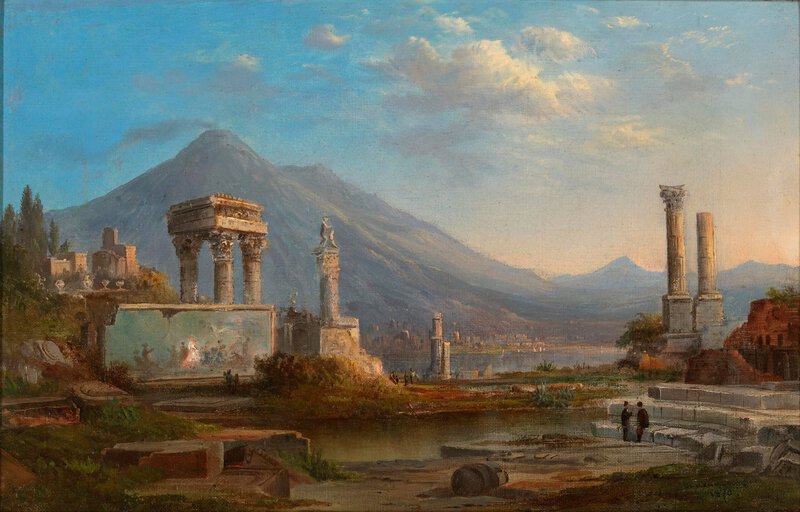
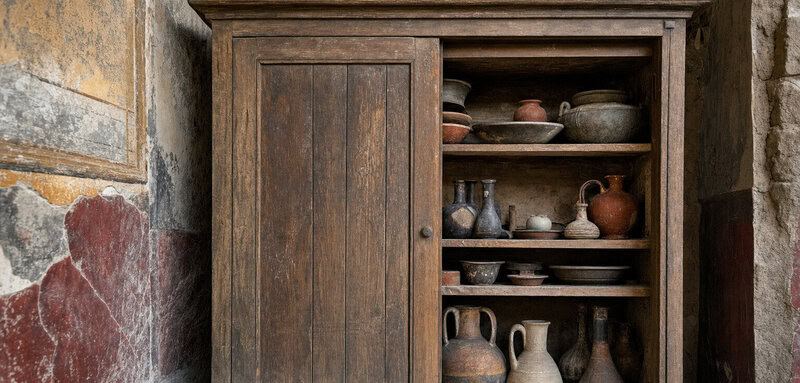
The street outside her door was Pompeii at full volume: cart wheels grinding ruts into limestone paving, thermopolia doing a brisk trade in hot food, election slogans painted fresh on whitewashed walls, the particular smell of a Roman city that never quite stopped moving. Inside, the cupboard held 38 coins, a necklace strung with a protective amulet, cookware still faintly marked by the meals it had made, and a handful of objects that served no practical purpose at all — childhood keepsakes, kept for reasons only she knew. She was, it seems, someone who held on to things.
The find, reported by archaeologists working the house on Via dell’Abbondanza, is remarkable less for what it contains than for what it proves: that the cupboard was never reopened. Whatever happened to the woman who closed it, she did not come back. The door stayed shut through the eruption, through the burial, through the long centuries of the city lying under ash, through further centuries of excavation. When archaeologists finally reconstructed the cupboard from the mineral shadows and carbonised timber traces Vesuvius left behind, the contents were undisturbed — a private arrangement from the last ordinary morning of Roman Pompeii, preserved in perfect, heartbreaking order.
The question those objects pose is not merely archaeological. It is the question that makes Pompeii impossible to look away from: what did it actually feel like to live there, in that city, in those final years, on an ordinary day when the mountain was just the mountain and the cupboard was just the cupboard?
The Street That Never Slept
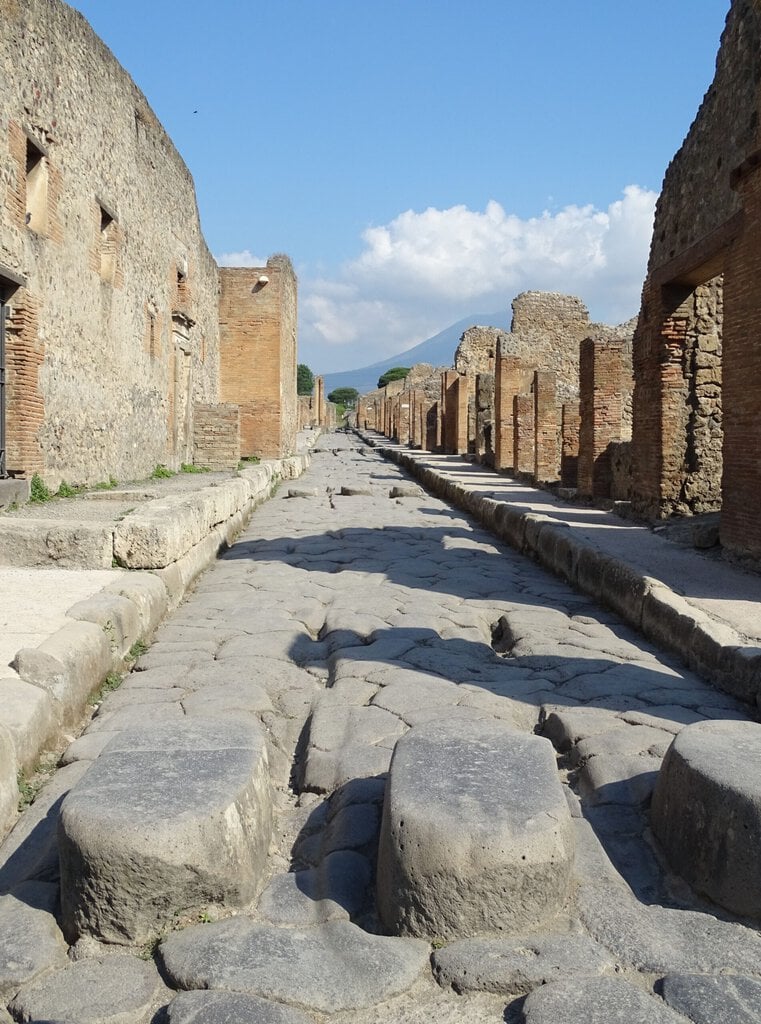
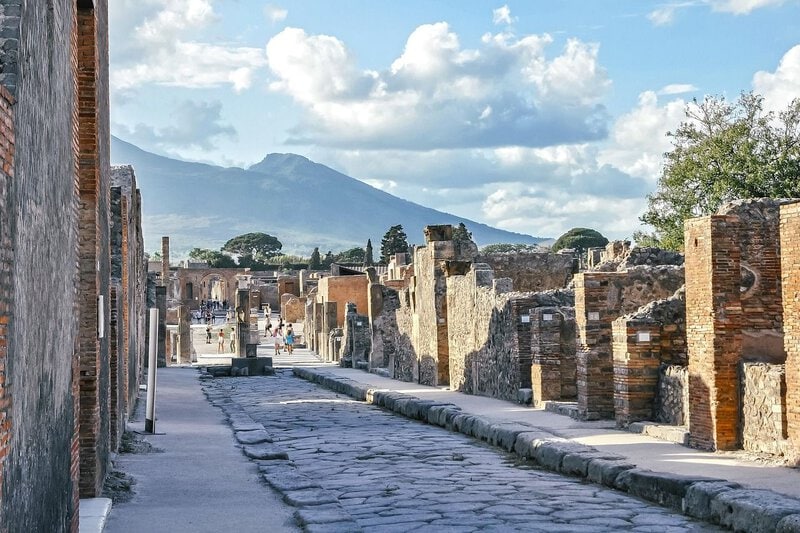
Via dell’Abbondanza ran the full width of Pompeii from east to west — the city’s spine, its loudest artery, lined with workshops and wine bars and the stepping stones pedestrians used to cross the street without wading through whatever the street contained. The name itself comes from a carved relief of Abundantia, the goddess of plenty, on a fountain at the street’s eastern end. There is something quietly, darkly ironic about objects sealed away from plenty forever standing on the Street of Abundance.
The Pompeii of the decades before AD 79 was not the settled, confident city its mosaics might suggest. A serious earthquake in AD 62 had damaged buildings across the city, and many households were still mid-renovation when Vesuvius erupted seventeen years later — scaffolding up, frescoes half-finished, rubble not yet cleared. The cupboard and its contents may well reflect a home caught mid-recovery: a household organising itself around what had survived, storing what mattered in the sturdiest, most trusted place available.
Pompeii’s population has been estimated at somewhere between 11,000 and 20,000 people — a figure that makes it easy to picture the woman on Via dell’Abbondanza as one among thousands, her daily rhythms of shopping and cooking and adorning herself and worrying about luck largely invisible to history. What archaeology is learning, find by careful find, is how to read those rhythms at the intimate scale that written records almost never reach.
Inside the Cupboard: A Forensic Reading
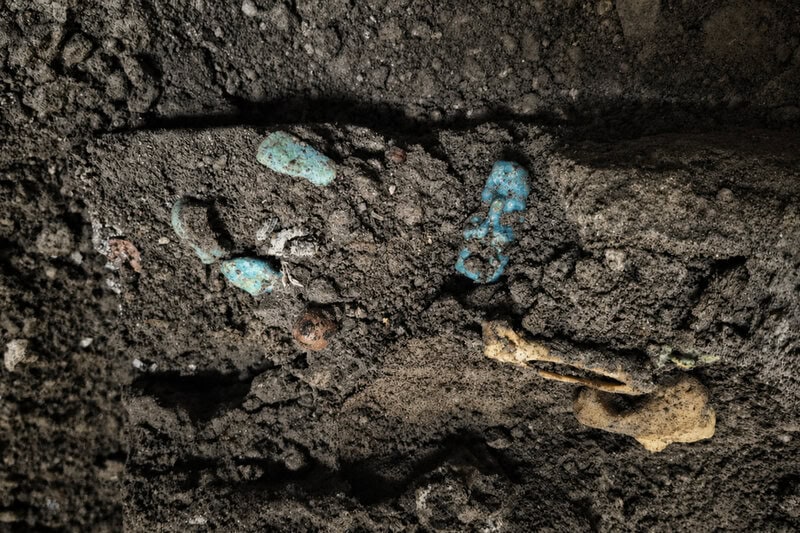
The sealed wooden cupboard, untouched since Vesuvius erupted in AD 79, was found intact at Pompeii, still holding coins, amulets, and a vessel — and the combination of those items, found together in context rather than scattered by later disturbance, gives each one a meaning it would not have in isolation. Archaeologists call this an assemblage: objects as a group, telling a story that no single object could tell alone.
The 38 coins anchor everything in real economic life. Not a fortune — not remotely. But not nothing, either. It is the kind of sum a household might keep for the weekly market, an emergency repair, a tax, an unexpected expense: the float of an ordinary Roman life. Its presence in a closed cupboard rather than on a person or in a more formal strongbox suggests it was the everyday money, accessible and trusted to one place.
The amulet necklace is the most emotionally charged item. Roman amulets — bulla-style protective charms, widely worn by women and children — existed at the intersection of superstition, habit, and genuine feeling. They were meant to deflect the evil eye, to keep the wearer safe from forces that Roman theology took entirely seriously. They were rarely set aside casually. That this one was in a cupboard rather than around a neck on the morning of 24 August either means she left in a hurry, or she had more than one, or the necklace was stored with the particular care people reserve for things they cannot afford to lose.
The cosmetics confirm whose cupboard this was. Roman cosmetics were personal equipment — not shared household goods in the way a cooking pot might be, but individual, specific to one person’s face and routine. Their presence makes this her space: her corner of the house, her private arrangement. The childhood keepsakes beside them are the most arresting detail of all. Objects with no cash value, no practical function, retained across years and probably across moves precisely because they meant something. Their presence in a locked domestic space is one of the clearest signals in the entire find that the woman maintained an interior life — a private self — inside a very public city.
How Archaeologists Rebuilt What the Volcano Destroyed
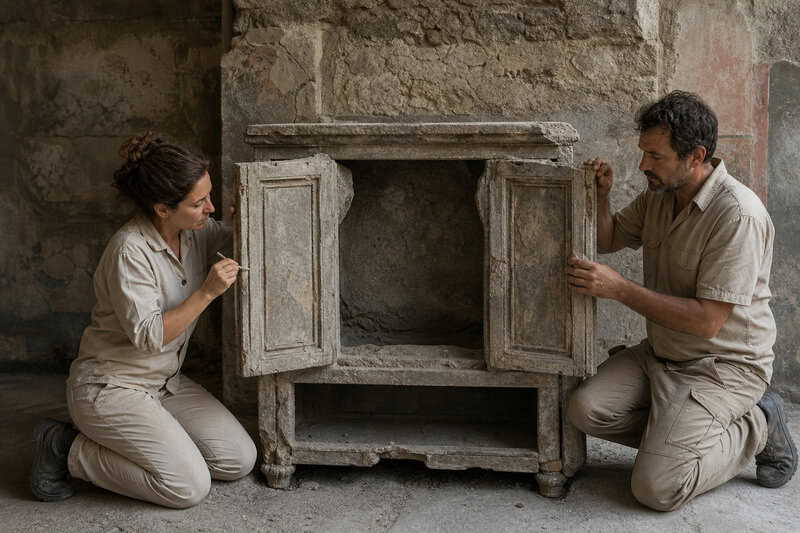
Wood does not survive a pyroclastic surge. What Vesuvius does instead is preserve the memory of wood: as the superheated ash and gas locked around organic material and the material burned or decayed, it left a void — a precise negative in the hardening mineral crust, retaining exact dimensions, joinery marks, sometimes even the grain of the timber. It is the same principle behind Pompeii’s most famous images, the plaster casts of human bodies: the person is gone, but the space they occupied remains, and if you fill that space carefully, you recover the shape of what was lost.
Archaeologists reconstructed the cupboard from traces found in the house on Via dell’Abbondanza, reading the absence of the wood as meticulously as they would read its presence. The contents survived because the sealed interior created a micro-environment slightly buffered from the full force of the eruption — the coins, the amulet, and the vessel held their positions as the ash set around the outer structure like a mould around a cast.
This is not guesswork. The reconstruction is forensic archaeology operating at the level of millimetres — the kind of work that allows us to say, with genuine confidence, that the cupboard was closed and undisturbed, not ransacked or half-emptied. Whatever happened in that house on the morning of 24 August, nobody came back afterwards and changed the arrangement.
The Morning She Didn’t Know Would Be the Last
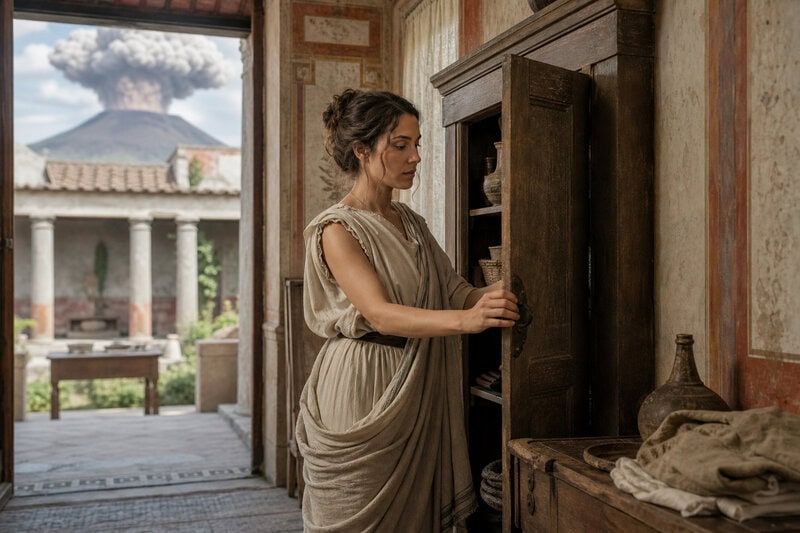
Mount Vesuvius had been giving warnings for days. Pliny the Younger, the sole eyewitness whose account has survived to us, describes a column of smoke rising from the mountain in the shape of a pine tree — that distinctive umbrella silhouette of a Plinian eruption, visible across the Bay of Naples. But Pompeii had lived with tremors since the earthquake of AD 62. Seventeen years of intermittent shaking had likely recalibrated what felt alarming. Many residents read the signs as familiar, manageable, part of the landscape they knew. The mountain had always been there.
The eruption unfolded in two phases. For roughly twelve hours, a column of pumice and ash rained down on the city — survivable, if disorienting — and during this phase some residents fled. Then, in the early hours of 25 August, a sequence of pyroclastic surges rolled down the mountain and killed those who remained. The exact fate of the woman on Via dell’Abbondanza is unknown, as it is for most of Pompeii’s population. She left no name in the record.
But the cupboard tells us something. She did not go back for the 38 coins. Thirty-eight coins is not an amount you forget about, not an amount you leave behind if you have time to think about it. The most plausible readings are two: she fled too fast to retrieve them, or she did not survive long enough to try. Either way, the cupboard stayed shut. The door was closed, not forced. The contents were in order, not scrambled. She had put things away tidily, and whatever happened to her happened before she could change her mind about what to take.
What Pompeii Keeps Teaching Us
Most of Pompeii’s celebrated finds speak to public life or elite life: the grand frescoes, the forum statues, the marble counters of wealthy thermopolia. The cupboard, sealed for nearly 2,000 years and containing household items dating to before the eruption of Mount Vesuvius in AD 79, speaks to something rarer — the interior domestic life of someone ordinary. Cosmetics and keepsakes and a modest purse of coins do not make it into the histories. They make it into the ash, which turns out to be more reliable.
The discovery joins a growing body of recent finds — including excavations at Regio IX that have produced remarkable new evidence of daily Pompeian life — that are steadily reframing how we understand the city. Pompeii is not, or not only, a frozen moment of catastrophic death. It is a frozen moment of life: the city mid-morning, mid-renovation, mid-ordinary-week, preserved with a completeness that no archive and no chronicle could replicate.
The Great Pompeii Project, launched in 2012, has transformed excavation and conservation across the site, opening areas untouched since the eighteenth century and applying modern forensic techniques to finds that earlier generations would have handled very differently. The Via dell’Abbondanza cupboard is a product of that rigour — its significance confirmed not just by what it contained but by the care with which those contents were recovered and read.
Why a Closed Door Matters
The contents of this cupboard are not spectacular. There is no gold hoard, no imperial jewellery, no document that rewrites history. There are 38 coins, some cosmetics, a necklace, a few keepsakes, some cookware — the exact, unglamorous texture of a life that history would otherwise never have preserved. That is precisely the point. The texture of ordinary life is almost always what history loses first, and almost always what we most want back.
Every sealed room, every intact assemblage, every coin left behind is Pompeii answering the question we keep asking it across two millennia: what were you like before the mountain? And the answer, again and again, is the same. The woman on Via dell’Abbondanza kept her money in a safe place and her keepsakes beside her cosmetics and her lucky charm near the door. She was worried about the evil eye and careful about her household budget and attached to objects from her childhood that she could not bring herself to throw away. She put things in order before she went out.
She was, in other words, recognisably, stubbornly, entirely human — and the cupboard she closed on an ordinary morning is, nearly two thousand years later, still telling us so.