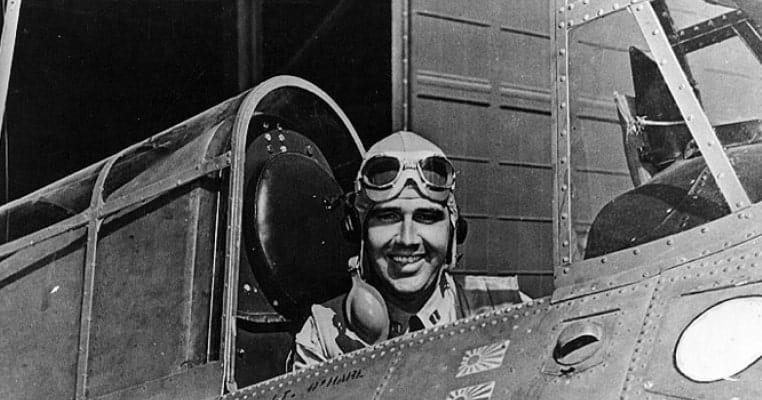

18. Edward O’Hare was the first flying ace of the United States Navy
Edward O’Hare was serving in the United States Navy, a graduate of the Naval Academy, when gunmen working for Al Capone killed his father, in revenge for testimony during Capone’s tax evasion trials. The younger O’Hare trained as a naval aviator in 1940, and by 1941 was serving in various aircraft carriers, known as Butch by his fellow flyers. In February 1942 he was serving in USS Lexington when that ship was attacked by Japanese bombers while operating near Rabaul. O’Hare was credited with shooting down five of the bombers himself (in fact he destroyed three) and thus became the United States Navy’s first flying ace, the first American ace of the Second World War, and was awarded the Medal of Honor. For the next several months he appeared in goodwill and morale building roles in the United States, and then as an instructor in Hawaii.
In 1943 O’Hare returned to combat operations. In November he became missing in action and for decades was presumed to have been the victim of a friendly fire incident. Later evidence revealed he had in fact been shot down by gunners from a Japanese bomber during an early night mission. O’Hare remained one of the most well-known Navy pilots of the war even after he was declared missing in action, and declared killed in action in November 1944. In 1949 the Chicago native whose father had been a victim of the notorious Al Capone was honored by his home town. Orchard Depot Airport was renamed for O’Hare, and is today known as O’Hare International Airport, known to travelers around the world simply as O’Hare. A restored F4F Wildcat similar to the one flown by O’Hare during his Medal of Honor winning flight is on display there in Terminal Two.
Where do we find this stuff? Here are our sources:
“Paul Revere’s Ride”. David Hackett Fischer. 1994
“Stark: The Life and War of John Stark, French and Indian War Ranger, Revolutionary War General”. Richard V. Polhemus, John F. Polhemus. 2014
“General John Glover and his Marblehead Mariners”. George Athan Billias. 1960
“Preble’s Boys: Commodore Preble and the Birth of American Sea Power”. Fletcher Pratt. 1950
“Humiliation and Triumph”. Walter Lord, American Heritage Magazine. August, 1972
“The War of 1812, the Forgotten Conflict”. Donald R. Hickey. 1989
“Jefferson Davis, American”. William J. Cooper. 2000
“Lost Triumph: Lee’s Real Plan at Gettysburg and Why it Failed”. Tom Carhart. 2005
“Barkley, David Bennes”. Entry by James Myers in Texas State Historical Association Handbook. Online
“Hall, Thomas Lee”. Entry in Medal of Honor recipients, US Army Center for Military History. Online
“Prisoner of the U-90”. Edouard Izac. 2012
“Antrim, Richard N. Rear Admiral USN (Retired)”. Entry, Naval History and Heritage Command. Online
“Twenty Million Tons Under the Sea”. Daniel V. Gallery. 2012
“Fateful Rendezvous: The Life of Butch O’Hare”. Steve Ewing and John B. Lundstrom. 1997


