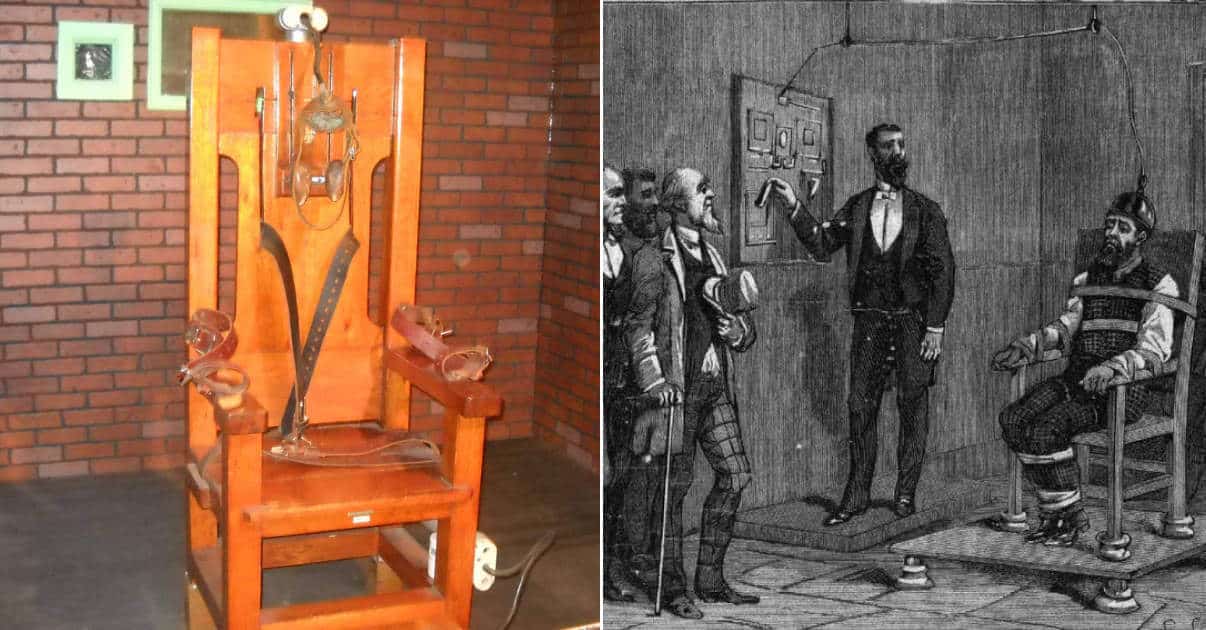

7 – The Electric Chair Was Partly Born Because of a Feud Between Thomas Edison & George Westinghouse
It could be said that the invention of the electric chair was something of an accident. In the 1880s, the popularity of arc lighting, a powerful form of outdoor street lighting, flourished. Arc lighting needed extremely high voltages between 3,000 and 6,000 volts, and it was responsible for dozens of deaths at the outset of its creation. The fatal accident that changed history occurred in Buffalo, New York, on August 7, 1881. A drunk dock worker broke into the arc lighting powerhouse of the Brush Electric Company, grabbed a large electric dynamo’s brush and ground, and was killed instantly. He was seeking the glorious tingling sensation he had felt before.
Alfred B. Southwick was a dentist and a member of a local scientific society, and he believed the bizarre new phenomenon whereby people died immediately with no marks on their body, could prove useful. With the help of a doctor named George E. Fell and the head of the local ASPCA, Southwick began experimenting by electrocuting hundreds of stray animals. He soon advocated electrocution as a better mode of execution. It was a burning issue in the United States at the time because of the increasing number of botched hangings.
At that time, Thomas Edison was in a fierce battle with George Westinghouse in what became known as the War of Currents. Southwick began correspondence with Edison and asked the inventor for his opinion about using electricity to kill convicts. Initially, Edison said it was barbaric, but in December 1887, he wrote to Southwick and said that alternating current voltage (AC) was the best choice for executions. AC was developed by his rival Westinghouse, and Edison believed if he could convince the public that AC was a fast and effective killer, his direct-current voltage (DC) would be deemed safer so his market share would increase.
The next couple of years were spent trying to prove that AC was a better way to kill criminals than DC. Edison proudly appeared at staged press conferences and would use AC to kill stray dogs and cats. One of the most famous experiments happened at West Orange on December 5, 1888. Edison was in attendance when Harold P. Brown used AC on a lame horse and four calves. He wanted to ensure the animal victims were all larger than a human and used 750 volts. The Medico-Legal Society recommended using between 1,000 and 1,500 volts based on the results of the test. The state of New York decided to proceed with electrocution as a death sentence, and the first chair was built by Edwin P. Davis. He was to act as the state’s executioner and didn’t have to wait long to try out the new invention.


