Somewhere on a Utah hillside, unremarkable to anyone passing through, a curve of fossilized bone juts from Cretaceous-age rock — the kind of detail that vanishes entirely if you don’t know what you’re looking for, and stops you cold if you do. The Utah Geological Survey paleontologist who spotted it knew exactly what they were looking at: the edge of something enormous, patient, and very, very old.
The Hillside That Kept a Secret for 138 Million Years
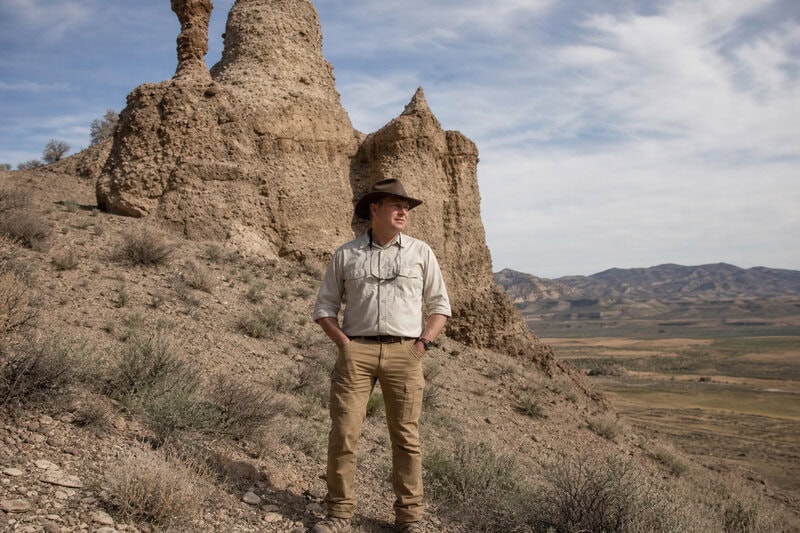
To stand on that Utah hillside today is to stand in two moments at once. In the present, there is scrub brush, thin air, and the particular silence of the high desert. In the deep past — so deep it resists easy imagination — there is warm, dark water, dying animals sinking slowly into river mud, and a world so foreign that the landscape we think of as “the American West” did not yet exist in any recognizable form. When these creatures fell and were swallowed by sediment, the Rocky Mountains had not yet begun their long push skyward. The Atlantic Ocean was little more than a narrow rift, a geological adolescent. And Utah, far from being landlocked plateau country, lay along the western shore of an immense shallow inland sea called the Western Interior Seaway — a body of water that would eventually split the North American continent in two.
That is the world the bones remember. On October 27, 2026, the Utah Geological Survey made it public: the excavation of a dinosaur bonebed from the Cretaceous period had begun, and the site beneath that quiet hillside may be unlike almost anything previously found on this continent. The estimated age — 138 to 141 million years — places it at the threshold of the Early Cretaceous, a chapter of Earth history so sparsely represented in the North American fossil record that every bone coming out of this hillside carries the weight of missing pages.
The claim that gives this excavation its sharpest edge is straightforward: the site is tied as potentially the oldest Cretaceous dinosaur bonebed in North America. “Potentially” is doing real scientific work in that sentence. The excavation itself will determine whether the age estimate holds — and whether the record books need to be rewritten.
What a Bonebed Actually Means — And Why This One Is Different
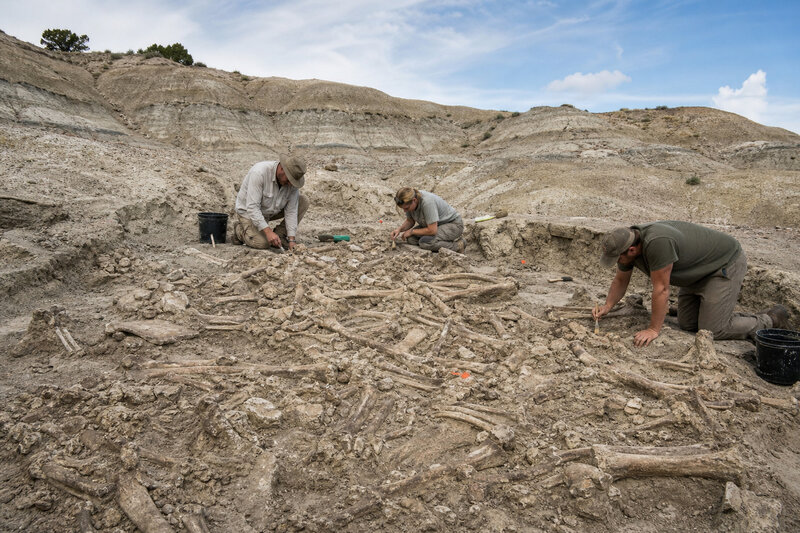
A bonebed is not what most people picture when they imagine a dinosaur discovery. It is not a single, heroic skeleton posed mid-stride in stone. It is a mass accumulation — bones from multiple individuals, sometimes dozens, occasionally hundreds, layered and intermixed in sediment as though the earth itself pressed them together like flowers in a book. The accumulation can happen violently, in a flood that swept a herd of animals downriver and deposited them in a bend where the water slowed. It can happen slowly, at a watering hole where animals returned season after season and occasionally died there. Either way, a bonebed is not merely a fossil. It is a snapshot of an entire ecosystem, frozen in mineral at a single moment or across a narrow window of geological time.
What makes this Utah bonebed different from the famous North American bonebeds most people have heard of — the dense Triceratops and Edmontosaurus accumulations of the Hell Creek Formation, or the spectacular Centrosaurus bonebeds of Alberta — is age. Those celebrated sites cluster in the 66-to-80-million-year range, products of the Late Cretaceous, the dinosaur world’s final act before the asteroid curtain fell. This site reaches back nearly twice as far, into the Early Cretaceous, a period when the North American fauna was still in the process of becoming itself, still trading evolutionary influences with Europe and Asia before the continents drifted into their modern isolation.
The gap between those two chapters of dinosaur history is not merely a number. It represents tens of millions of years during which North American dinosaurs evolved largely out of sight of the fossil record. Paleontologists know roughly what came before and roughly what came after, but the middle chapters are thin. A site pushing 138 to 141 million years old is, in that sense, a library that was thought lost.
The UGS team’s language in the announcement reflects the disciplined caution of working scientists who have learned to love the word “potentially.” Every claim this site might make about the record books still has to survive the full scrutiny of excavation, preparation, and peer review. That caution does nothing to diminish the excitement — it simply measures it honestly.
Reading the Rock: How Geologists Dated a Hillside
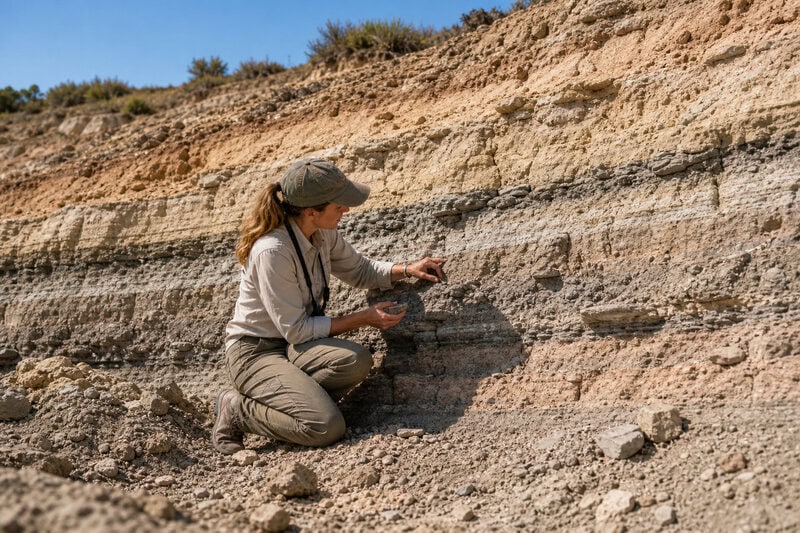
Assigning an age range of 138 to 141 million years to a layer of rock is not a matter of intuition. It is a matter of chemistry and geometry. Geologists use radiometric dating — specifically the decay of radioactive isotopes locked into volcanic ash layers called bentonites — to bracket fossil-bearing strata like bookends. If a layer of volcanic ash above the fossil zone dates to 138 million years and a layer below it dates to 141 million years, the bones in between must fall within that window. The fossils cannot be younger than the rock that covers them, and they cannot be older than the rock that lies beneath them.
The rock itself is an archive written in grain size and color. Coarse red sandstone speaks of energetic river channels moving fast. Fine-grained silts and mudstones record the quiet backwaters and floodplains where sediment settled slowly over dead things, encasing them, pressing out the organic material and replacing it atom by atom with mineral over millions of years — the slow alchemy that turns bone to stone. The UGS geologists cross-referenced outcrop maps, hand samples collected in the field, and laboratory assays before a single excavation permit was filed.
One oddly clarifying detail puts the age in human terms: 138 million years ago, Stegosaurus was already extinct. The plated giant of every child’s dinosaur book had come and gone before these animals were even born. Meanwhile, the ancestors of Tyrannosaurus rex — that icon of prehistoric menace — were still small, feathered predators living on distant continents, nowhere near the apex of anything. The world of this Utah bonebed is genuinely alien, even by dinosaur standards.
The Excavation Begins: Brushes, Chisels, and the Patience of Geologic Time
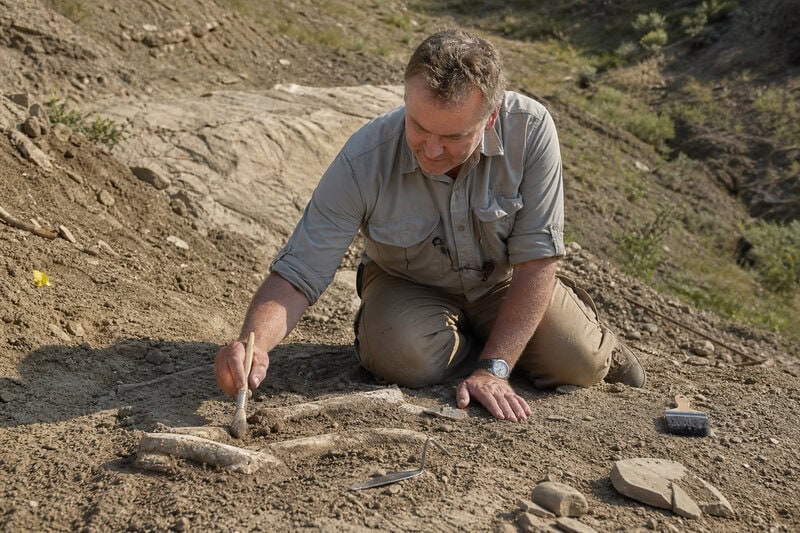
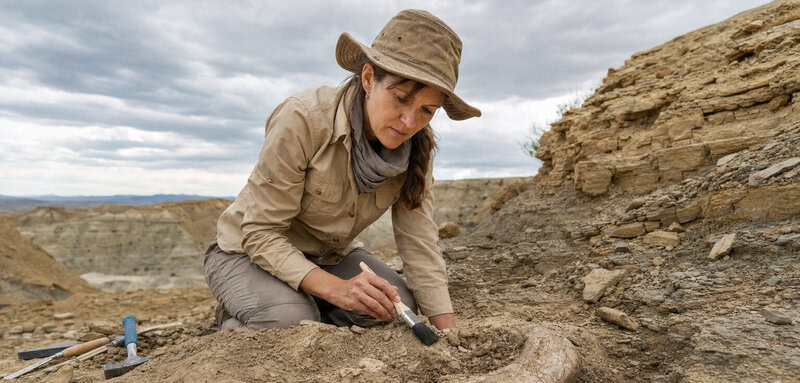
Field teams begin each day the same way: grid stakes driven into the hillside at measured intervals, a paper map clipped to a board, a camera charged and ready. Nothing is touched before it is photographed. Every bone is recorded in three dimensions — its position, its orientation, its relationship to the bones around it — because the moment a specimen is lifted from the ground, the spatial information it carries is gone forever. The photograph is not documentation for documentation’s sake. It is science. It will eventually tell the story of how these animals came to rest here together, which matters as much as knowing who they were.
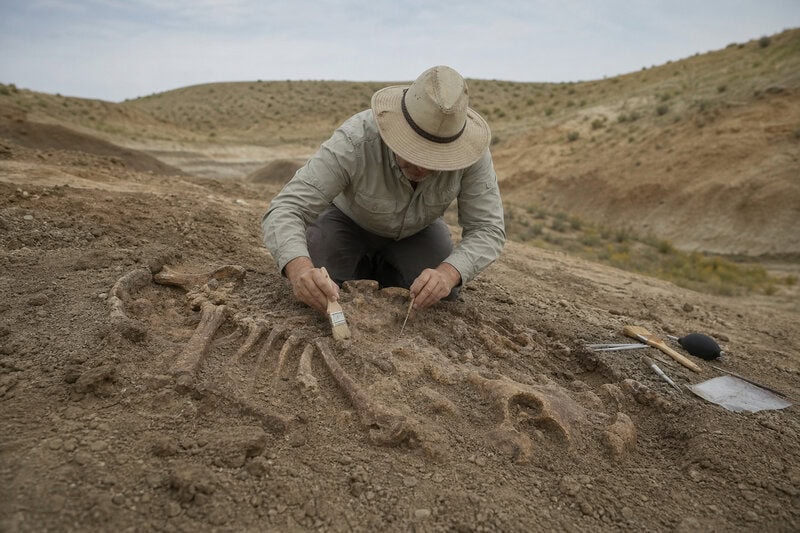
The physical work of a bonebed excavation is not glamorous. It is grid stakes and plaster, brushes and dental picks, the careful mixing of burlap and plaster of Paris into field jackets that will protect fragile specimens for the ride back to the laboratory. It is moving inches through rock that took millions of years to form. A chisel swung too hard can destroy in a single second what survived through deep time.
The scale already suggested by the UGS announcement confirms that this is not the story of a single animal. Multiple individuals lie here, their bones interleaved by whatever event or slow accumulation brought them together. Whether that event was catastrophic — a flash flood, a drought that concentrated a herd around a dying water source — or gradual is one of the open questions the excavation will try to answer. The bones themselves, once properly mapped and studied, may carry the answer encoded in their arrangement.
What the Bones Might Tell Us
The scientific stakes of an Early Cretaceous bonebed excavation in Utah extend well beyond the individual site. Because so few Early Cretaceous bonebeds exist on the North American continent, each new specimen carries outsized power to shift — or confirm — current hypotheses about how dinosaur lineages dispersed across the globe before the continents fully separated. Were the dinosaurs living in what is now Utah at 138 million years ago more closely related to European fauna, or to Asian? Were large sauropods still present, or had the ecological landscape already shifted toward the ornithopods and ankylosaurs that would dominate the Late Cretaceous? The bones in this hillside may not answer all of those questions, but they will answer some of them in ways that no amount of theorizing can replicate.
The UGS team is already shaping the analytical framework. Were these animals killed in a single catastrophic event, or did the site accumulate deaths over centuries? Are multiple species represented, or does the bonebed reflect a single gregarious species — a herd — whose members happened to die together? The spatial mapping being conducted now, before any specimen is removed to the laboratory, will be the primary data set that eventually answers those questions.
Beyond the specialists, there is the broader human project that makes any of this matter: the long effort to understand life’s deep history, the reason museums exist, the reason school groups press their faces against glass cases to look at something old and vast and strange. Paleontologists with the Utah Geological Survey have begun excavating a newly identified dinosaur bonebed that could provide important clues — and clues have a way of becoming answers, given enough time and enough careful hands.
Utah’s Remarkable Fossil Legacy — And Where This Site Fits
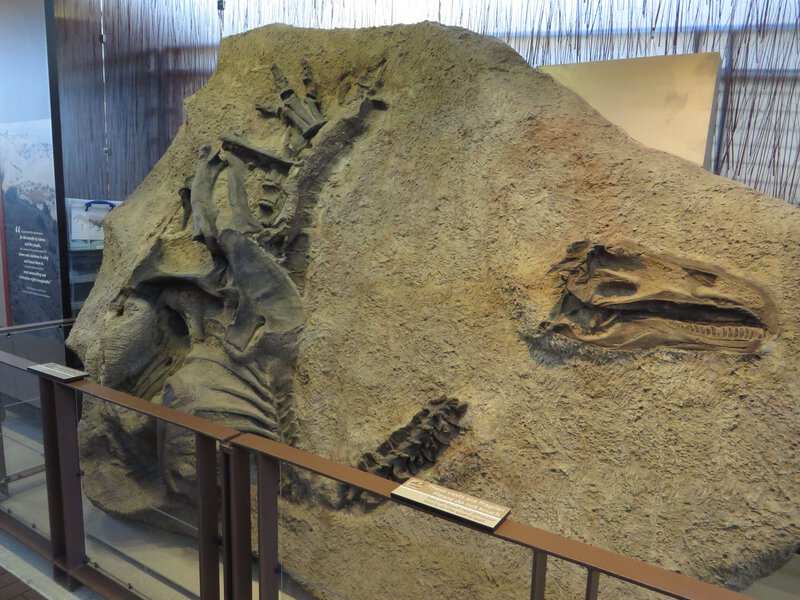
Utah has been accumulating paleontological laurels for over a century, and the inventory is extraordinary. Dinosaur National Monument preserves a Jurassic wall of bones so dense it was quarried in place and turned into a museum. The Kaiparowits Plateau in Grand Staircase-Escalante National Monument has yielded a parade of Late Cretaceous species known nowhere else on Earth. The state’s layered geology is, in the most literal sense, a library — each formation a different shelf, each fossil a different volume of the same long story.
The Utah Geological Survey has been the institutional backbone of many of these discoveries, a state agency whose work resonates in research institutions and natural history museums around the world. The permit officials, the preparators who spend thousands of hours in laboratory cleanrooms with air scribes and microscopes, the field technicians who carry plaster and water up hillsides in the Utah heat — science is a collective enterprise, and the lone-genius discovery narrative has never accurately described how it actually works.
This new Cretaceous dinosaur bonebed fills a specific gap in Utah’s already remarkable fossil legacy. Most of the state’s celebrated fossils are younger — Late Jurassic giants and Late Cretaceous specialists. A site pushing 138 to 141 million years old reaches further back into the Mesozoic than almost anything Utah has previously offered, extending the state’s fossil story into a chapter that, until now, the state could barely claim.
The Long Wait Ahead — And Why It’s Worth It
There is a timeline here that deserves honesty. The bones announced in October 2026 will not yield published findings quickly. Excavation of a major bonebed routinely continues for multiple field seasons. Laboratory preparation — the careful removal of matrix from bone under magnification, the consolidation of fragile specimens, the casting and molding — can take years for a single significant find. Analysis, comparison with existing collections, and peer review add more time still. Scientific papers that emerge from this hillside may not appear until the early 2030s. That is not a failure of urgency. It is the pace that accuracy requires.
There is something quietly philosophical in that timeline. The same patience geology demands of rock — slow pressure, slow change, transformation across timescales that make human impatience look frankly small — it demands of the humans who read the rock.
At the end of a field day, when the grid stakes throw long shadows across the hillside and the light goes amber and horizontal the way it does in the Utah desert, a fragment of bone rests in a gloved hand — heavy, cold, dense with mineral. No living creature has touched it in 138 million years: through the rise of the Rocky Mountains, through ice ages, through the arrival of the first humans on this continent, through everything the world has managed to do to itself in the interim. The real work, as anyone on the team will tell you, is just beginning.
A hillside kept its secret through all of that. In 2026, it finally began to give it up — one careful brushstroke at a time.