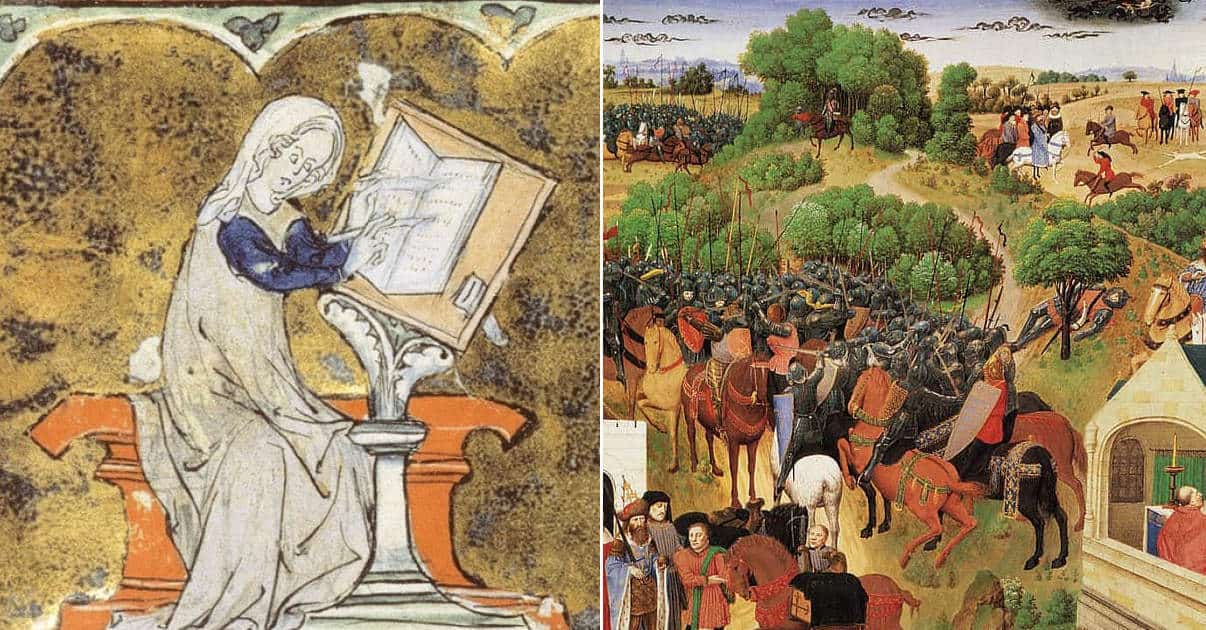

Bede, A History of the English Church and People
It may at first appear strange to include an ostensibly-historical work on a list of literature, but omitting it would do Bede a great disservice. Bede (672/3-735) wrote the History in around 731 from the confines of his monastery at Jarrow, Northumbria, taking in both available historical and theological sources and oral tales from visitors to the monastery. Though he is chiefly remembered for the History, as an author Bede was chiefly a theologian and exegete, and his success in this unusual, monumental undertaking should not be undervalued. The History is still a vital source for studying the Anglo-Saxon period.
The History was written to establish an English identity and to situate the Anglo-Saxon people as God’s chosen nation. Bede strives to give a history of England from the Celtic period to the present, relating the struggles of the Romans to establish a Christian Church, the Anglo-Saxon invasion and subsequent conversion in 597, and the territorial disputes and battles that characterised the country’s history thitherto. Although England would not be united under a single king until the following century, Bede was pleased to see that there was religious uniformity uniting the once mutually-hostile Anglo-Saxon kingdoms as he reached old age.
There is nothing dry about the History. Bede’s writing is beautiful and moving: ‘when we compare the present life of man on earth with that time of which we have no knowledge [afterlife], it seems to me like the swift flight of a single sparrow through the banqueting-hall where you are sitting on a cold winter’s day… this sparrow flies swiftly through one door of the hall, and out through another. While he is inside, he is safe from the wintry-storms; but after a few moments of comfort, he vanishes from sight into the wintry-world from which he came’ (II.13).


