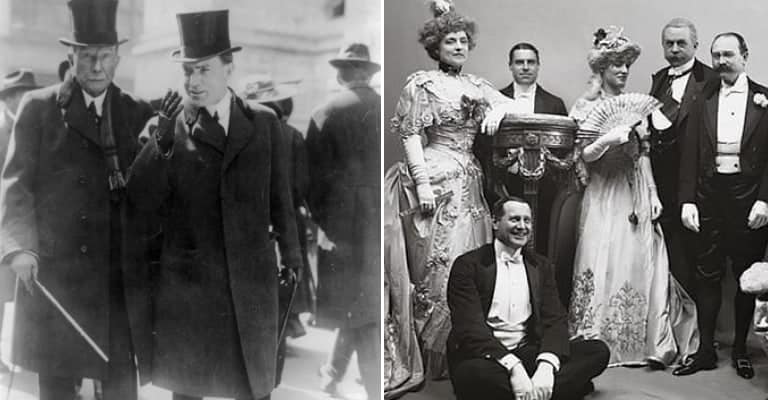
20. The Gilded Age ended around the turn of the 20th century

When the Gilded Age began, the United States had a mostly wooden navy, with its ships powered by both steam and sail. When it ended, three decades later, the United States Navy was a steel navy, the victor over the first colonizer of the Americas, Spain, in the Spanish-American War. The United States had joined the imperialist powers of Europe in acquiring overseas possessions. The Gilded Age yielded slowly to the reforms of the Progressive movement, and as the robber barons, corrupt officials, and political machines found their influence waning, they took steps to protect their holdings which signified the Gilded Age.
Many of the great mansions which were built during the period still stand, though few are used for their originally intended purpose. Others, such as the great row of houses along Fifth Avenue in New York are long gone. Even the railroads, which largely drove what became known as the Gilded Age, waned in importance to American passenger traffic, though they remain critical to shipping as part of the containerized shipping system. The greatest legacy of the Gilded Age was the creation of the American middle class, though at the time it was limited to white collar workers. Blue collar workers would not gain access to the middle class until the days after World War II, when the strength of the labor unions reached its peak.
Where do we find this stuff? Here are our sources:
“History of the Baltimore and Ohio Railroad”. John F. Stover. 1987
“The Gilded Age 1877-1896”. Vincent de Santis. 1973
“New Spirits: Americans in the Gilded Age”. Rebecca Edwards. 2006
“The Great Bicycle Craze”. Fred C. Kelly, American Heritage Magazine. December 1956
“The Gilded Age”. H. Wayne Morgan, American Heritage Magazine. August/September 1984
“Mark Twain: The Contemporary Reviews”. Louis J. Budd. 2011
“Telephone: The First Hundred Years”. John Brooks. 1976
“John D. Rockefeller: The Cleveland Years”. Grace Goulder. 1972
“The Parlor”. Russell Lynes, American Heritage Magazine. October 1963
“Maids in America: The Decline of Domestic Help”. Ester Bloom, The Atlantic. September 23, 2015
“Then & Now: The 1876 Centennial Exposition”. Austin Weber, Assembly Magazine. September 1, 2001
“The Gilded Age: Perspectives on the Origins of Modern America”. Charles W. Calhoun, editor. 2007
“The Origins of the New South”. C. Vann Woodward. 1951
“The Gilded Age in American History”. Vincent P. de Santis, Hayes Historical Journal. 1988
“The Gilded Age: A Reappraisal”. H. Wayne Morgan, ed. 1970
“Edward Bellamy”. Arthur E. Morgan. 1944
“Goodbye to the Interurban”. William D. Middleton, American Heritage Magazine. April 1966


