
10. Several women portrayed Aunt Jemima during the 1920s and 1930s
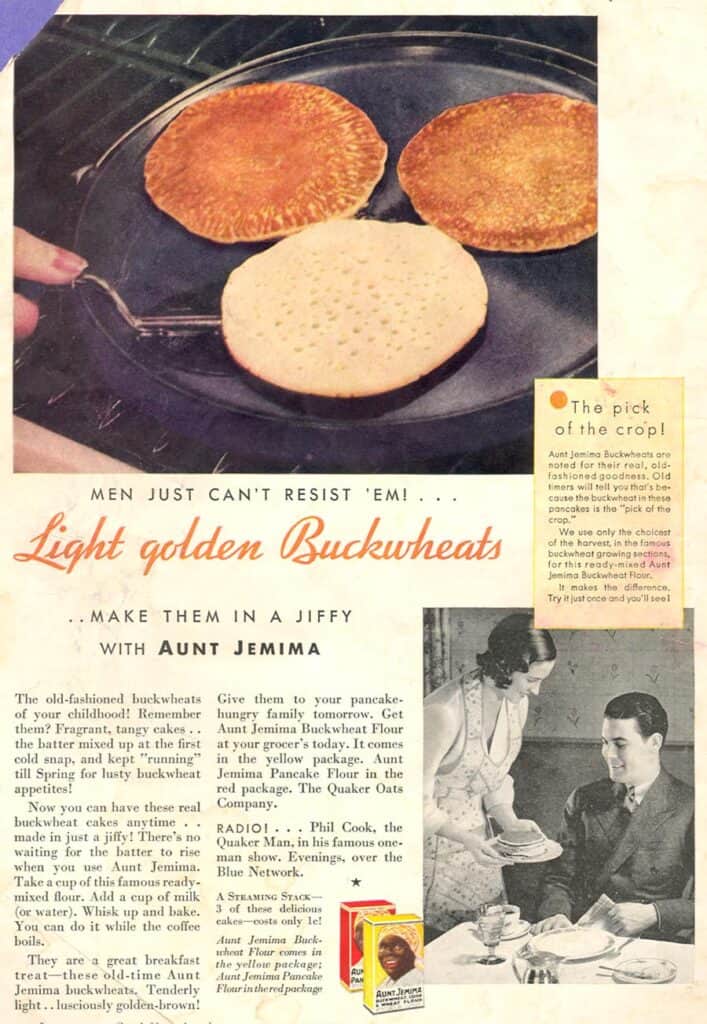
Shortly after acquiring the Aunt Jemima brand, Quaker Oats hired several women to portray her in person. They adopted the appearance, more or less, as that of Nancy Green. In Texas, Quaker hired Lillian Richards, a cook who operated out of the town of Paris. Lillian traveled, as had Nancy Green, to portray Aunt Jemima at fairs, festivals, and to perform demonstrations in grocery stores and shows featuring new appliances. She held the role until she suffered a stroke in 1947. Although her shows were successful, Quaker did not consider her for the role of Aunt Jemima at the World’s Fair in 1933, Chicago’s Century of Progress Exhibition.
After an open casting call, Quaker’s advertising company, Lord and Thomas, selected Anna Robinson. Like Green, Anna hailed from Kentucky, but unlike Green, she was a large woman, about 350 lbs, and she closely resembled the “Mammy” stereotype then returning to prominence in films. She became so successful the image of Aunt Jemima on packaging changed to more closely resemble her. Anna became a celebrity. Following her appearance at the World’s Fair, Quaker used her to market the brand in New York by having her prepare pancakes for other celebrities in highly promoted events. She prepared and served Aunt Jemima’s pancakes in famed venues such as the Stork Club, the Waldorf-Astoria, and even the 21 Club, always in character.


