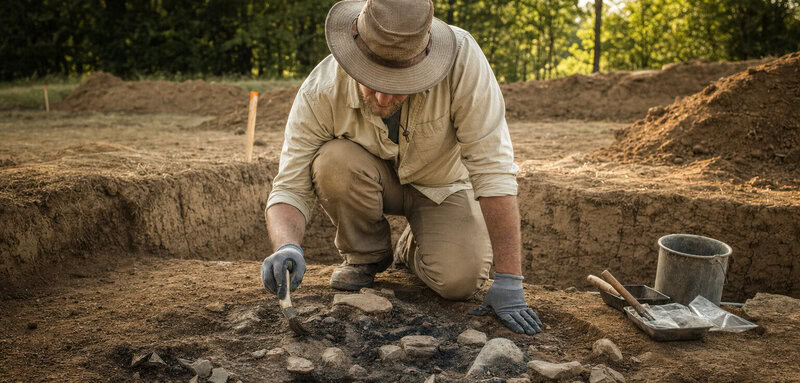
Somewhere beneath a Tennessee parking lot, a highway shoulder, or a soybean field gone to stubble, there are hearths that burned a thousand years before the first European set foot on this continent — and for most of the state’s recorded history, those fires have existed only in the memory of the soil.
The Dirt Beneath the Pavement
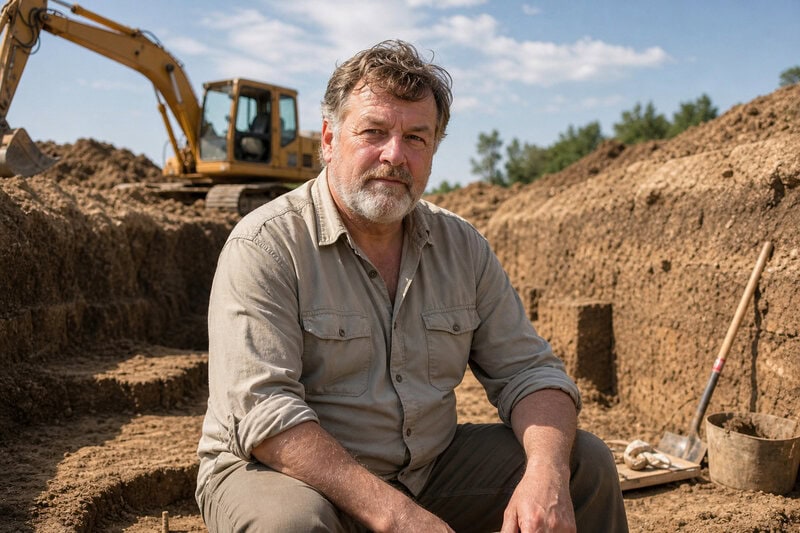
Michael C. Moore, Tennessee State Archaeologist, has spent a career knowing that memory is fragile. Every construction season brings a fresh round of losses: a Woodland-period midden scraped away for a retention pond, a Mississippian house floor pulverized beneath a new interchange. The knowledge that something irreplaceable once existed there disappears not with a bang but with the quiet bureaucratic finality of a closed contract report filed in a cabinet no one will open again.
On November 20, 2026, that problem took a significant new form. The Tennessee Division of Archaeology announced the launch of Tennessee Archaeology (New Series), a peer-reviewed, open-access publication designed to pull decades of excavation reports, geospatial data, and artifact studies out of gray filing cabinets and into a searchable, permanent archive available to anyone with an internet connection.
The Crisis of Forgotten Fieldwork
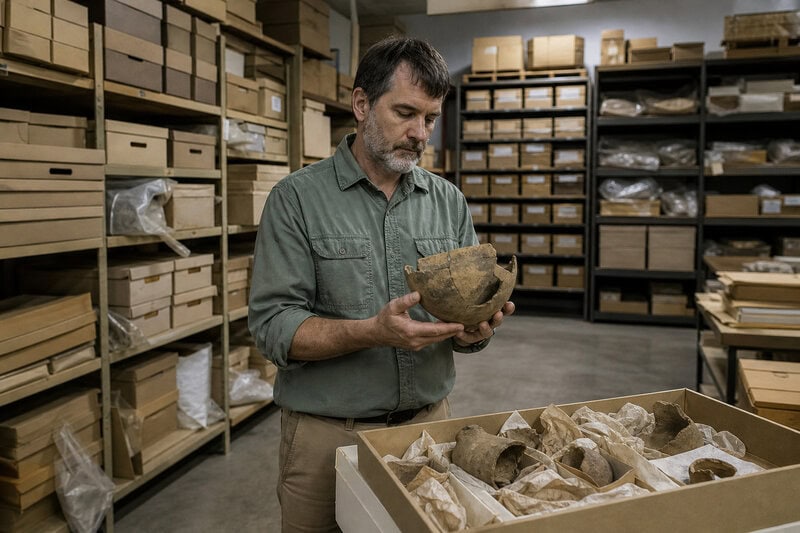
The problem Moore and his colleagues face is structural and stubborn. Archaeological knowledge in Tennessee has historically lived in unpublished contract reports, in museum storage boxes stacked in climate-controlled rooms that few people ever enter, and in the institutional memory of researchers who eventually retire and take their hard-won expertise with them. Findings that took years of fieldwork and hundreds of thousands of dollars to produce simply vanish from public view — not destroyed, technically, but functionally lost. A result that no one can find is, for all practical purposes, a result that does not exist.
What makes this especially costly is the scale of what Tennessee’s archaeological record actually contains. The state’s human story stretches back at least 13,000 years — from Paleoindian hunters tracking mastodons and ground sloths along river corridors at the close of the last Ice Age, through the sophisticated shell midden builders of the Archaic period along the Tennessee River, to the platform mound societies of the Mississippian era and the Cherokee and Chickasaw nations whose territorial sovereignty was systematically dismantled in the eighteenth and nineteenth centuries. It is a timeline so deep that even professional historians routinely underestimate it, let alone the general public navigating school curricula that devote weeks to Andrew Jackson and paragraphs to everything before European contact.
The new journal is explicitly designed to close that gap. According to the official announcement, Tennessee Archaeology (New Series) will publish contributions derived from excavation, geospatial analysis, experimental archaeology, and museum studies — giving field researchers a formal, citable destination for work that would otherwise never reach either the public or the broader scholarly community.
What the Journal Will Actually Publish
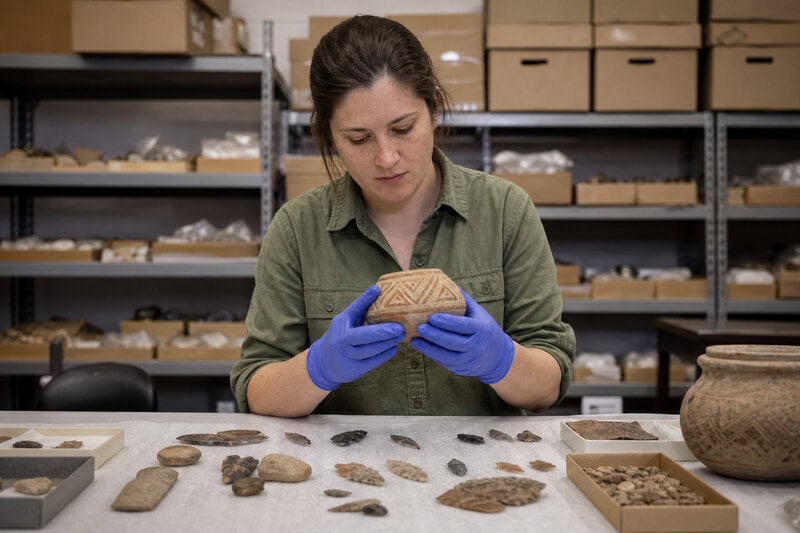
The scope of Tennessee Archaeology (New Series) is deliberately broad. Excavation narratives will sit alongside geospatial analysis of site distributions, experimental archaeology, and museum studies examining collections that have waited largely unstudied since they were donated in the mid-twentieth century. Each category addresses a different species of the same underlying problem: knowledge that exists somewhere but has not yet been made usable.
Geospatial analysis represents a particular frontier. LiDAR surveys — aerial laser mapping that strips away forest canopy to reveal the terrain beneath — flown over forested ridgelines in the Appalachian highlands have already revealed earthworks and settlement patterns invisible to observers on the ground. Features that would have required years of difficult survey work to find can now be identified in an afternoon of image analysis. The journal gives those findings a permanent, citable home, transforming a dataset into an argument that other researchers can challenge, refine, or build upon.
Experimental archaeology entries occupy different ground. A researcher who spends weeks knapping flint in the style of a Woodland-period toolmaker, documenting precisely which angles produce a usable blade edge and which shatter the stone into useless fragments, is generating a kind of embodied knowledge that never fits neatly into a standard site report but is essential for understanding how people actually lived and worked. The journal’s scope, as outlined in the launch announcement, makes room for exactly this kind of inquiry.
Then there is what might be called the quiet crisis: the thousands of objects excavated in the mid-twentieth century that were catalogued hastily, stored correctly, and then never analyzed. Artifacts sitting in acid-free boxes, waiting for a question someone finally thought to ask. Museum studies sections of the journal exist precisely to surface those questions — and to give the answers somewhere to live.
The Indigenous Deep Time Tennessee Forgot to Teach

The launch of a Tennessee archaeology journal is also an opportunity to surface a central tension in the state’s public historical identity. Tennessee’s official narrative has long foregrounded the colonial and antebellum eras while treating the 13,000-plus years of Indigenous history that precede them as prologue rather than story. The archaeology, increasingly, refuses that framing.
Excavation and geospatial work has been steadily rewriting what specialists understand about Mississippian-era Tennessee. The great platform mound centers — Pinson Mounds in Madison County among the most prominent — were not isolated ceremonial curiosities but nodes in regional exchange networks stretching from the Gulf Coast to the Great Lakes. Obsidian, marine shell, and copper moved across a continent, and Tennessee was not a backwater through which they passed but a crossroads where they converged. The civilization that built those networks was sophisticated, durable, and deeply rooted in this specific landscape.
One stated goal of expanding archaeological publication is ensuring that descendant communities — Cherokee, Chickasaw, Muscogee — have meaningful access to research conducted on their ancestral landscapes, rather than finding that knowledge locked behind university library paywalls or buried in institutional archives. This is not simply a matter of equity, though it is that. It is also a matter of accuracy: communities with living connections to these places carry knowledge that changes what researchers find and how they interpret it.
Appalachian Archaeology: The Mountains Are Full of Surprises
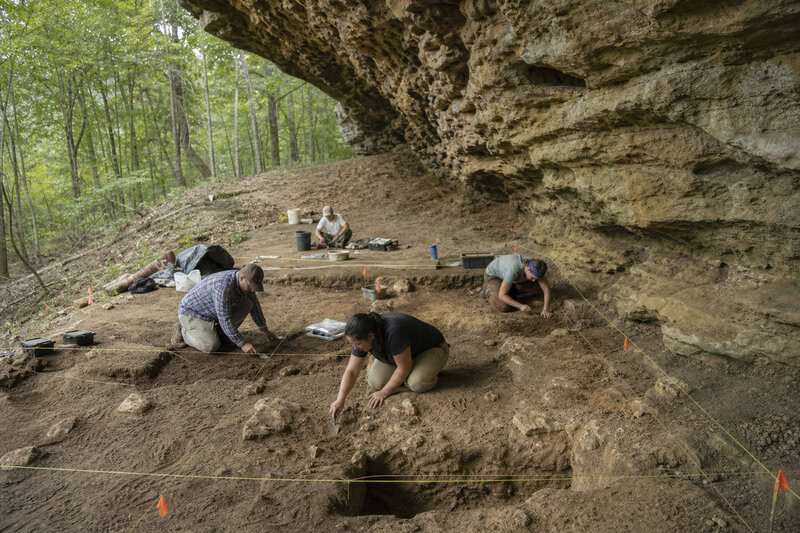
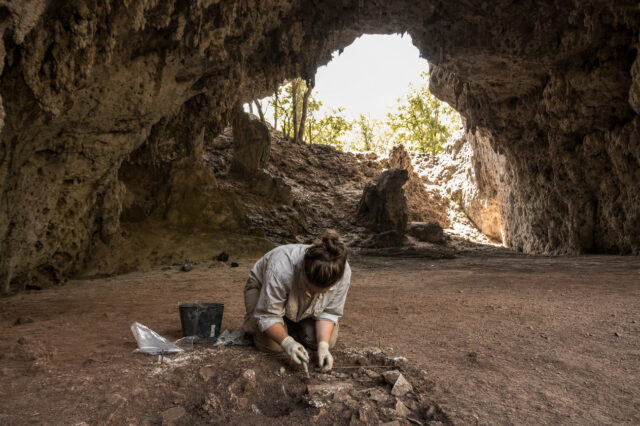
Eastern Tennessee’s ridge-and-valley terrain has produced some of the most unexpected findings in recent Appalachian archaeology. Rockshelter sites tucked into limestone outcroppings offer a preservation environment rare in the Southeast: cool, dry, and sheltered enough that organic materials — cordage, wooden tools, plant remains — survive conditions that would destroy them completely in open-air sites. These are places where the past is not just present in stone and ceramic but in fiber, wood, and seed.
LiDAR data from the Cumberland Plateau has added another layer of complexity, revealing what appear to be stone enclosure walls running along ridge crests — features that do not fit neatly into any established site typology and are now queued for the ground-truthing fieldwork required to understand them. Some of the most significant archaeological features in Tennessee have been visible from aircraft for years and simply awaited the right kind of attention.
The mountains also complicate a persistent assumption: that Indigenous peoples avoided high-elevation terrain except for seasonal hunting forays. Accumulating evidence points toward year-round occupation of Appalachian uplands across multiple periods, reshaping models of how people organized their lives across this landscape. These are findings too granular for a newspaper story and too significant to remain locked in a contract report — precisely the kind of work that Tennessee Archaeology (New Series) is built to carry into the public record.
Open Access and the Politics of Who Gets to Know
One of the most consequential decisions embedded in the journal’s design is accessibility. State-published and peer-reviewed, the journal will be available without a subscription paywall — a detail that matters enormously in a field where the people most affected by archaeological findings are rarely affiliated with research universities. A Cherokee community member in Oklahoma researching ancestral Tennessee landscapes should not need an institutional login to read a site report funded by Tennessee taxpayers. A high school teacher in Cookeville building a unit on the Mississippian period should not encounter a forty-dollar access fee when searching for primary scholarship.
Moore’s position as a state employee rather than a university researcher shapes this commitment. His mandate is explicitly public: the Division of Archaeology exists to serve Tennessee’s citizens, not to optimize for citation metrics in a departmental review. The journal reflects that orientation — it is infrastructure for a preservation mission, not a credential for an academic career. There is also a practical dimension that any state archaeologist understands: open-access publication makes it considerably harder for archaeological knowledge to be dismissed as the private concern of an institutional elite, which matters when the Division’s budget faces scrutiny in a legislative session.
The November 20, 2026 launch arrives within a broader national moment of renewed attention to cultural heritage digitization — a moment when questions about who controls historical narratives, and who benefits from their preservation, have become openly contested. Tennessee’s answer, embedded in the journal’s design, is at least structurally clear: the knowledge belongs to everyone.
What Gets Rewritten — and What Comes Next
A state archaeologist’s career is measured not only in discoveries made but in discoveries preserved — in whether the knowledge his generation excavated survives to be questioned, refined, and expanded by researchers not yet born. The findings Moore’s office oversees today will be most valuable not when they are first published but when a researcher years from now, armed with better isotope dating technology or a sharper theoretical framework, returns to a 2026 excavation report and sees something the original team could not quite name.
That is what Tennessee Archaeology (New Series) ultimately is: not an ending but an infrastructure. A platform that makes future revision possible. A commitment that the work done in these years will not dissolve back into the filing cabinet from which it came. The journal’s breadth — covering excavations, geospatial analysis, experimental archaeology, and museum studies — reflects an understanding that archaeological knowledge is not a single data type but an ecosystem of evidence, each strand capable of illuminating the others in ways no one can fully anticipate in advance.
What the journal ultimately promises is a richer, more accurate account of the Tennessee past — one in which 13,000 years of human ingenuity, adaptation, and loss are treated as the main event rather than a footnote to a story that only begins when the first Europeans push through a mountain gap. The colonial and antebellum eras belong in that story, but they belong in proportion.
And somewhere beneath a parking lot, a highway shoulder, a soybean field — a hearth waits in the dark, as it has for a thousand years or more. The soil remembers everything. With a little luck, and a peer-reviewed journal with no subscription fee, so might we.