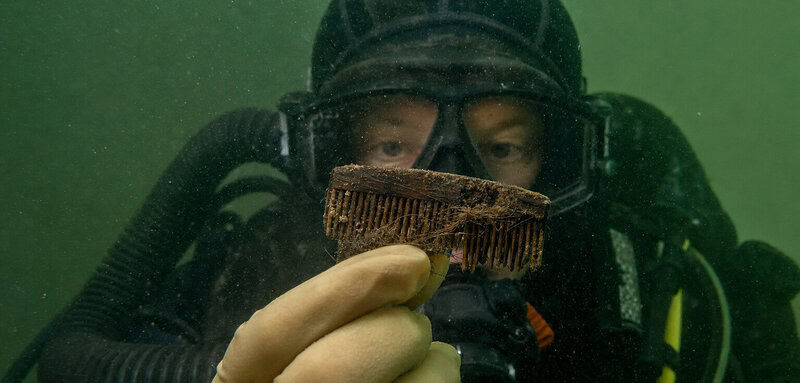
She could barely see her own hand in front of her face, but Margaret Rule’s fingers knew what they had found before her mind caught up — a small wooden comb, still threaded with the hair of a Tudor sailor who had drowned in the Solent more than four centuries before she touched it.
Before the Divers, There Was Only Rumour
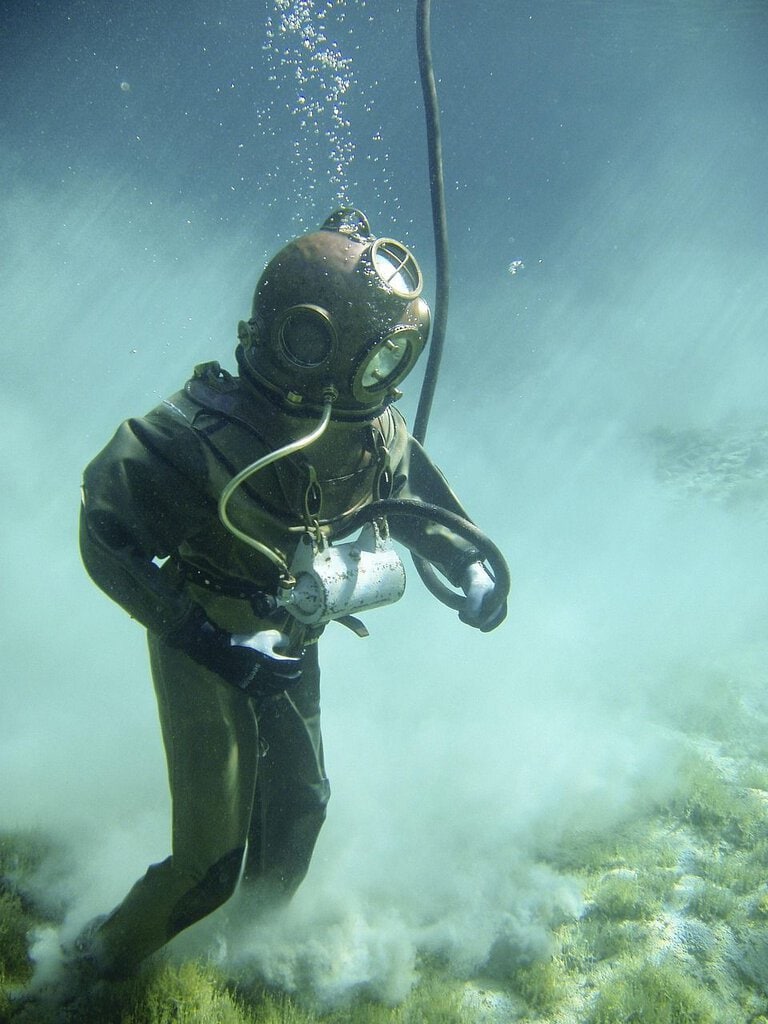
In the 1960s and early 1970s, what passed for underwater archaeology in Britain was, to put it charitably, enthusiastic. Wrecks were located, descended upon, and stripped — bronze guns hauled up for garden ornaments, ceramic cargo scattered across harbour floors, centuries of layered context dissolved in an afternoon of excited fin-kicking. The objects surfaced. The stories they carried did not.
The discipline needed a law before it could become a discipline. The Protection of Wrecks Act 1973 gave scheduled status to sites of genuine historical importance, drawing a legal line between salvage and scholarship. It was an imperfect instrument — blunt where the archaeology demanded nuance — but it created the framework within which a new generation of practitioners could work with rigour rather than racing amateur salvors to the best finds. Margaret Rule was among those who seized that framework and built something inside it.
The early years were improvisational by necessity. Specialist training barely existed. Recording methods were invented on the fly, adapted from land archaeology and tried against conditions that land archaeology had never imagined. Rule later described sketching hull timbers on plastic slates in currents strong enough to rip a notebook away — a detail that neatly captures the gap between the discipline’s ambitions and its early working conditions. That those records survived, and that their cross-referenced entries by object, layer, and date would eventually set recording standards exported to projects across Europe, says something about the people doing the work in conditions the textbooks hadn’t yet been written to describe.
The Mary Rose and the Making of a Discipline
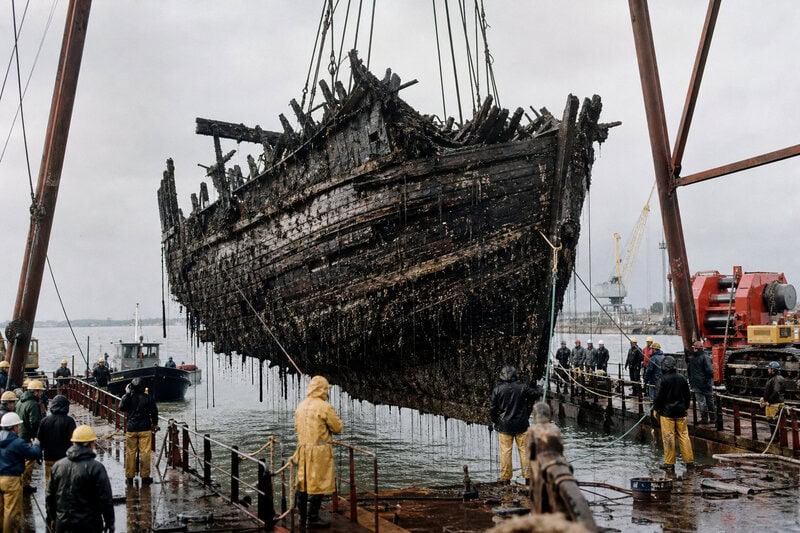
If there is a single moment when British underwater archaeology crystallised into something the public could feel, it was the morning of 11 October 1982, when Henry VIII’s warship Mary Rose was lifted from the Solent seabed and carried — dripping, extraordinary, improbable — through television screens into an estimated sixty million homes worldwide. Margaret Rule, by then director of the Mary Rose Trust, had spent years preparing for a spectacle she had always insisted was secondary to the science. The spectacle came anyway, and it brought the science with it.
The ship had sunk in 1545, taking around five hundred men with her during a skirmish with a French fleet. The Solent’s cold, low-oxygen, silted conditions had done what no museum curator could: they had preserved the organic material that normally vanishes from the archaeological record within decades of deposition. The excavation yielded more than 19,000 artefacts. Among them were longbows still holding something close to their Tudor draw-weight — a fact that rewrote assumptions about English archery. A barber-surgeon’s chest contained syringes and a wooden mallet used for field amputation, a quietly devastating inventory of sixteenth-century military medicine. And there was the comb.
The wooden comb Rule recovered, still threaded with its owner’s hair, became shorthand among maritime archaeologists for why the work mattered — not because it was the rarest find or the most historically significant, but because it was the most human. It stopped seasoned professionals cold in a way that gun carriages and navigation instruments, however important, simply did not. Rule understood that instinctively, and it shaped the story-first ethic she championed for the rest of her career: the object tells you what happened; the person tells you why it matters.
Her meticulous site notebooks from the Mary Rose excavation became templates. Teams from Britain carried those recording protocols to projects across the continent, and what had begun as improvisation on plastic slates in murky water gradually became a methodology rigorous enough to satisfy academic scrutiny and vivid enough to hold public attention simultaneously. Not many disciplines manage both. The live broadcast helped.
Drowned Landscapes: The Bronze Age World Beneath the Waves

Ships, it turns out, are not the strangest things the British seabed has been keeping. Some of the most startling maritime archaeology discoveries of the past two decades have had nothing to do with vessels at all. They are landscapes — submerged forests still standing in coastal shallows, field systems legible in sonar scans, wooden platforms constructed by people who had no idea that the land they stood on would, a few thousand years later, be forty feet underwater.
When sea levels rose after the last Ice Age, they did not rise evenly or announce themselves. They crept across low-lying plains and estuary margins, drowning settlements, hunting grounds, and agricultural land that communities had occupied for generations. The result, preserved in cold anaerobic sediment, is a record of prehistoric Britain that the land surface cannot offer — because the land surface has been ploughed, built upon, and eroded for millennia, while the seabed simply accumulated mud on top of whatever was already there.
Submerged prehistoric finds have shifted from occasional curiosity to a systematic field of study. The Bouldnor Cliff site off the Isle of Wight has produced worked timber and evidence of wheat cultivation dating to around 6,000 BCE — placing organised human activity in a landscape that was already ancient when the water claimed it. These sites demand skills that wreck archaeology alone cannot supply: archaeologists must read peat stratigraphy and pollen cores, blend marine geophysics with Neolithic landscape interpretation, and work in conditions where a trowel stroke too many can destroy evidence that survived six thousand years of submersion.
The discipline, in other words, has outgrown its origins. What began as the cataloguing of historic shipwrecks has expanded into something closer to a biography of the seascape itself — asking not just what sank here, but what was here before the sea arrived.
Medieval Ports, Wool Bales, and the Trade That Built England
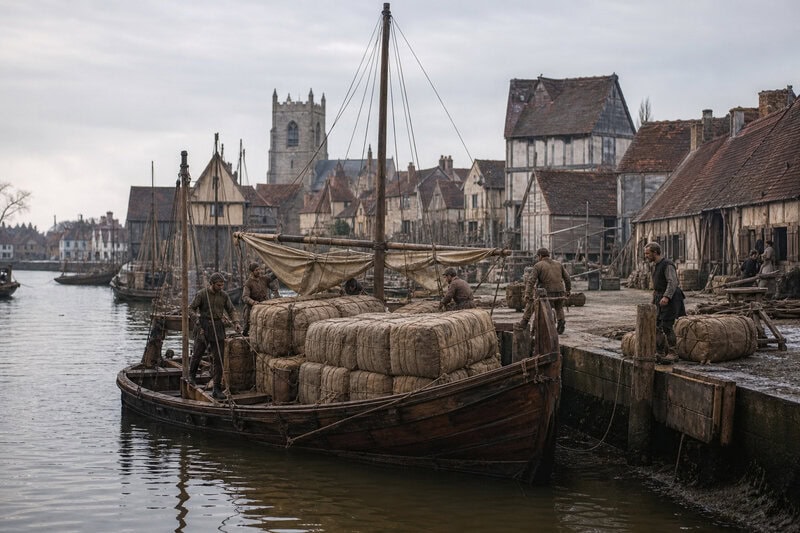
Between the drowned Bronze Age and the Tudor warships lies a medieval seabed that is only now giving up its accounts. Survey work in the estuaries of the Humber, Thames, and Solent has begun to map the underwater footprint of medieval commerce: collapsed quays, waterlogged warehouse timbers, cargo assemblages that complicate — and in some cases flatly contradict — what the written record suggests about trade volumes in the thirteenth and fourteenth centuries.
One recurring and gloriously unglamorous find type is the ceramic bung used to seal wine barrels shipped from Bordeaux. Small, utilitarian, the kind of object nobody would ever have thought to record in a ledger, these stoppers have been turning up in channel sites with a frequency that implies regular crossings considerably busier than the documentary sources account for. Archaeology has a habit of finding the transactions that nobody thought worth writing down.
Historic England’s National Record of the Historic Environment now lists over 46,000 maritime entries, the majority added in the last thirty years as systematic sonar survey replaced opportunistic diving. The sheer scale of that catalogue is itself a measure of how far the field has travelled since the chaotic early 1970s, when a handful of practitioners were essentially making it up as they went — productively, brilliantly, but making it up nonetheless.
Some of these medieval harbour finds have an immediacy that the prehistoric sites, extraordinary as they are, cannot quite match. At Winchelsea on the Sussex coast, a drowned quay lies directly beneath a town whose residents can still read the street plan of the medieval port the sea reclaimed. The archaeology is not abstract here. It is under the car park.
The Exhibition Itself: Fifty Years in a Single Room
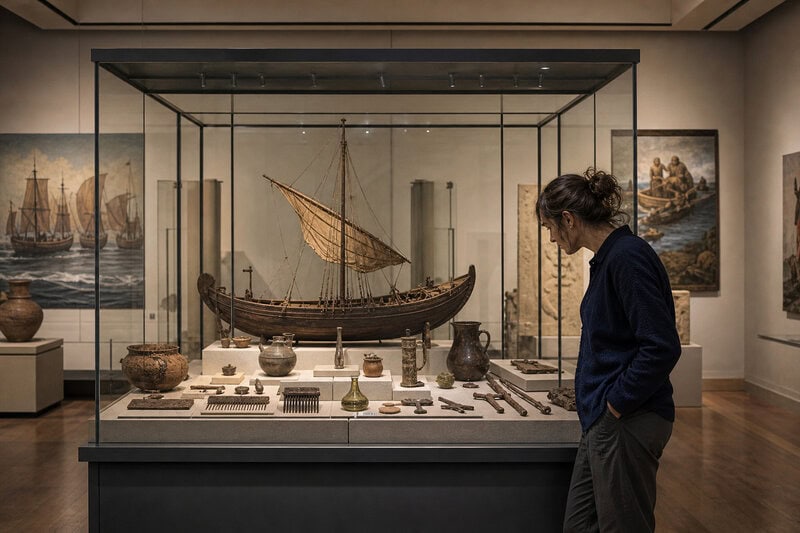
The exhibition marking this half-century brings together objects, survey data, and personal testimony to make a coherent argument about what the discipline has become. The case it puts is this: British maritime archaeology has moved from rescue-and-recover — diving on threatened sites, lifting what could be lifted, hoping the records were good enough — to something closer to landscape biography, reading whole seascapes rather than individual wrecks.
Margaret Rule’s original site drawings from the Mary Rose excavation are displayed alongside drone-rendered photogrammetry models of contemporary wrecks. The contrast is worth pausing over: the hand-drawn hull sections on plastic-slate copies, precise and hard-won and faintly heroic, set against the seamless three-dimensional render generated by algorithms processing thousands of overlapping photographs. Fifty years of technological change made viscerally legible in a single wall.
Curators have structured the show around five thematic sections — prehistoric, Roman, medieval, post-medieval, and industrial — rather than a straight chronology, allowing visitors to follow threads of trade, warfare, and migration across periods rather than marching obediently through time. It is a sensible choice that reflects how the archaeology actually works: a Roman amphora and a Victorian coal barge can tell connected stories about the same estuary, and chronological siloes obscure more than they reveal.
A deliberate interpretive principle runs through every panel: each wreck is introduced through a person before the object evidence is presented. A named sailor. A merchant. A ship’s cook whose pottery survived when his name did not. It is the story-first ethic that Rule championed throughout her career, applied now to a discipline that has accumulated enough evidence to tell those stories with something approaching confidence.
The anniversary also invites reflection on how underwater archaeology has developed internationally. A special exhibition celebrating fifty years of Korean underwater archaeology at the National Research Institute of Maritime Cultural Heritage offers a striking parallel — there, the focus falls on artefacts recovered from ships that sank off the coasts of Taean-gun, with everyday objects illuminating the trade routes that connected Korea to China and Japan. Different seas, different centuries, the same fundamental revelation: that what sank is often better preserved than what survived on land. The Korean underwater archaeology exhibition demonstrates that this is a discipline coming of age on multiple continents simultaneously, each national tradition enriching a shared methodology.
What the Next Fifty Years Must Reckon With

The discipline that Margaret Rule helped forge is under pressure from a direction nobody fully anticipated when the Protection of Wrecks Act was drafted in 1973. Climate change is simultaneously the field’s greatest threat and, grimly, its greatest research accelerant. Coastal erosion is exposing and destroying sites faster than teams can record them. Warming seas are beginning to compromise the cold, low-oxygen conditions that preserved organic material — hair, wood, leather, rope — for centuries. The same seabed that kept a Tudor comb intact for four hundred years cannot be assumed to keep it intact for another hundred.
The legal framework has not kept pace. The Protection of Wrecks Act, essentially unchanged in its fundamentals since 1973, was designed for a world in which the underwater heritage record was understood to be sparse and exceptional. It is now known to be vast and systematic — tens of thousands of sites, many of them unscheduled and legally vulnerable. The gap between what the law protects and what the archaeology has revealed is one the exhibition does not flinch from acknowledging.
Against that, there is genuine cause for optimism in an unexpected quarter. Networks of sport divers, trained in basic recording protocols, have become important data sources — logging wrecks, flagging disturbance, contributing photographic surveys that professional teams could not resource alone. The democratisation of diving technology has democratised the archaeology to a degree that would have been unimaginable to Rule’s generation, working with improvised slates in zero visibility. The tension between access and protection remains real, but the citizen-science contribution is now too substantial to dismiss.
Rule died in 2023, having watched the discipline she helped build grow from a legal framework and a handful of determined practitioners into a mature field capable of rewriting national history. She had spent forty years arguing that the seabed was not a dumping ground or a treasure chest but a repository — patient, indifferent to human timescales, holding things in trust that the land surface had long since lost. The exhibition that marks fifty years of the work she helped define is, in the end, an answer to the question she always said mattered most: not what did we find, but what are we going to do about keeping it.
The mud gave something back. The question the next fifty years will answer is whether we were serious enough to deserve it.