It is smaller than a fingernail clipping, yellowish, hardened to the consistency of old stone — and inside it, invisible to any naked eye that ever lived, is the record of a meal eaten thousands of years ago in what is now southern Portugal. The person who ate that meal left no name, no written word, no monument with their face carved into it. What they left, pressed into the calcified plaque along their gumline, was milk.
The Teeth Don’t Lie: A Discovery Buried in Ancient Plaque
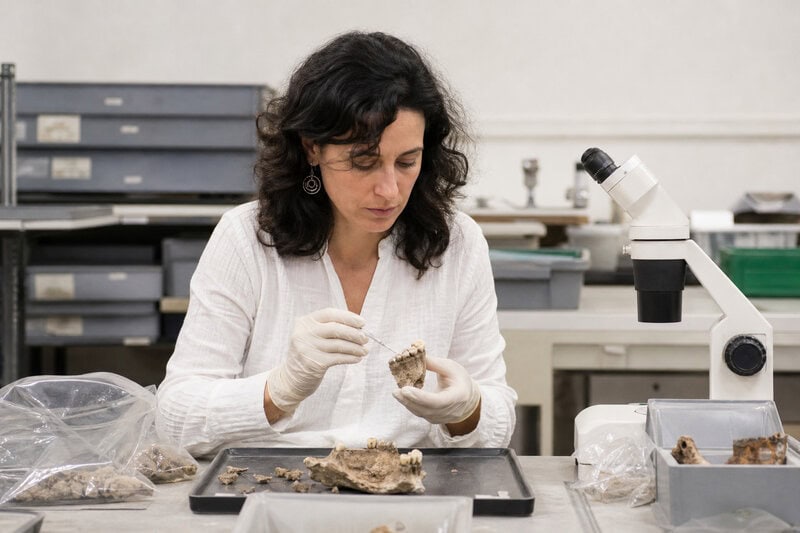
Adriana Carolina Carvalho Ferreira Malheiro Leite works with dental calculus — which is to say, she works with the prehistoric world’s most unlikely diary. When saliva minerals harden over soft plaque, they create a natural time capsule, trapping food proteins, plant microfossils, lipids, and in some extraordinary cases, ancient DNA in a matrix tough enough to outlast the civilisations that formed it. For a researcher trying to reconstruct what people actually ate before writing existed, this is not a footnote. It is the entire archive.
Her project, formally titled “HIDDEN MILK — Uncovering Dairy Consumption in Recent Prehistoric Southern Portuguese Communities via Ancient Human Dental Calculus,” rests on a premise that is deceptively simple and genuinely provocative: that the communities of prehistoric southern Iberia were consuming dairy products far earlier than conventional timelines have suggested. The evidence is not a decorated vessel, not a wall painting, not a text. It is locked in the calcified plaque of people who had no idea they were leaving any evidence at all.
Before the Farmers: A World Without the Dairy Animal
For the vast majority of human prehistory, milk was not a food for adults. It belonged to infants and to the animals that produced it. Hunter-gatherers across Europe and the Iberian Peninsula moved with the seasons, reading landscapes rather than remaking them, eating what the land offered without managed herds or dedicated dairy animals.
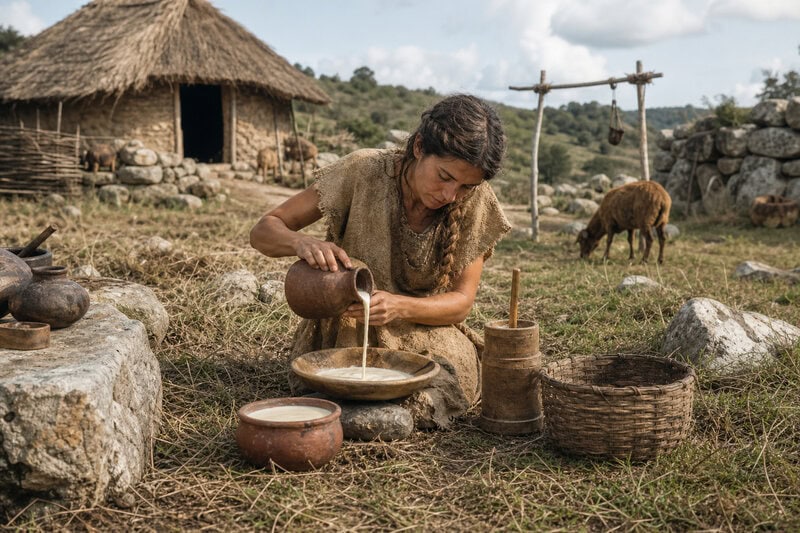
Then the Neolithic arrived, and with it a pivot so consequential that its reverberations are still felt in the diets of every person alive today. Humans began domesticating ruminants — cattle, sheep, goats — and with that domestication came something genuinely new: a calorie-dense, year-round food source drawn from another species. The changeover from hunting and gathering to agropastoralism is recognised as one of the most significant transitions in human history, and understanding precisely when and how milk entered southern Iberian diets is exactly the gap that Leite’s research is designed to close.
The odd, quietly astonishing thing is that this shift happened at all, given the biological obstacle that stood squarely in its path.
The Lactose Paradox: Drinking Milk Before the Body Was Ready
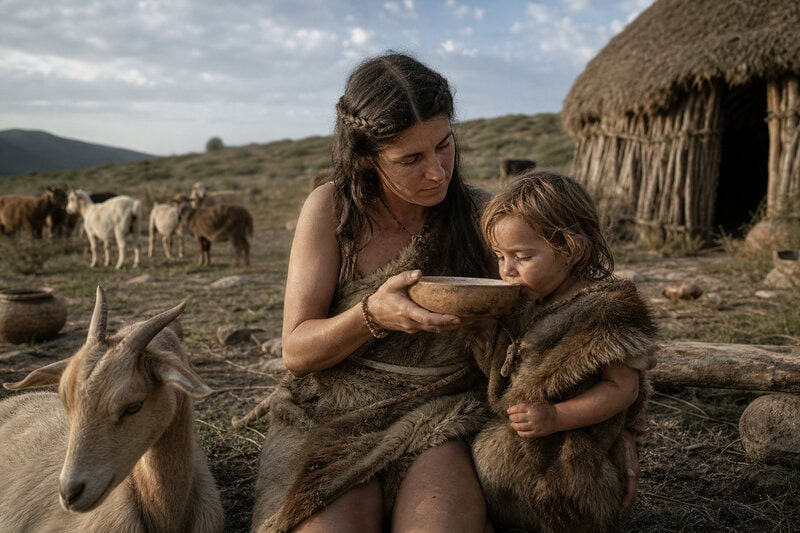
Here is the puzzle that sits at the heart of research into prehistoric dairy consumption in Portugal and across Neolithic Europe: the genetic mutation that allows adults to digest lactose — the primary sugar in milk — spread through European populations only gradually, over centuries and millennia. Many prehistoric individuals simply did not carry it. By the strict logic of biology, they should not have been drinking milk at all.
Yet biomolecular and archaeological evidence from sites across Neolithic Europe increasingly tells a different story. Prehistoric people were processing and consuming dairy products well before lactase persistence became anything like widespread in their populations. The resolution to this apparent contradiction is bacterial. Fermented dairy products — cheese, yoghurt, kefir-like preparations — have much of their lactose broken down by microbial action before they ever reach a human stomach, making them digestible even by individuals who would struggle acutely with fresh milk straight from the animal.
This distinction — fresh milk versus transformed milk — is not a minor footnote. It is one of the central questions that Leite’s project is designed to answer. The goal is not simply to confirm that dairy was present in prehistoric southern Iberia, but to determine in what form it arrived: a question that could reshape our understanding of how early farming communities adapted a revolutionary new food to bodies not yet fully evolved to handle it. As the collaboration framing the project puts it, the domestication of dairy ruminants in the Neolithic provided a novel food source, milk, that once transformed revolutionised human diets.
The Perdigões Complex: Reading Ruins at the Edge of a Lost World
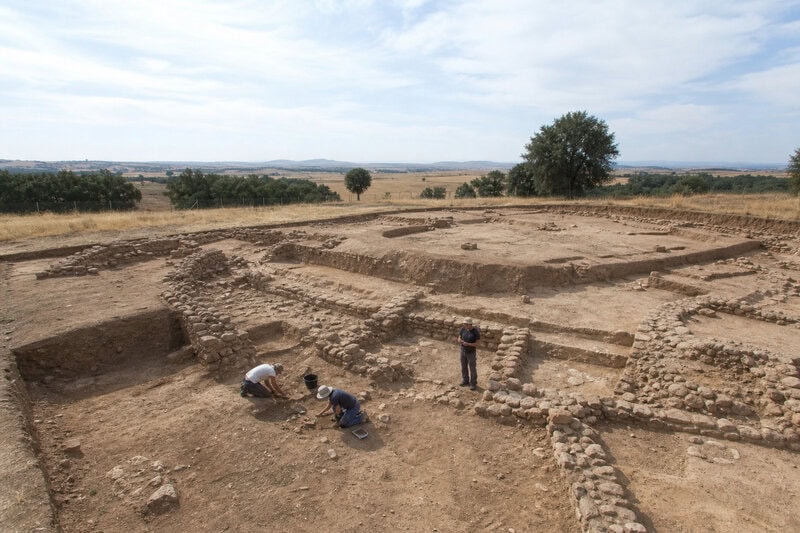
The fieldwork is anchored at the Perdigões Archaeological Complex in the Alentejo region of southern Portugal — a vast, multi-phase prehistoric enclosure site whose concentric ditched circuits and collective burial practices point to a community life of surprising sophistication. Perdigões was occupied across several prehistoric periods, which makes it an extraordinary layered archive of human behaviour, and it is one of the three collaborating institutions on Leite’s project alongside ICArEHB and FCT.
The human remains recovered from Perdigões — skeletal material from collective tombs, teeth that last bit into food several thousand years ago — carry in their calculus a frozen record that burial goods and architectural remains simply cannot provide. A decorated pot might suggest a feast. A cattle bone might suggest herding. But dental calculus, examined under the right biomolecular lens, can tell you what a specific human being actually swallowed. That specificity is what makes the methodology so powerful, and so comparatively new to the field.
For Leite, working within this three-way collaboration means her molecular findings can be cross-referenced against the full archaeological context of the site: the animals kept, the vessels made, the social structures implied by the way the dead were arranged together in collective burial. The tooth does not exist in isolation. It existed in a mouth, in a person, in a community whose wider life is slowly becoming legible.
Scraping the Past: How Ancient Dental Calculus Becomes Evidence
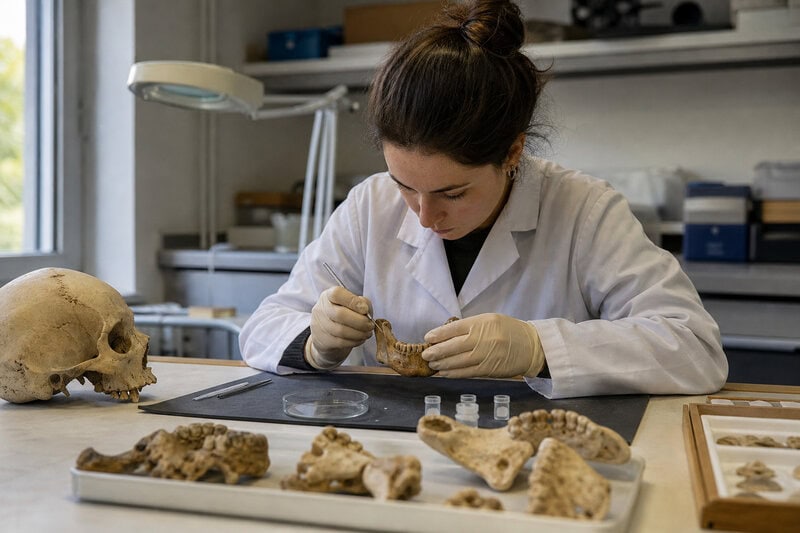
The methodology is painstaking in ways that reward attention. Dental calculus forms through a process both mundane and fortuitous: saliva minerals harden over soft plaque, trapping organic material — food proteins, lipids, plant microfossils — in a mineral matrix that can survive millennia with its molecular contents largely intact. What was once a dental hygiene problem is now, for bioarchaeologists, a primary source.
Leite carefully samples this calculus from prehistoric human teeth and subjects it to biomolecular analysis techniques capable of identifying dairy-specific proteins — most critically, milk proteins that remain detectable even after thousands of years in the ground. The laboratory protocols required are stringent: contamination from modern handling can corrupt results entirely, and the sample sizes involved are small enough that a careless moment cannot be undone.
What the approach achieves, at its best, is a bypass of the ambiguity that haunts almost every other form of prehistoric dietary evidence. Pottery sherds can indicate what a vessel was used for, but not by whom, or whether the contents were consumed or discarded. Animal bones can suggest herding, but not drinking. Dental calculus goes straight to the human body itself as the site of consumption — it is, in the most literal sense, the evidence of an act.
Rewriting the Map: Why Southern Iberia Changes the Whole Story
Most of what scholars currently know about the spread of dairy consumption across prehistoric Europe comes from northern and central sites — the Neolithic of Britain, the Linear Pottery Culture of central Europe, farming communities in Scandinavia and the Alpine foothills. The southwestern Iberian Peninsula has long been a persistent blank on this map, its prehistoric diet a matter of inference rather than molecular fact.
If Leite’s analysis of Perdigões dental calculus confirms dairy consumption in prehistoric southern Portugal, it would push the evidence for ancient milk use in Iberia back significantly and fill a geographical gap that has quietly distorted the continental picture. The findings would also carry implications for how researchers model the spread of agropastoralism itself. Southern Iberia was not a passive recipient of farming practices filtering down from elsewhere; evidence of early, locally adapted dairy use would reinforce its status as an active, innovative zone in its own right — a place where people solved the problem of feeding themselves with considerable ingenuity, one fermented mouthful at a time.
The research is funded by the Archaeological Institute of America’s Archaeology of Portugal Fellowship — a grant that recognises the particular importance of Iberian prehistory to the broader European story, and that funds the kind of specialist biomolecular work that standard excavation budgets rarely stretch to cover. As an ICArEHB PhD candidate, Leite sits within a research environment that has made the Algarve and Alentejo regions central to the global conversation about prehistoric diet, mobility, and social organisation. The fellowship supports the sustained, patient commitment that this kind of research demands — months of careful sampling, stringent laboratory work, and the slow accumulation of molecular evidence from material most people would mistake for dirt.
Four Questions, One Biography of a Food
The project’s ambitions are explicitly framed around four linked questions: the origins of dairy use in the region, how it spread between communities, the extent to which it was integrated into everyday life, and the social or nutritional role it played. Together, these questions amount to a full biography of a food — from the moment a Neolithic farmer first transformed milk from an animal into something another human being could safely eat, to the moment that habit became, quietly and without anyone recording it, a cornerstone of a diet.
They are also questions with direct relevance beyond academic prehistory. Understanding how early populations adapted to dairy consumption — which products they developed, how fermentation reduced the lactose barrier, how the practice spread geographically — contributes to the longer history of lactase persistence and human digestive evolution that researchers in genetics, nutrition, and evolutionary biology continue to investigate today. The calculus scraped from a prehistoric tooth in Alentejo is, in that sense, connected to questions still very much alive in modern science.
Adriana Carolina Carvalho Ferreira Malheiro Leite works at the junction of all those questions, with a scraper, a microscope, and a tooth. The person whose plaque she is reading never suspected they were making history. They were, in all probability, just hungry. But inside the calcified record of their hunger — preserved by the same biological process that any dentist in the world would advise you to brush away — is evidence that may push the story of prehistoric dairy consumption in Portugal, and of lactose tolerance history more broadly, further back into human time than anyone previously thought to look.
It is, by any measure, an extraordinary thing to find at the edge of a tooth.