
The Evolution of the Viking Sword
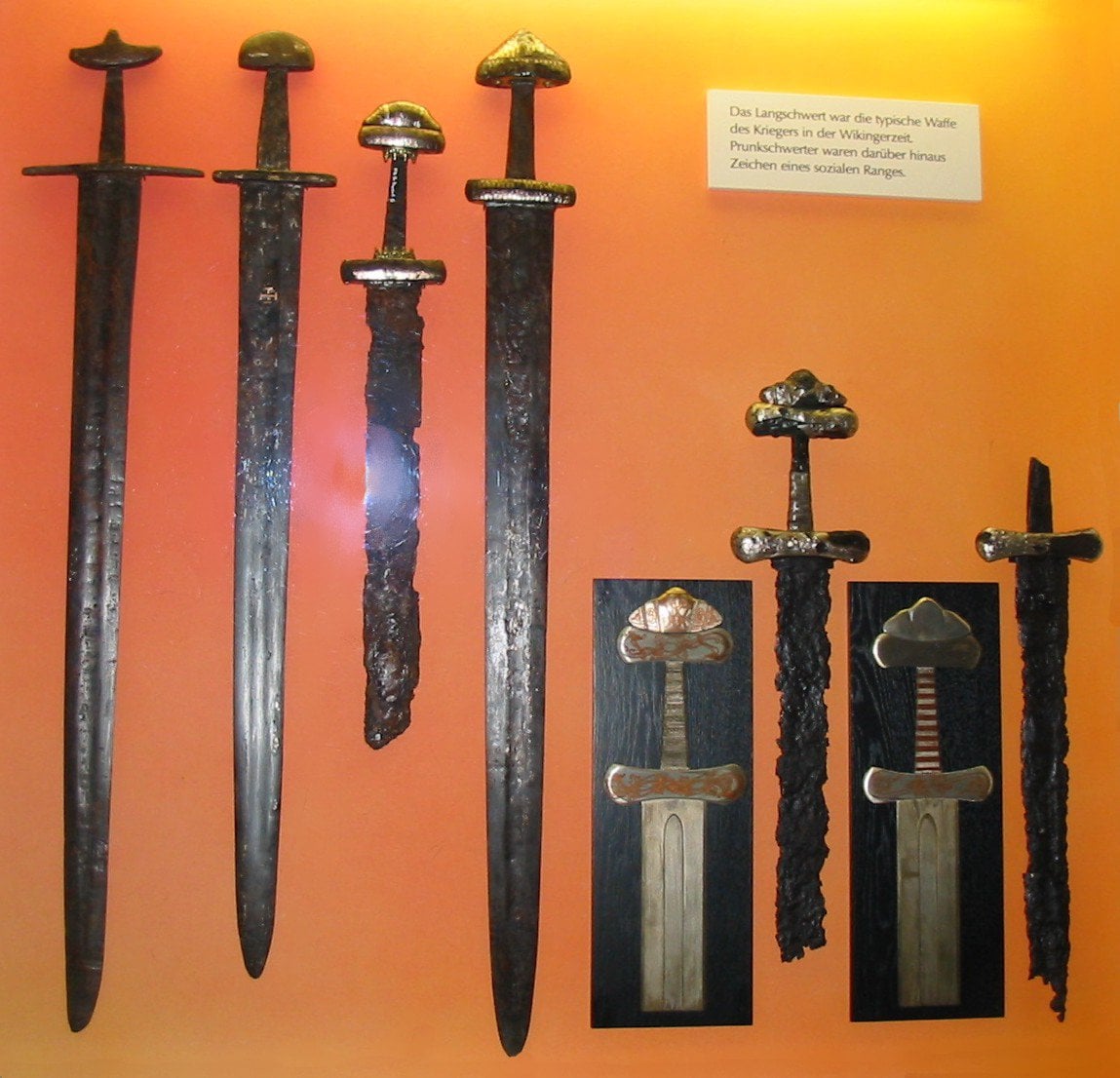
Viking swords first emerged in the eighth century. They evolved from the Merovignian sword, which in turn had evolved from the Roman spatha, and were prevalent in Northern and Western Europe in the early Middle Ages. Early versions were made via pattern welding, in which iron bars of soft and hard qualities, for flexibility and strength respectively, were combined, and heated to weld them together. They were then twisted and drawn out in a thin strip that eventually became the blade.
Later, pattern welding was abandoned after advances in metallurgy produced quality iron that could be smelted into good steel for sword blades. In use, the Viking sword was wielded one-handed, although some historic texts mention two-handed use. However, the space on the sword’s handle between hilt and pommel, while commodious for a single handed grip, is too small to be gripped by two hands. Some speculate that the texts might have meant not two hands on the handle. Instead, it might have meant one hand gripped the sword, while the other cupped the wrist of the sword hand to deliver blows with significantly more power.


