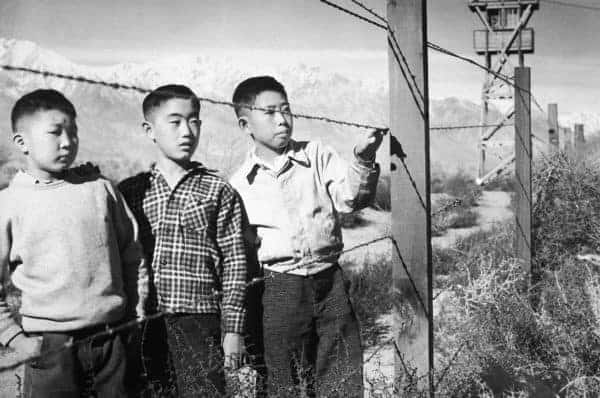

The Supreme Court Found the Internment Camps to be Constitutional
Today it is easy to look back and know that Japanese internment was wrong. That there was no reason to deprive more than 100,000 American citizens of their liberty for no other reason than their heritage. Most them had very little in common with the enemy that the United States was fighting and felt just as attacked as the rest of America when Pearl Harbor was bombed.
On February 19, 1942, President Roosevelt issued Executive Order 9066 which provided for the creation of military areas from which any or all American citizens might be excluded. Proclamations followed that created military areas out of much of the West Coast. Once the military areas were created it was deemed that any Japanese, German or Italian aliens or any one of Japanese descent be excluded. Civilian Restrictive Order No. 1 would be issued on May 19, 1942 and it forced Japanese Americans into relocation camps.
Fred Korematsu refused to leave the military area and even got plastic surgery in order to avoid being sent to an internment camp. He was eventually arrested and convicted. However, he argued that Executive Order 9066 was unconstitutional and his case went all the way to the Supreme Court. The order was found to be constitutional in a 6 to 3 decision.
The court found that the need to protect the country from espionage outweighed the individual rights of Fred Korematsu and other Americans of Japanese descent. Korematsu’s conviction was eventually overturned but the Supreme Court ruling still stands. The case is now seen as so flawed that it is now used as an example of bad legal decision making and it is therefore not even considered to be precedent by most people.


