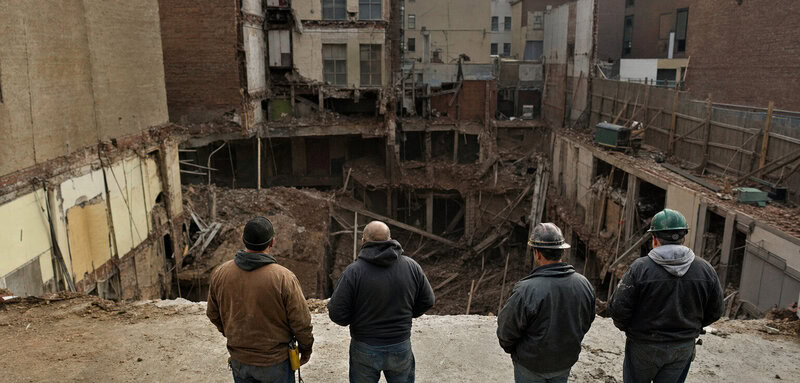
Hours before eight people died, a few workers stood at the edge of a hole in Brooklyn, filmed without knowing they were being filmed, beside a thin skim of concrete that engineers call a “rat slab” — a nickname that tells you, with brutal economy, exactly how much protection it was designed to offer.
The Last Morning: A Rat Slab and a Building on the Edge
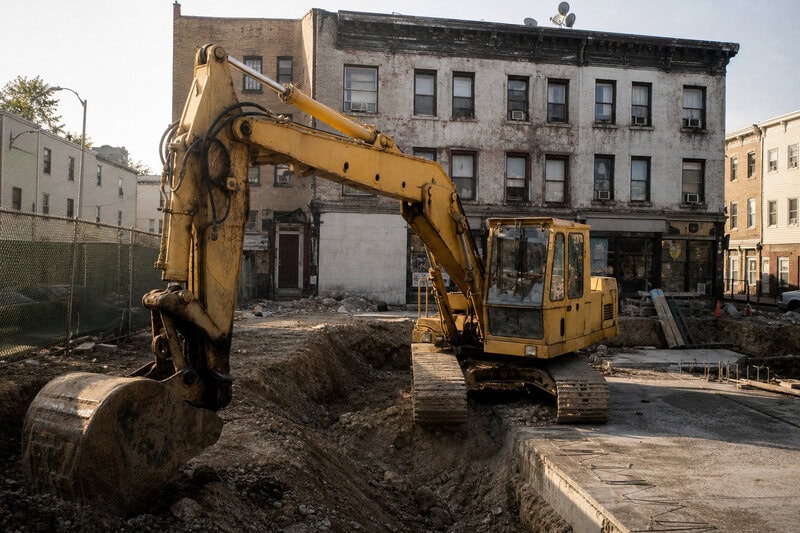
November 11 began like any other Wednesday on a New York construction site. Workers moved around the active dig that abutted a century-old, three-story mixed-use building on a Brooklyn block that had seen better decades. Someone pointed a camera at the excavation. The footage that resulted — showing workers standing beside a rat slab, that cosmetic pour of concrete covering an open dig, with dirt reportedly banked six feet high against the neighboring building’s unshored foundation wall — would become, within hours, the central exhibit in every investigation that followed.
By that afternoon, the three-story building had collapsed, killing eight people. The rat slab was gone with everything else. The workers who had stood beside it were gone too, into the ordinary chaos of a city that had not yet realized what it had just lost.
What the footage preserved — and what investigators would spend days reconstructing — was the specific, terrible geometry of the final morning: an unshored earthen wall, a century-old foundation already carrying the weight of years of neglect, and the precise point at which the earth decided it had been patient long enough.
How a Dig Next Door Becomes a Death Sentence
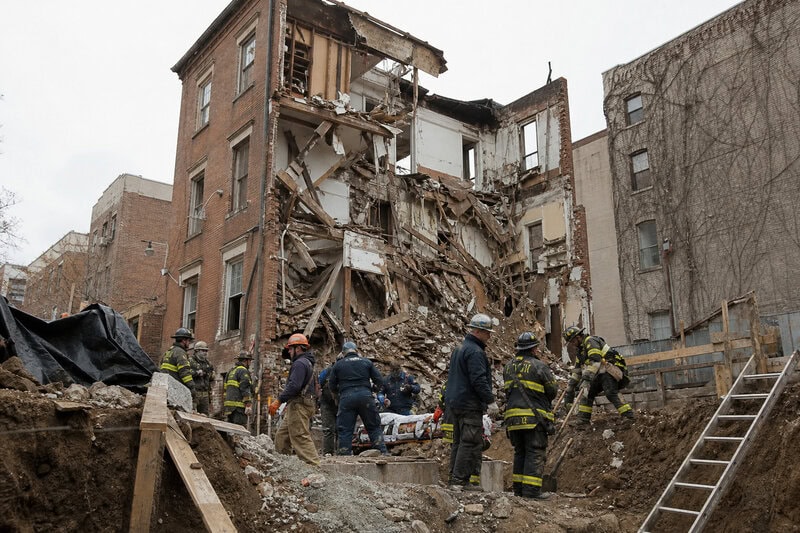
To understand what happened on November 11, it helps to understand what soil does when you remove the thing next to it. Geotechnical engineers describe a concept called the “zone of influence” — the radius within which any excavation reorganizes stress in the ground, silently, invisibly, and without regard for property lines. In dense urban neighborhoods built on old fill and older decisions, that zone routinely extends beneath buildings that were never consulted about the arrangement.
The dirt reportedly banked six feet high against the Brooklyn building’s foundation was not inert. It was a column of lateral pressure being transferred directly into masonry that had been designed, as all old masonry is designed, to handle weight from above — from floors, from roofs, from the vertical logic of gravity. Old brick walls have almost no tolerance for the sideways shove of disturbed earth. They are, structurally speaking, the worst possible neighbor for an unshored excavation.
Investigators concluded the building most likely fell because the adjacent excavation had progressively undermined its foundation — the soil that had held the structure upright for a hundred years silently redistributed under lateral pressure, millimeter by millimeter, until the threshold crossed in an instant. Structural engineers call this “passive failure.” The ground does not announce its intentions. It simply moves, and then it is finished moving, and what stood is rubble.
The video of the rat slab, captured the same morning the building fell, makes the failure sequence legible in a way that no post-collapse diagram can quite replicate: the hazard was visible, the coverage was inadequate, and the people tasked with managing the dig had eyes on the evidence before it became fatal. As one engineering analysis of the excavation site’s alleged lack of shoring at the portion that abutted the collapsed building put it, the question is not whether the signs were there — it is what anyone did about them.
What Shoring Does — and What Happens Without It
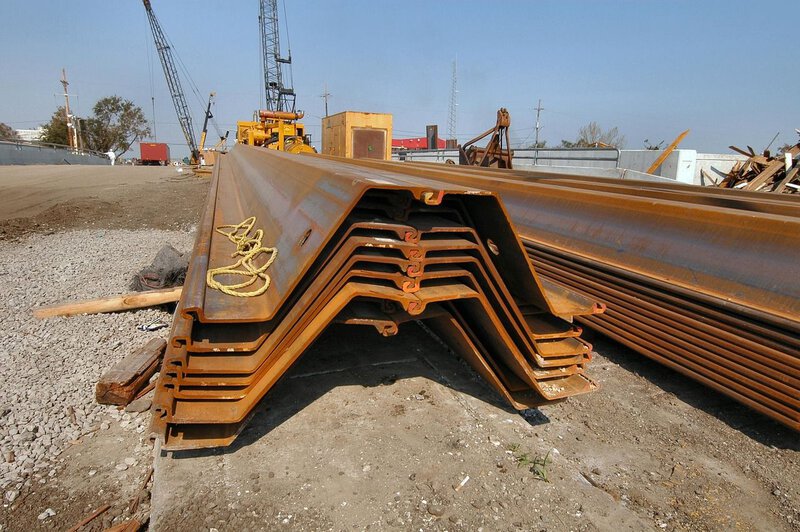
Shoring is not an optional refinement in urban excavation. It is the engineered substitute for the soil you have removed: steel sheet piles, timber lagging, or soldier beams driven into the ground before digging begins, creating a retaining wall that absorbs the lateral pressure the removed earth can no longer resist. When an excavation abuts an occupied structure, shoring is what stands between the dig and the building’s foundation. A rat slab — a thin, lightly reinforced concrete pour laid over an open excavation — serves an entirely different purpose. It reduces dust, it gives workers a surface to walk on, and it offers no meaningful resistance to the lateral earth pressure that shoring is designed to absorb. Calling a rat slab protective in a structural sense is a category error. The footage shot on the morning of November 11 showed the former where engineers and regulators require the latter.
New York City’s building code requires protection of adjacent structures during excavation, including underpinning or shoring when a dig extends below a neighboring building’s foundation level. The specific requirements are triggered by the depth of excavation relative to the adjacent footing — a calculation that must be performed and documented before work begins. Whether that calculation was performed, and what it concluded, is among the central questions now facing investigators and, in all likelihood, prosecutors.
Archaeology’s Mirror: When the Spade Destroys the Thing It Sought

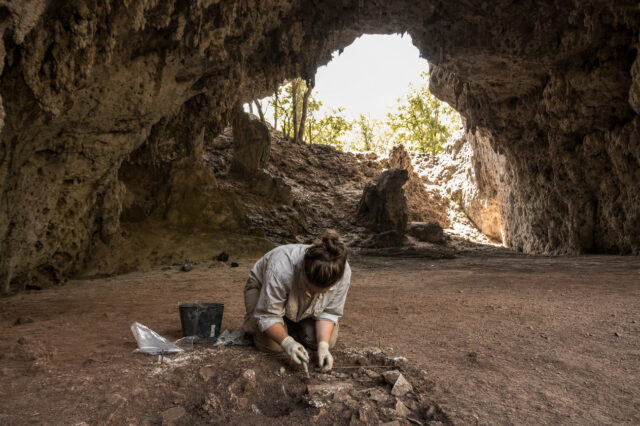
Brooklyn is not an isolated case. It is the urban, industrial cousin of a pattern that archaeologists and historians have catalogued with grief for more than a century: the excavation that destroys the very thing it was meant to uncover.
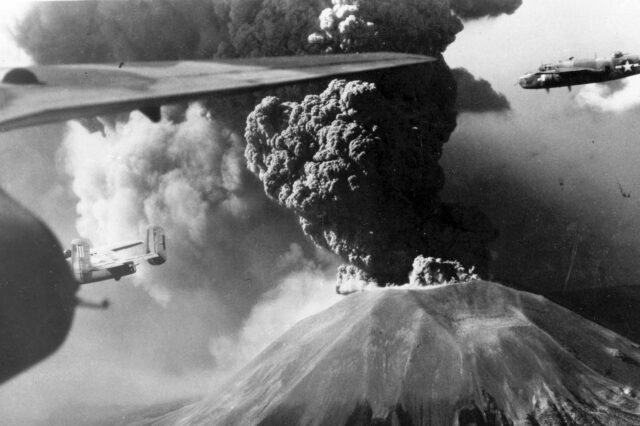
The most instructive parallel may be Pompeii, where 19th-century excavators arrived with the best intentions and the worst methodology. The compacted volcanic debris that had buried the city in 79 AD had, paradoxically, been holding its standing walls upright for nearly 1,700 years. When excavators removed that debris — quickly, to expose the spectacular — the walls lost their lateral support and began to fail. The rescue became the ruin. Pompeii had survived a volcanic eruption, Roman collapse, the medieval period, and the Renaissance. It did not survive the people who came to save it.
At medieval sites across northern Europe, the rush to expose lower Roman strata without adequate shoring has brought stone ceilings down onto Bronze Age floors, compressing millennia of carefully stratified history into a single catastrophic moment and a great deal of embarrassed correspondence between excavation directors. And then there is Heinrich Schliemann at Troy in the 1870s, who drove through seven distinct layers of civilization in his determination to reach the deepest, most heroic stratum — destroying, in the process, the very Troy he was searching for. His logic was the rat-slab logic: the cost of doing it correctly was, in his calculus, less important than the speed of doing it gloriously.
The through-line in every case is identical to Brooklyn: an unshored void, lateral pressure, and a structure that had survived everything except the people who came to protect it.
The Paper Trail: A Building Made Collapse-Ready Over Years

Long before the excavation began next door, the collapsed Brooklyn building carried a documented history of trouble. The building had a long history of citations for housing code violations, including ones for exposed wiring — the kind of detail that, in retrospect, reads less like bureaucratic routine and more like a countdown.
Consider what a housing inspector sees when they write a citation for exposed wiring in an aging mixed-use building: a symptom. Exposed wiring means deferred maintenance, which means deferred everything — pointing, waterproofing, foundation monitoring, the slow and unglamorous work that keeps a century-old structure from becoming a statistic. Each citation was a data point in what structural historians call a “vulnerability profile.” A building does not simply collapse. It is made collapse-ready, over years, by the accumulation of things nobody fixed.
Investigators argued that the excavation did not create the building’s weakness — it found it, exploited it, and accelerated a failure that the violation record suggests was already quietly in progress. That distinction matters enormously in legal terms, and it is precisely what makes cases involving pre-existing fragility and excavation damage so morally complex. The question is never only “who dug?” but “who knew what was already broken, and when did they know it?”
The inspector whose citation trail threads through the building’s final years could not have known, writing up exposed wiring on an ordinary Tuesday, that the notes would one day be read as a structural obituary. That is the particular horror of paper trails: they are always clearest in retrospect.
What Changes After a Collapse — and What Does Not
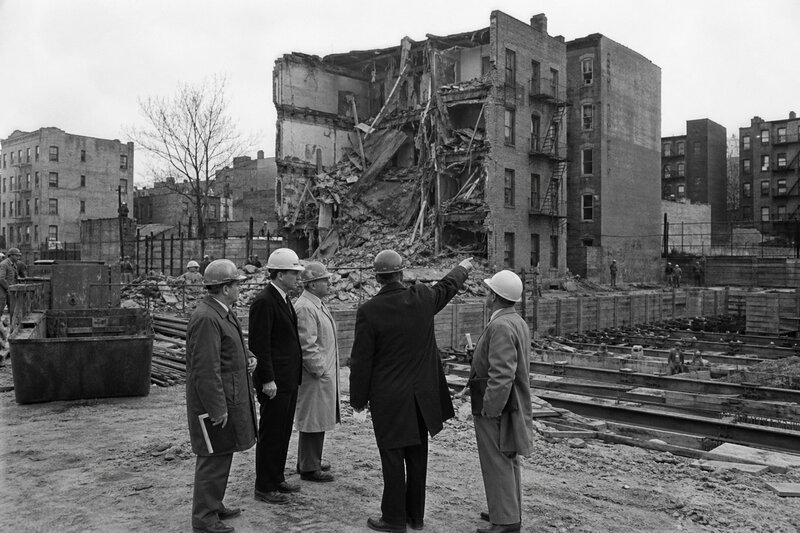
Post-collapse investigations in cases like this have historically produced a consistent cluster of recommendations: mandatory pre-excavation structural surveys of adjacent buildings, real-time ground-movement monitoring sensors tied to automatic work-stop triggers, and shoring requirements calibrated to proximity as well as depth. These are not novel proposals. They appear, with only minor variation in language, in the aftermath reports of excavation-related collapses in New York, Chicago, Boston, and a dozen other American cities over the past four decades.
The more uncomfortable finding, repeated just as consistently, is that implementation has been uneven — a word that, examined carefully, explains much of why the recommendations keep needing to be made. Uneven enforcement means that the contractor who shores properly and the contractor who lays a rat slab and hopes can compete for the same jobs at different cost structures. Until the gap between those cost structures is closed by regulation that is enforced rather than merely written, the economics favor speed over safety in ways that individual inspectors, however diligent, cannot correct on their own.
New York’s Department of Buildings has, in recent years, expanded its requirements for monitoring adjacent structures during excavation. Whether the Brooklyn site was subject to those requirements, and whether compliance was verified, is a question that the investigation will need to answer in public, with specificity, if the findings are to have any deterrent value.
What the Earth Remembers — and What We Keep Forgetting
There is a phrase geotechnical engineers use that deserves wider circulation: the earth remembers every void you open in it, and it will fill that void with whatever is nearest. In Brooklyn on November 11, what was nearest was a hundred-year-old foundation already compromised by decades of deferred maintenance, pressed against six feet of unshored earth with nowhere to go.
Visual evidence from the site, analyzed in detail, suggests the excavation directly compromised the building’s ability to stand. That framing — “suggests,” in the careful language of ongoing investigation — belies the starkness of what the footage actually shows: a rat slab, a six-foot earthen bank, no shoring, and a wall that would not survive the afternoon.
The eight deaths in Brooklyn joined a statistical category that rarely feels urgent until it is suddenly, catastrophically urgent: fatalities attributable to excavation-related structural failure in urban zones with pre-existing building vulnerability. The category is not new. The buildings that fall into it are not new. The footage of workers standing beside inadequate protection, hours before the collapse, is not new either — it is one more entry in a very old record of excavation gone wrong, stretching from Schliemann’s Troy to a Brooklyn Wednesday in November.
Until the full cost of doing it correctly — in archaeology, in urban construction, in any excavation that touches something old and irreplaceable — is treated as a non-negotiable line item rather than a negotiable one, the rat slab will keep appearing in the frame. And somewhere, an inspector will keep writing citations that nobody reads until it is too late to read them as anything other than a warning that went unheeded.