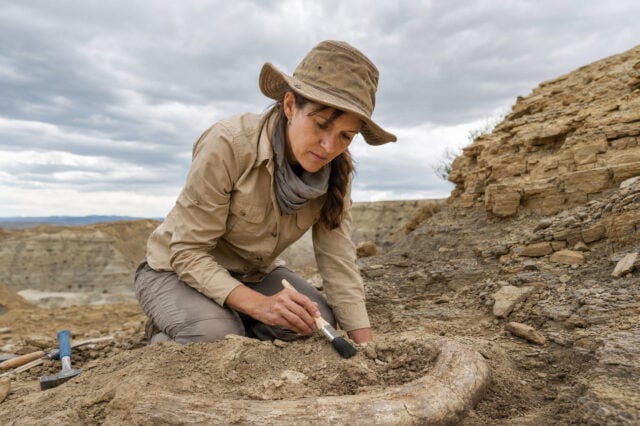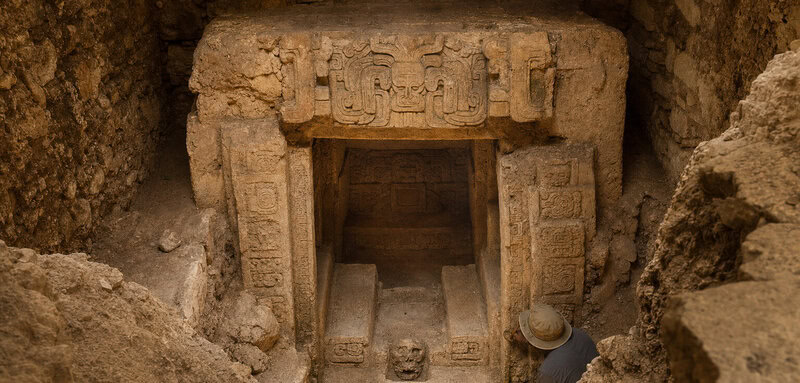
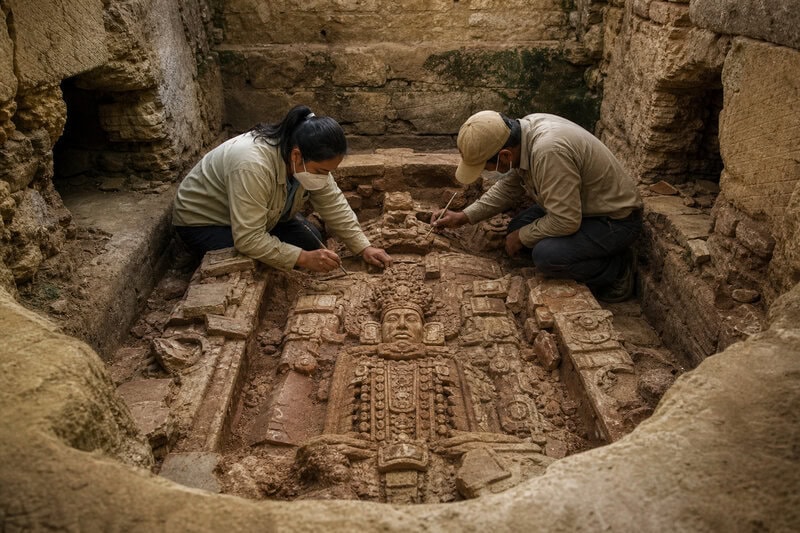
The brush moves in small, deliberate strokes. The air is thick with humidity and the smell of red Belizean clay. And then, slowly, the shape of something ancient begins to emerge from the dark — not a shard, not a fragment, but a chamber, sealed for roughly 1,700 years, waiting with the patience only the dead can manage.
The Tomb That Rewrote Everything
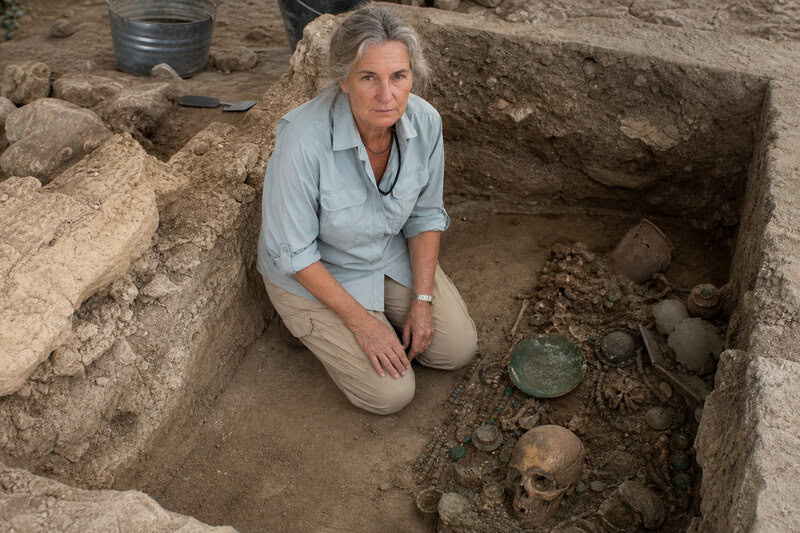
Diane Chase has spent a good portion of her life on her knees in excavation trenches like this one, deep in the Chiquibul Forest Reserve of western Belize. Alongside her husband and research partner Arlen, she has returned field season after field season to Caracol, an ancient Maya metropolis hidden beneath the forest of Belize that has repeatedly refused to behave the way Maya cities are supposed to. The discovery of a burial chamber believed to hold the remains of Te K’ab Chaak — one of Caracol’s earliest documented rulers — is the kind of find that careers are measured against. Archaeologists excavating the site have unearthed what may be a 1,700-year-old royal tomb, and the implications have rippled outward through the field like a stone dropped into still water.
A single tomb shouldn’t be able to shake an entire scholarly discipline. But at Caracol, it doesn’t arrive alone. It arrives as the latest in a long chain of discoveries that, taken together, have quietly dismantled the story textbooks told about the ancient Maya for most of the twentieth century — myths about their cities, their society, their warfare, and their so-called collapse.
A Metropolis Hidden in Plain Sight
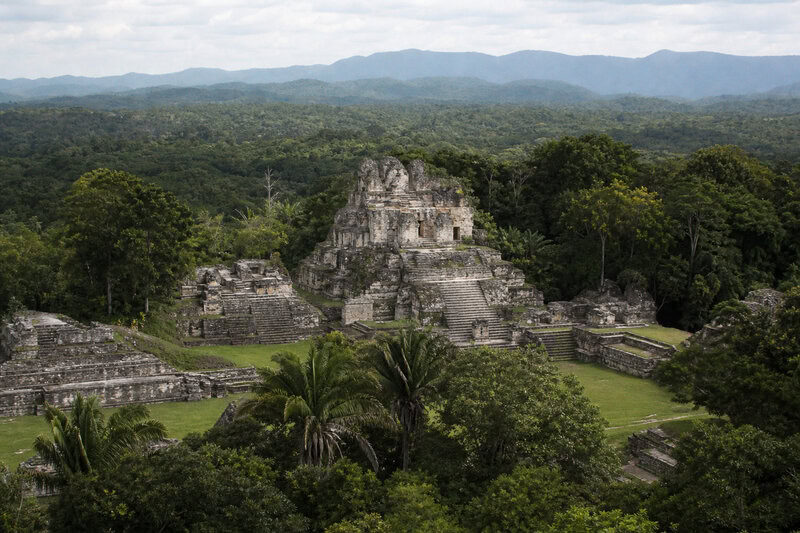
Caracol was rediscovered in 1937 — not by an archaeologist, but by a mahogany logger making his way through the jungle canopy of what is now the Chiquibul Forest Reserve in western Belize. The trees had done their work thoroughly. For generations after that rediscovery, the true scale of the city went unrecognized, its plazas and causeways and residential terraces swallowed so completely by vegetation that even trained eyes couldn’t fully grasp what was there.
The Chases began their systematic work at Caracol in the 1980s, and what they found — methodically, season after season — was not a modest ceremonial center of the kind that dominated early scholarly imagination. It was a metropolis. When LiDAR aerial mapping technology finally stripped away the tree cover digitally, producing a bare-earth image of the landscape beneath, even veteran researchers were taken aback. Causeways connecting distant neighborhoods. Plazas scaled for thousands of people. Reservoirs engineered to hold water through the dry season. Residential terracing spreading across roughly 200 square kilometers of the Belizean interior — a footprint that rivals or exceeds the area of present-day Belize City.
The sheer physical scale of Caracol demolishes the first and perhaps most persistent myth about the ancient Maya before a single artifact needs to be examined: the idea that Maya cities were essentially ceremonial villages with temples attached, rather than genuine urban centers supporting dense, complex populations. Caracol was always a metropolis. It just took the right technology — and the right researchers — to see it.
What the Excavations Found That the Textbooks Missed
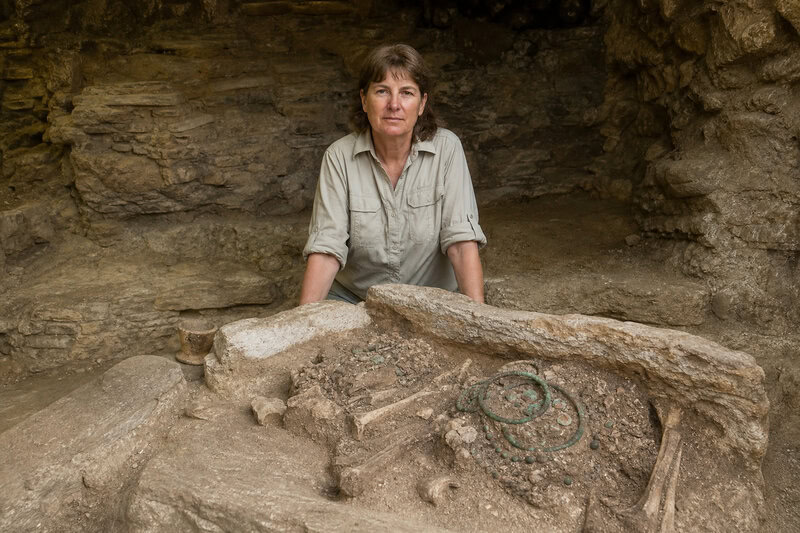
Diane Chase has described the work at Caracol as an exercise in constant surprise. The site has a habit of producing evidence that contradicts the scholarly consensus she herself was trained on — which, for a researcher of her standing, requires a particular kind of intellectual honesty to acknowledge and pursue.
Among the most destabilizing findings are the burials. Maya archaeology long organized itself around a tidy social model: divine priest-kings at the top, subsistence farmers at the bottom, with very little in between. Caracol’s residential floors told a different story. Elaborate burials and rich grave goods appeared not only in royal tombs or elite palace contexts but beneath the floors of ordinary houses — households with imported materials, craft goods, and formal interment rites that implied comfort, aspiration, and accumulated status. A prosperous intermediate social class, in other words. A Maya middle class. The two-tier model, as an explanation for how this civilization actually functioned, simply cannot accommodate what Caracol’s soil keeps producing.
The city’s hieroglyphic stairways and monument inscriptions add another layer. They record military campaigns and political alliances that position Caracol not as a provincial backwater but as a dominant regional power — one capable of projecting force and negotiating relationships across the Classic-period Maya world. Over the following decades, the painstaking work at Caracol exploded a number of misleading myths about the Maya that had accumulated over a century of scholarship conducted primarily at more famous, more accessible sites elsewhere in Mesoamerica.
The Myth of the Warlike, Collapsing Maya
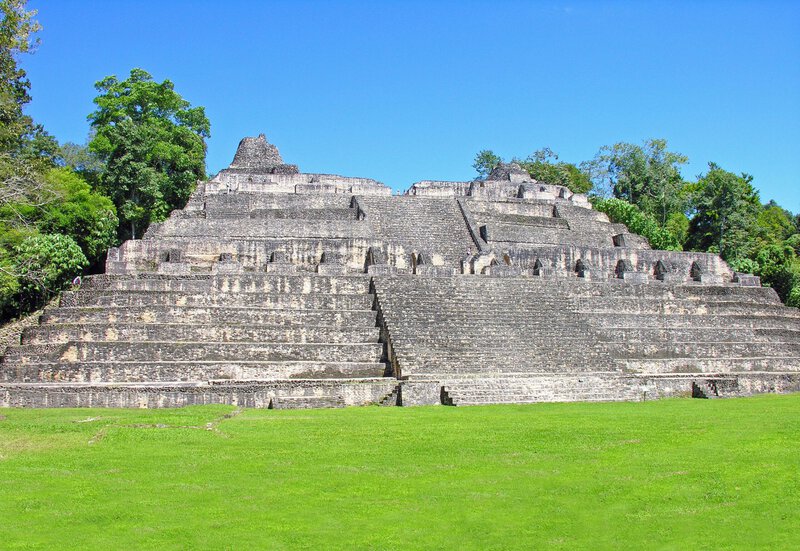
Few narratives have proven as durable — or as seductive — as the story of Maya collapse: a brilliant civilization brought low by endemic warfare, environmental degradation, and its own imperial overreach, fading from the historical stage like a cautionary tale conveniently timed for modern readers. Caracol’s own occupation history makes this tidy story considerably messier.
The city’s inscriptions record that in 562 CE, Caracol defeated Tikal — at the time arguably the most powerful city in the Maya world — in a military engagement that shifted the regional balance of power for generations. What followed was not the unraveling that collapse narratives predict but centuries of sustained urban civilization: continued monumental construction, population growth, monument dedication, and the elaborate social complexity visible in those middle-class burials. Resilience, in other words. Strategic statecraft. An adaptive human project rather than a doomed spectacle.
The LiDAR data reinforces this picture from a different angle. Visible across Caracol’s hinterland is an extensive system of agricultural terracing — careful, deliberate modification of hillslopes to extend productive farmland and manage water and soil across generations. This is not the portrait of a civilization carelessly exhausting its own environment. It is the portrait of a civilization doing precisely the opposite, and doing it well enough to sustain a major urban population for an impressively long time.
For Diane Chase, each field season at Caracol adds texture to what ancient Maya civilization was really like — and complicates the satisfying but ultimately misleading story of inevitable decline. The question the site demands is not “why did the Maya collapse?” but something harder and more interesting: how did they build something this sophisticated, for this long, and what does that tell us about complex societies everywhere?
A Royal Burial and What It Tells Us About Power
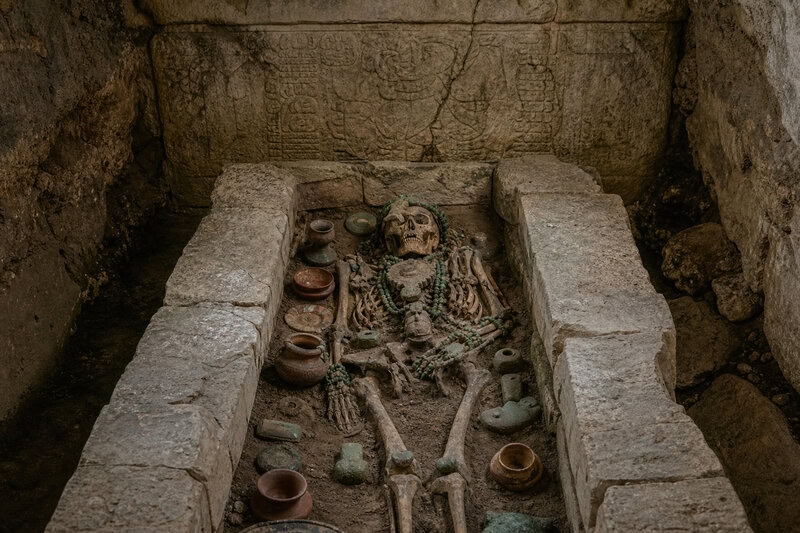
The tomb believed to belong to Te K’ab Chaak is remarkable on multiple levels. Its age — approximately 1,700 years — pushes Caracol’s documented royal sequence earlier than many scholars had anticipated, anchoring the city’s dynastic history in a period when our understanding of early Classic Maya political organization is still being assembled, piece by careful piece.
What matters as much as the tomb’s contents is its context: where within Caracol’s monumental architecture the burial was placed, what ceramics accompanied the interment, how the skeletal remains were positioned, and what the stratigraphy of the surrounding deposits reveals about construction sequences and ritual use. The discovery of what may be the 1,700-year-old tomb of Te K’ab Chaak is the headline, but the durable historical evidence lies in the methodical documentation that transforms a dramatic find into a data point scholars can build on across decades.
This is precisely the kind of work Diane Chase has made her career doing — not just finding significant objects but contextualizing them with enough rigor that future researchers have something solid to argue with. In an era when archaeological sites across Mesoamerica face mounting pressures from looting, development, and climate change, that methodological care is itself a form of preservation.
Debunking Maya Society, Myth by Myth
The myths that Caracol dismantles are worth naming plainly, because they shaped popular understanding of the ancient Maya for generations.
- The isolation myth. Caracol was not an inward-looking city-state sealed off from the wider world. Trade goods, artistic styles, and hieroglyphic texts reveal a city deeply enmeshed in pan-regional Mesoamerican networks of exchange and influence — a node in a connected world, not an island.
- The two-tier society myth. The evidence of middle-class households with craft goods, imported materials, and formal burial rites dismantles the priest-king-and-peasant model that dominated twentieth-century scholarship. Maya society, at Caracol at least, was layered, differentiated, and recognizably complex in ways that look less exotic and more universal the closer you examine them.
- The rainfall-dependent city myth. Caracol’s elaborate water-management system — reservoirs, channels, and catchments engineered to carry the population through dry seasons — refutes the notion that Maya urban centers were passive recipients of whatever weather came their way. They were engineered environments, shaped by deliberate human intention and maintained by organized human labor across centuries.
- The inevitable collapse myth. Caracol’s long occupation history, its agricultural terracing, and its demonstrated capacity to absorb a major military confrontation with Tikal and continue growing all complicate the narrative of a civilization structurally incapable of sustaining itself.
Why Caracol Still Has Secrets — and Why That Matters
After decades of excavation, Caracol continues to surprise — which is either a testament to how much of the ancient metropolis remains buried beneath the Belizean forest floor, or a quiet reminder that the jungle is under no obligation to give up its contents on a human schedule. Probably both.
Each field season at the site risks interruption by the practical realities of jungle archaeology: rainy seasons that render trenches unworkable, funding cycles that determine how many researchers can be in the field, and the simple physical limits of what a team can clear, document, and protect in a single season. The revelations Caracol holds will unfold across generations of scholars, not just one. Diane Chase and Arlen have laid the methodological foundation — systematically, comprehensively, at considerable personal investment of time and energy — but the structure being built on that foundation extends far beyond any single career.
The broader lesson Caracol offers the field is as much methodological as it is historical. Assumptions formed at famous, heavily studied sites like Chichén Itzá or Tikal — assumptions about political structure, social organization, urban scale, and economic complexity — need to be tested against evidence from cities like Caracol, where the jungle preserved what ambition, tourism, and a century of selective scholarly attention erased or obscured elsewhere. The best-known sites are not always the most representative ones. Sometimes the most important city is the one the mahogany loggers found by accident and the scholars took decades to fully see.
For anyone who wants to understand what Maya civilization was really like — not the myth, not the collapse narrative, not the priest-kings-and-peasants shorthand, but the actual, adaptive, sophisticated, long-running human project — Caracol in Belize is the answer that keeps growing. A city that broke every rule the textbooks wrote. And, if Diane Chase’s field seasons continue to run true to form, it is almost certainly not finished breaking them yet.