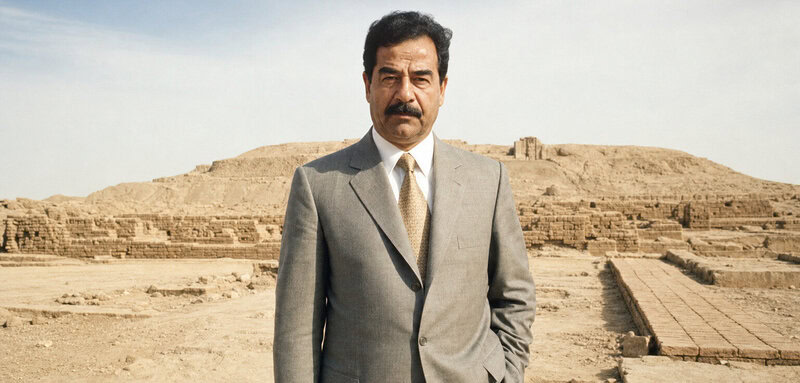
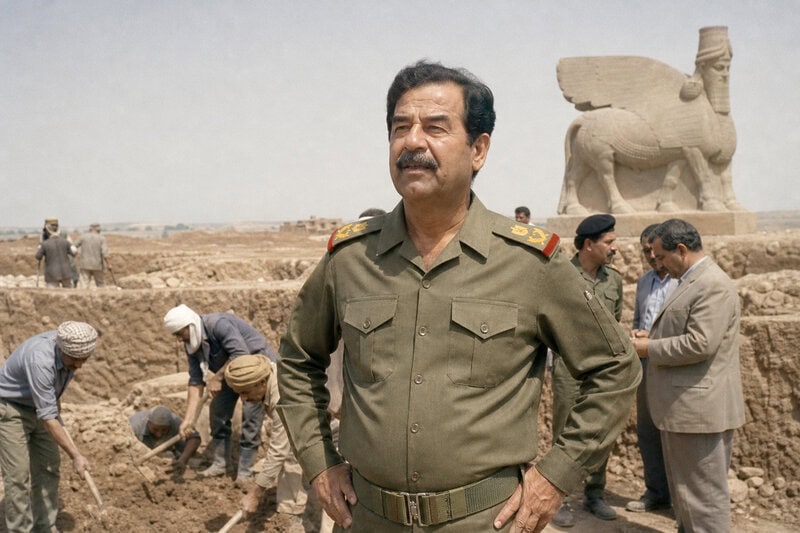
Somewhere in the Iraqi desert in the 1980s, a worker pressed a wet brick and left behind a name — not Nebuchadnezzar’s, dead these two and a half millennia, but Saddam Hussein’s, very much alive and paying close attention to the past with the focused intensity of a man who understood that history is not just remembered, it is built.
The Bricks Had His Name on Them
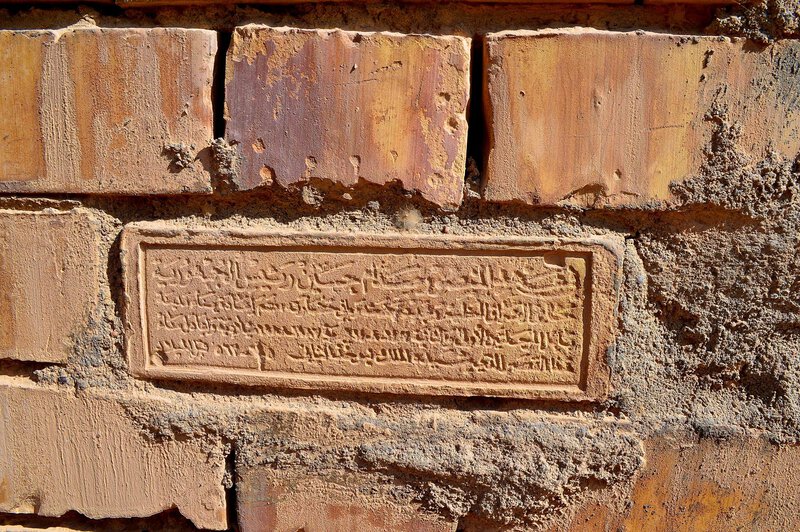
The ancient city of Babylon had already survived Persians, Greeks, and centuries of slow collapse when Saddam Hussein decided to rescue it. Workers dispatched to the site in the 1980s laid millions of new bricks, each one stamped with a phrase that translated, in the bureaucratic poetry of the Ba’ath Party, as something to the effect of: in the era of the leader Saddam Hussein. The echo was entirely deliberate. Nebuchadnezzar II, who ruled Babylon around 600 BCE and built some of its most legendary structures, had done exactly the same thing — firing his own name into every brick he laid as a kind of royal signature pressed into clay. Saddam was not restoring a ruin. He was costuming himself in one.
The entrance tickets sold at the reconstructed site made the equation explicit: Saddam’s portrait appeared alongside Nebuchadnezzar’s profile, two rulers across twenty-five centuries sharing the same frame. The Iraqi Directorate of Antiquities, operating under Ba’ath Party oversight, described the whole project publicly as national heritage preservation. Archaeologists who visited told a different story. The new bricks, photogenic and imposing, had been laid directly on top of original structures, compressing and destroying the stratigraphic layers that would have revealed the actual, complicated, human history of who lived in Babylon and when. What Saddam built was less a ruin and more a film set — and that, of course, was precisely the point.
This scene in the Iraqi desert opens onto a story that stretches from the Alpine foothills of South Tyrol to the lecture halls of Nazi Germany — everywhere, across ideologies and centuries, that governments have decided the spade is mightier than the sword. Understanding how that logic operates, and why it keeps working, is not merely an academic exercise. It is a guide to reading the political uses of the past wherever they appear next.
What Propaganda and Archaeology Have in Common
Both deal in the same raw material: stories about origins. Who was here first. Who built what. Whose blood, as nationalist rhetoric has always liked to put it, runs in the soil. That shared preoccupation makes archaeology uniquely vulnerable to political capture, especially when rulers need a usable past rather than an accurate one. Archaeology can be a powerful political weapon when used for propaganda rather than an impartial study of past artifacts — a point that sounds obvious until you consider how many times the ruse has worked on a national scale.
The mechanism is consistent across centuries and ideologies. Find — or manufacture — a material link to a glorious ancestor. Present it as scientific fact, ideally with credentialed experts and published journals lending the apparatus of scholarship to the enterprise. Then use that apparatus to claim territory, rally citizens, or delegitimize a rival’s presence on the land. The conclusion arrives first; the archaeology is recruited afterward to prove it. This reversal of the normal direction of inquiry — from evidence to conclusion, rather than the other way around — is the defining feature of weaponized archaeology in every era and setting in which it appears.
Saddam Hussein’s reconstruction project at Babylon ran through the 1980s and into the 1990s, coinciding almost exactly with his wars against Iran and Kuwait — periods when he needed Iraqis to feel they were the heirs of an ancient, unconquerable civilization rather than subjects of a regime hemorrhaging young men on two fronts. The timing was not incidental. Heritage projects of this kind tend to accelerate precisely when governments face the greatest pressure to justify themselves.
The Nazis and the Spade: Race Science Goes Underground

If Saddam’s project was autobiography stamped in mud and straw, the Nazi version was something more systematically sinister. Heinrich Himmler funded and championed the Ahnenerbe — the SS “Ancestral Heritage” research bureau, founded in 1935 — which dispatched scientists across Europe and beyond to find prehistoric evidence that a master Germanic race had once dominated the continent. As documentation of the South Tyrol case makes clear, Nazi scientists exploited prehistoric finds as “Germanic” evidence to support their ideological agenda, bending the emerging discipline of prehistoric archaeology into a pseudoscientific arm of racial ideology.
What made the Ahnenerbe genuinely dangerous — more dangerous than a dictator stamping bricks — was its institutional legitimacy. Its researchers published in peer-reviewed journals. They held university posts. They presented findings at conferences, where the trappings of scholarly debate disguised what was, at its core, a eugenics program dressed in fieldwork boots. Burial goods were reinterpreted as proof of ancient Germanic dominance. Skull measurements were recruited into arguments about racial continuity. Settlement patterns were read backwards from a predetermined racial map.
This is how propaganda and archaeology become truly dangerous together: not when a despot builds a fake wall, but when credentialed experts provide the footnotes. Institutional legitimacy functions as a force multiplier for disinformation, because it raises the cost — professional, social, and sometimes physical — of publicly disagreeing. It is also worth noting that it is a great deal easier to falsify the deep past than the recent past, because the deep past cannot answer back. The further back the claimed precedent, the thinner the evidentiary record and the wider the interpretive latitude available to anyone with an agenda.
South Tyrol and the Roman Makeover: Italy’s Alpine Rewrite
The same years that saw Himmler’s researchers fanning out across Europe also saw Mussolini’s Italy confronting an inconvenient demographic fact in the Alpine region of South Tyrol, absorbed after World War I. The people there spoke German, not Italian, and felt culturally Austrian in ways no amount of administrative decree could simply overwrite. The Fascist response was to reach for the same tool. Fascist Italian researchers sought evidence of South Tyrol’s Roman past as part of a coordinated propaganda effort — Roman-era finds that might reasonably have been contextualized as evidence of a diverse frontier province were instead presented as proof of continuous Italian civilization stretching back through the centuries.
The archaeology was not invented wholesale. That is the subtler and more instructive point. Real Roman artifacts existed in the region. Real excavations took place. What was manufactured was the interpretation — the selective emphasis, the strategic publication, the museum labels that smoothed away complexity and delivered instead a clean, usable narrative: this land is Italian because it has always been Italian, and here is the dirt to prove it.
The South Tyrol case illustrates something important about how politicized archaeology actually functions in practice. Outright forgery — the fabrication of artifacts from nothing — is comparatively rare and comparatively easy to expose. The more durable form of manipulation operates on genuine material, reshaping not what is found but what is said about it, which institutions amplify it, and which inconvenient findings are quietly left unpublished. Control over interpretation is, in the long run, more powerful than control over the objects themselves, because interpretation is what reaches schoolchildren, tourists, and citizens forming views about whose homeland this actually is.
The Pattern Repeats — and Why It Never Really Stopped
The temptation to read these cases as relics of a more credulous era — the 1930s, the 1980s, the age before peer review became genuinely international — collapses quickly under scrutiny. The weaponization of archaeology spans every ideological context and continues into the present. Medieval churches in the former Yugoslavia were excavated to establish ethnic priority over contested ground. The Khmer Rouge invoked Angkor Wat as evidence of a pure agrarian civilization that modernity had corrupted. Across the Israeli-Palestinian conflict, excavations near contested holy sites generate international headlines with a regularity that has its own grim rhythm. In each case the structure of the argument is identical: we have always been here, the ground says so, and therefore our claim supersedes yours.
Researcher L. Meskell’s review, Ruin Warfare: How and Why We Weaponize the Past, makes a point that should unsettle anyone who imagines the problem belongs exclusively to obvious villains: all parties to a conflict might manipulate antiquity and its materialities. The framework matters because it shifts the question from “who are the bad actors?” — a question that lets everyone else feel comfortable — to something structural: what conditions allow any government to transform a dig site into a political argument?
The answer, almost invariably, is control. Governments manipulate history most effectively when they hold both the excavation permits and the museum display cases, deciding not just what gets uncovered but what gets shown, labeled, and taught to schoolchildren as settled national truth. Where those two levers — the permit and the display — are held by independent or internationally accountable bodies, the scope for systematic manipulation narrows considerably. Where a single authority controls both, the temptation to orchestrate the past in the service of the present is very nearly irresistible.
Saddam Hussein’s Babylon is now a cautionary exhibit in itself. The UNESCO-designated site carries visible scars from his reconstruction, and post-2003 military use of the grounds added further damage to what his project had already compromised. The bricks stamped with his name remain embedded in ancient walls — a permanent record of what happens when no one stops a government from directing its own historical drama. Nebuchadnezzar, at least, was building something for the first time. Saddam was building a performance on top of someone else’s reality, and the original suffered for it.
What Honest Archaeology Looks Like — and Why the Difference Matters
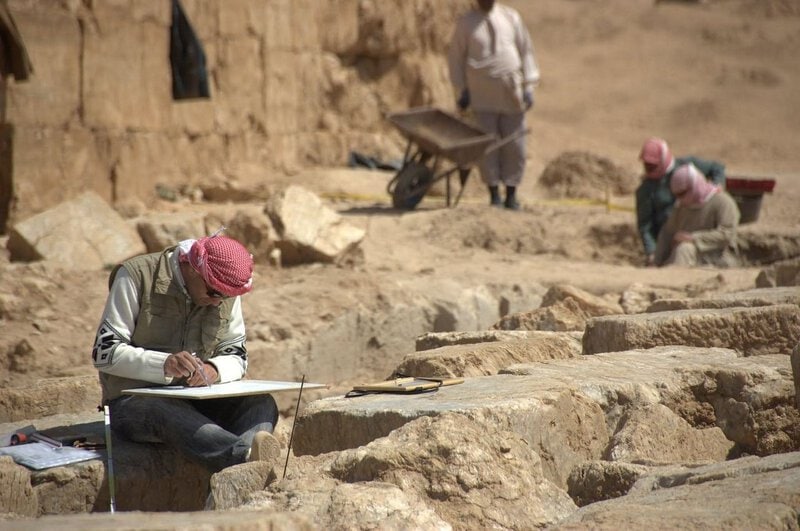
The antidote to weaponized archaeology is not less digging. It is more transparency: open publication of raw field data, international oversight of excavations in politically contested zones, and historians and archaeologists willing to say publicly — with their names attached — when a government’s heritage project is a political project wearing a hard hat. None of that is easy when the government in question controls the funding, the site access, and sometimes the physical safety of the researchers involved. The professional risks faced by scholars who publicly challenge a state’s archaeological narrative range from loss of funding and site access to, in some political environments, personal danger. The asymmetry between the resources available to a nationalist state and those available to a dissenting academic is rarely discussed, and rarely comfortable to acknowledge.
Professional associations and international bodies such as UNESCO and the World Archaeological Congress have developed ethical frameworks intended to insulate archaeological practice from precisely this kind of political capture — frameworks that require transparent reporting of findings, prohibit selective publication designed to support political conclusions, and encourage international collaboration on contested sites. Those frameworks are only as strong as the professional culture willing to enforce them, and in practice their reach is uneven. Where they function well, the record shows that politicized interpretations can be challenged and corrected. Where they are absent or overridden by state authority, the record shows something else entirely.
The curious reader who wants to understand why nations go to war over ruins, why a contested dig can ignite riots, or why a dictator would bother stamping his name on a brick already two and a half thousand years old will find the same answer at the bottom of every excavation trench: because whoever controls the story of the past controls the argument about who belongs in the present. Saddam Hussein understood this with the instinctive clarity of someone who had spent his life fighting over exactly that question. He pressed his name into wet clay and laid it over Nebuchadnezzar’s city, and in doing so he left behind not just a propaganda project but a near-perfect illustration of how the impulse works — the conclusion first, the evidence arranged around it, and the original truth buried somewhere underneath.
Archaeology is a science, but it is also a story, and stories, as propagandists from Babylon to Berlin have always known, are among the most powerful weapons ever invented. The discipline’s best defense against those who would use it as such is the same quality that makes it valuable in the first place: a commitment to following the evidence wherever it leads, even when — especially when — the destination is inconvenient for whoever holds the excavation permit.