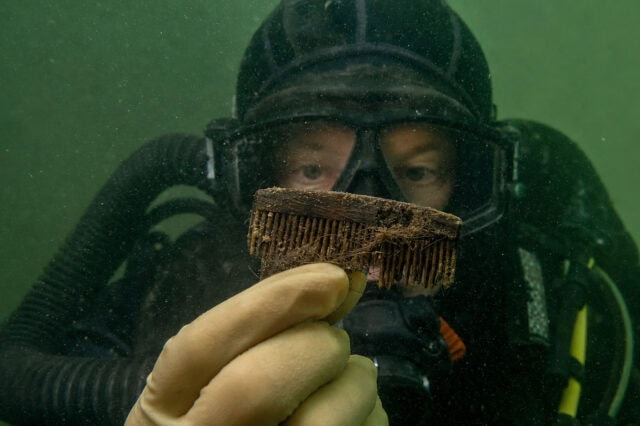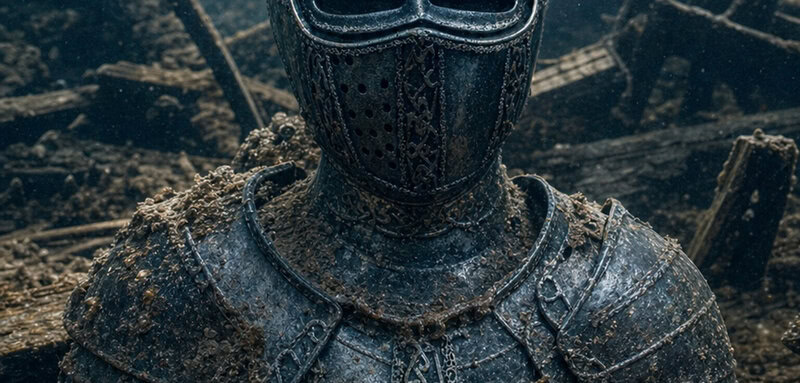
Five hundred and thirty years ago, a Danish royal warship slipped beneath the Baltic Sea and took its secrets with it. This past excavation season, underwater archaeologist Rodrigo Pacheco-Ruiz descended through cold, dark water and watched one of those secrets slowly materialize out of the silt — pieces of high-quality medieval plate armor, components still in relation to one another, as though a soldier had simply chosen that spot on the seafloor to lie down and rest.
The Ship: Meet the Gribshunden
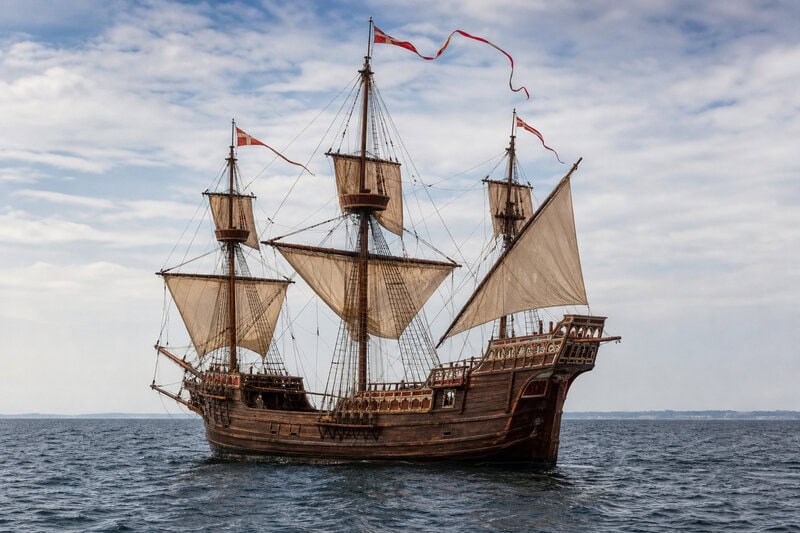
The wreck is known by both a Danish name and an English translation: Gribshunden, or Griffin. It was a Danish royal warship — not a merchant hulk or a fishing vessel, but a prestige ship of the kind that projected dynastic power across the Baltic, whose movements were noted in royal courts and whose loss was recorded with something close to official grief. It sank in 1495 off the coast of what is now Sweden, and then, like so many things that sink, it was largely forgotten by everyone except the maritime archaeologists who eventually came looking.
What elevates the Gribshunden beyond a footnote in naval history is who was aboard when she went down. German mercenaries known as Landsknechts were aboard the ship when it sank, Pacheco-Ruiz confirmed — and that detail transforms the entire character of the wreck. The Landsknechts were the dominant professional soldiers of late 15th-century Europe: pike-and-sword fighters, disciplined and ferocious, recognizable in period illustrations by their slashed and puffed uniforms, their long halberds, and the air of men who expected to be paid well. They were not sailors. They were soldiers-for-hire traveling aboard a royal ship, and they brought their equipment with them.
Finding their armor in the wreck reframes the Gribshunden from a naval loss into something richer: a window onto Renaissance-era military logistics, and the moment when land warfare and sea power were learning, awkwardly, to share a hull.
What 1495 Actually Looked Like
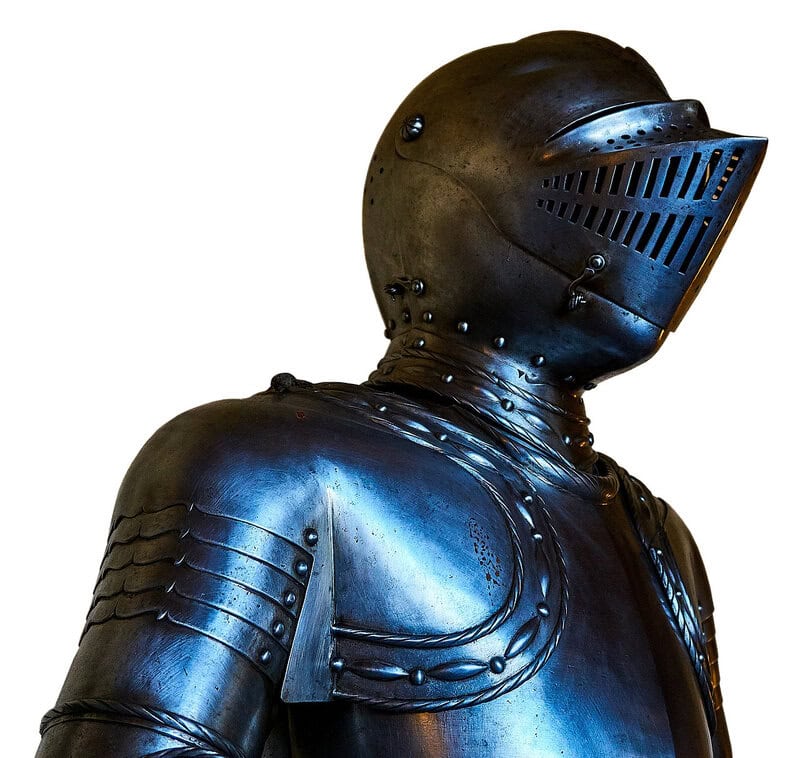
The year the Gribshunden sank, Christopher Columbus had just returned from his second voyage to the Americas. Leonardo da Vinci was filling notebooks in Milan with sketches of flying machines and hydraulic pumps. And plate armor — the full articulated steel suit that most people picture when they hear the word “medieval” — was at the absolute apex of its craft. This is not crude chain mail. This is the product of master armorers working in Innsbruck and Augsburg at the height of the Renaissance, men whose workshops charged prices that only royal paymasters and wealthy mercenary commanders could meet.
Landsknecht armor of this period was engineered equipment in the most serious sense. Each piece was shaped and tempered to articulate with the others — to allow a fighting man to sprint across broken ground, drop to one knee, and swing a halberd in a full arc without the steel binding at the shoulder or the elbow. The best examples were custom-fitted to named individuals rather than issued from a barrel. Hundreds of hours of skilled labor went into a single high-quality suit.
The Gribshunden going down in 1495 means this armor bypassed every subsequent disaster that metal could meet on land: the cannon-foundries that melted old weapons into new ones, the 19th-century museum restorers who stripped and re-lacquered surviving pieces until their original surface chemistry was gone, and the wars that consumed everything in their path. The ship entered the Baltic as a time capsule almost the instant it left the armorer’s workshop, and the Baltic — cold, brackish, low in oxygen and lower in the corrosive salinity of the open ocean — proved to be an extraordinarily conscientious archivist.
The Discovery: How It Happened
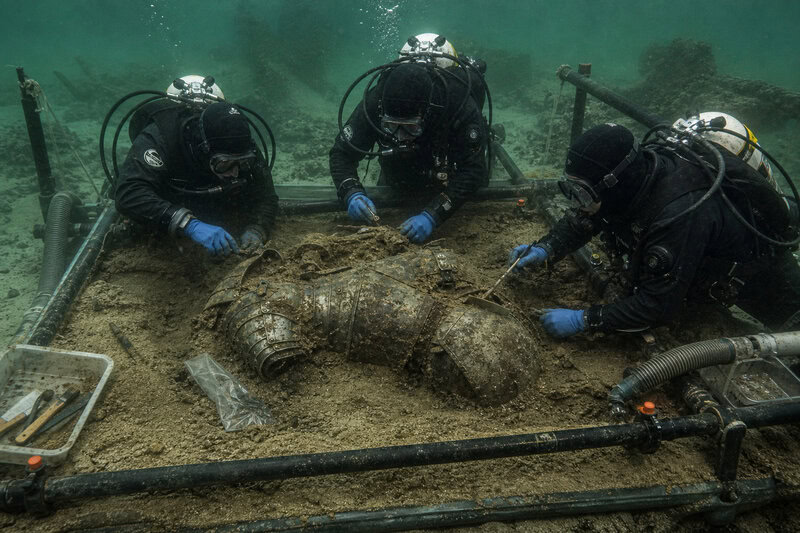
It is worth pausing on what “discovered in a shipwreck” actually involves, because the popular image — diver swims down, diver picks up artifact — is almost perfectly wrong. Excavating a site like the Gribshunden means sonar mapping before anyone enters the water, sediment removed in carefully controlled layers rather than shovelfuls, and every object photographed and recorded in its exact position before a hand comes within reach of it. Pacheco-Ruiz’s team would have documented the armor’s orientation, the angle of each component, and its relationship to the surrounding timbers and debris before anything was lifted.
This is not fussiness. It is the difference between information and an expensive paperweight. The position of objects within a wreck carries meaning that the objects themselves cannot convey once they are removed — armor found near the bow tells a different story than armor found in a hold or in crew quarters, and that story matters for understanding how the Gribshunden was organized and who was where when she went down.
Pacheco-Ruiz described the moment in terms that left little ambiguity about its significance:
“It was truly an amazing find!”
Researchers do not use exclamation marks lightly. That one is doing real work.
The Armor Itself: What “High Quality” Actually Means
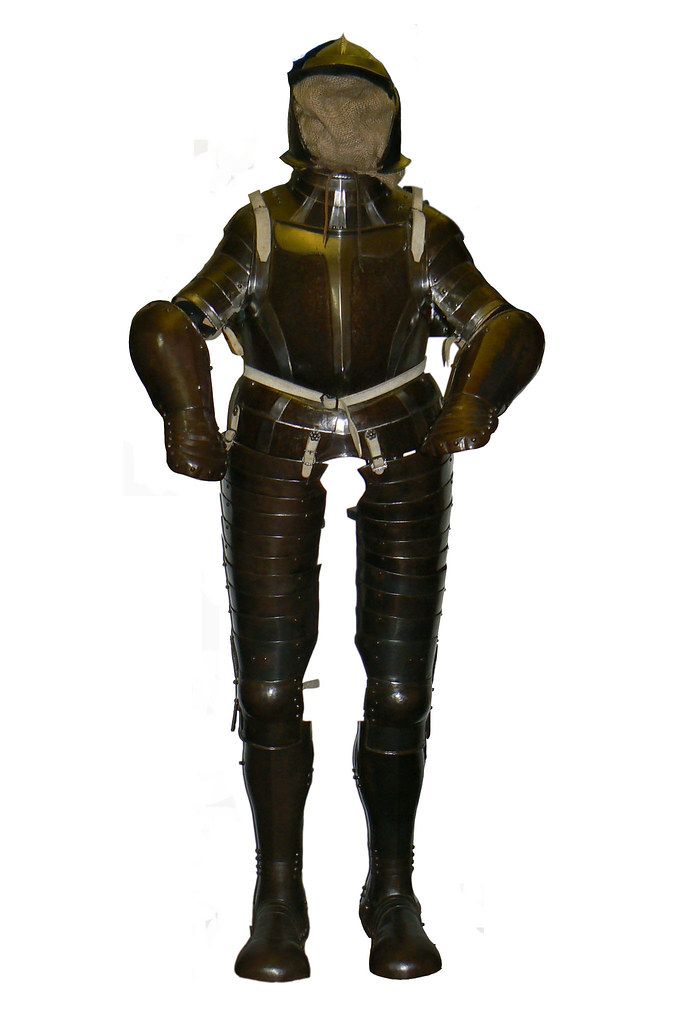
When maritime archaeologists describe this as high-quality medieval armor, they are not reaching for flattering language. “High quality” in this context signals a specific tier of manufacture — the custom-fitted, surface-finished, individually articulated kind of plate armor that belonged to named individuals or wealthy mercenary commanders, not the mass-issued equipment handed to rank-and-file soldiers before a campaign. The joint construction alone — the way the pieces allow movement without gaps in protection — required a level of craft that most workshops simply could not deliver.
Renaissance-era naval armor also presents its own engineering problem worth appreciating: a man in full plate who goes overboard does not swim. The best Landsknecht armor for shipboard use was therefore designed to be shed quickly — buckles and straps in preference to rivets, sections engineered to be stripped in seconds rather than minutes. The armor was protection, but it also needed to be escapable.
The fact that components were found still in relationship to one another — as a set, rather than scattered across the site — suggests the armor may have been stored or stowed rather than worn at the moment the ship went down. That single detail is the kind that keeps archaeologists awake: it implies the soldiers were not on deck and armed when the Gribshunden sank, and what that means for the circumstances of the sinking is something Pacheco-Ruiz and his team will spend months working through.
What This Find Changes — and What It Confirms
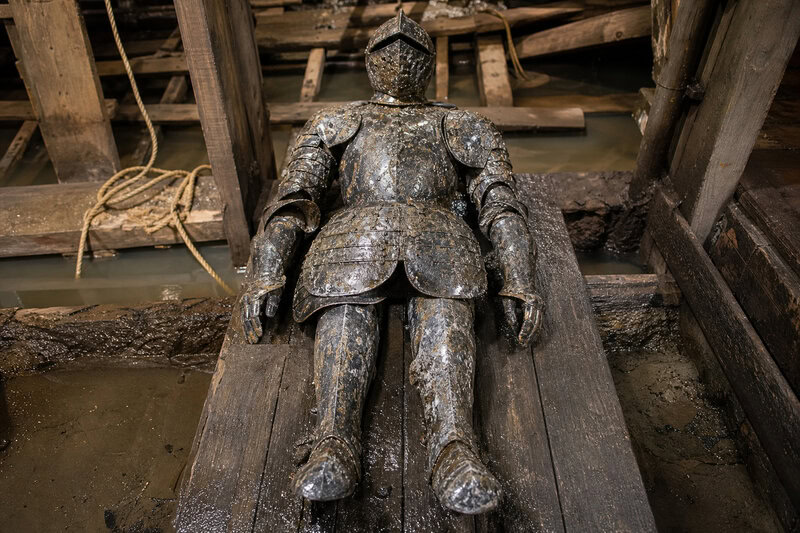
Most surviving plate armor of this period lives in climate-controlled museum galleries, heavily restored, its original surface chemistry long since altered by centuries of storage and 19th-century conservation practices that prioritized appearance over authenticity. The Gribshunden armor comes up with its original metallurgical fingerprint intact — a significant resource for materials scientists who can now analyze the steel’s composition and construction in ways that surviving land-based examples do not permit.
For Pacheco-Ruiz, the find lands inside a larger argument maritime archaeologists have been making for decades: that shipwrecks are among the best-preserved time capsules available to researchers, preserving military and material culture that land archaeology recovers, if at all, only in fragments. A suit of armor buried on a battlefield is exposed to centuries of freeze-thaw cycles, groundwater, and agricultural disruption. A suit of armor resting on the Baltic floor, under a layer of protective sediment, is in a different category of preservation entirely.
The discovery also reopens questions about the Gribshunden‘s final voyage. If elite mercenary soldiers carrying high-grade equipment were aboard a Danish royal warship, then whatever political or military mission lay behind that sailing matters considerably more than historians had previously assumed. The ship was going somewhere, with soldiers, for a reason. The armor is now evidence in an argument about what that reason was.
What Comes Next — and Why It Takes Years
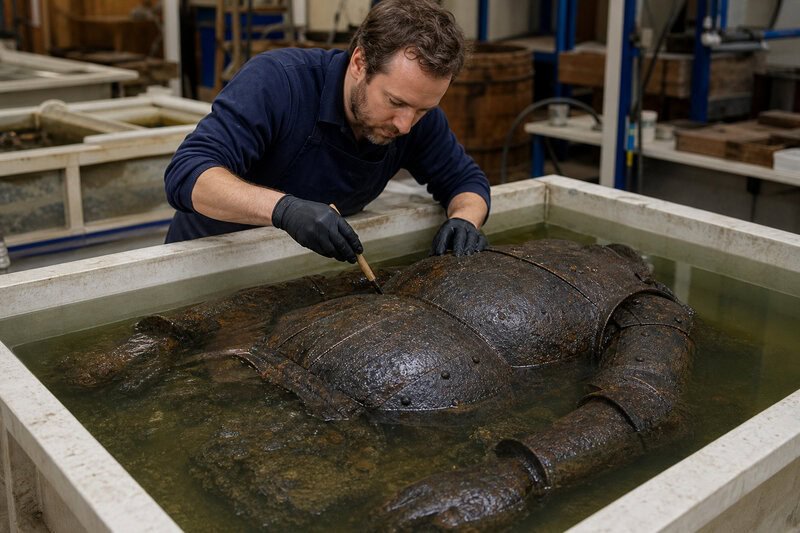
Conservation of waterlogged iron and steel is not a process that rewards impatience. Metal that has spent 530 years saturated with water must be desalinated in controlled baths — a process that can itself take months or years — before it can safely be exposed to open air without crumbling or cracking as the moisture it has relied upon for structural integrity finally departs. Pacheco-Ruiz’s team will not see the armor fully stabilized quickly, and they know it. This is part of what it means to do this work.
Once stable, the armor will be analyzed for maker’s marks, steel composition, and construction techniques that could identify the specific workshop — and potentially the specific armorer — who made it. The craft workshops of Innsbruck and Augsburg left identifiable signatures in their work, and narrowing a provenance that has been underwater for five centuries to a particular city, a particular decade, and a particular set of hands is exactly the kind of result that makes the long conservation process worthwhile.
The Gribshunden site is not close to exhausted. It is regarded as one of the most significant medieval shipwreck sites in northern Europe, and each season of careful excavation has produced finds that have rewritten small corners of Renaissance military and naval history. The Griffin gave up one of its secrets. It is keeping the rest, for now, with characteristic patience.