In August 79 AD, a mountain killed a city in a matter of hours — and nearly two thousand years later, a group of French teenagers walked into its ruins and found something disturbingly familiar looking back. That collision between adolescent aliveness and ash-frozen mortality is the beating heart of Marine Atlan’s La Gradiva, a 2026 coming-of-age film that stretches its roots back through psychoanalysis, a haunting Roman relief, and one of literature’s strangest obsessions.
79 AD: Vesuvius Buries Pompeii — Creating the Frozen Tableau the Film Inhabits

When Mount Vesuvius erupted in August 79 AD, it did not simply destroy Pompeii — it preserved it, locking streets, homes, and human beings in a mid-moment stillness that has unnerved visitors ever since. The volcanic ash did not bury a ruin; it buried a city in the full swing of life, which is a very different and far more troubling thing. The pyroclastic surges that ended the city so quickly were also responsible for the extraordinary fidelity of its preservation: objects, frescoes, and human postures caught at the precise instant of ending, with a specificity that no slow decay could ever produce.
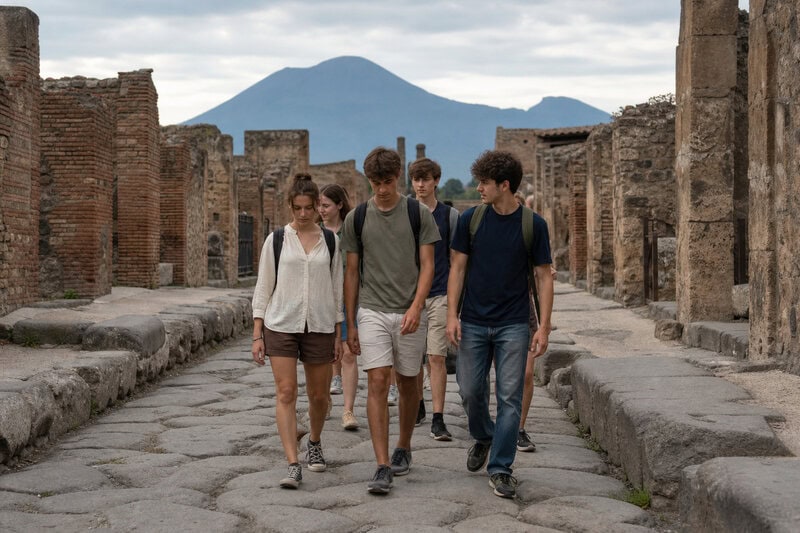
La Gradiva plants its French teenagers directly among those excavated remains, treating the preserved bodies and fractured streets not as atmospheric backdrop but as the story’s emotional engine. The collision between youthful intensity and ancient death is not incidental to the drama — it is the drama, Pompeii’s catastrophe functioning as a mirror for the volatility and fragility of youth itself.
The Gradiva Relief — the Image That Haunts the Title
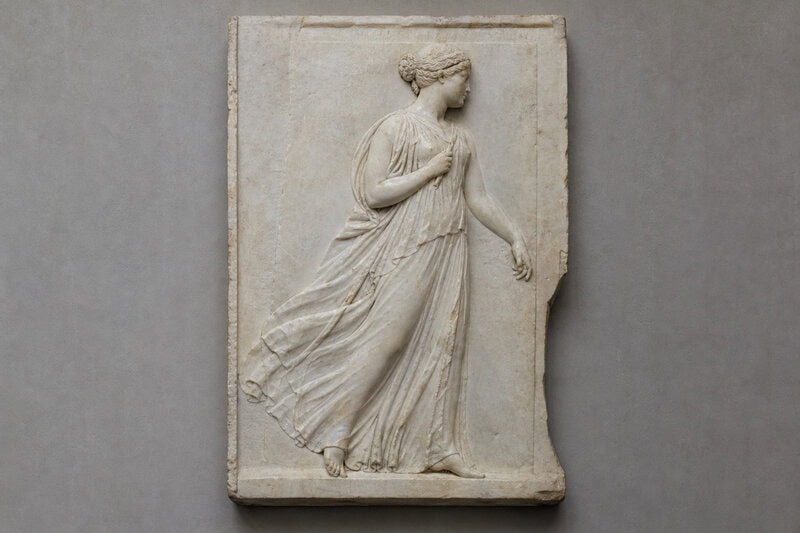
A marble bas-relief depicts a young woman caught mid-stride, her robes trailing behind her as though she has just stepped into a room and not yet noticed she has turned to stone. The relief came to be known as Gradiva — from the Latin for “she who walks” — and its peculiar quality, a figure suspended between motion and stillness, between the living and the monumental, gave it a power that outlasted its anonymous sculptor by centuries.
What makes the relief so persistently compelling is precisely its ambiguity: the figure is neither fully present nor fully absent, neither entirely of the past nor of a timeless now. She is in transition, and that transitional state — poised on a threshold she will never quite cross — is what the film’s title invokes most directly. Atlan’s adolescent characters inhabit the same suspended condition, vivid and unresolved, moving through a landscape whose permanent residents were stopped far more abruptly than they expect to be.
The borrowing is not decorative. The adolescent girls at the film’s centre are themselves Gradiva figures — vivid, transient, forever caught mid-stride on the edge of becoming something they cannot yet name, moving through ruins that were themselves once full of people equally convinced they had somewhere important to be.
1903: Wilhelm Jensen Publishes ‘Gradiva’ — the Novella That Names the Film

The German author Wilhelm Jensen published Gradiva: A Pompeiian Fantasy, a novella in which a young archaeologist becomes so obsessed with the Gradiva relief that he travels to Pompeii and begins to believe he sees her walking among the ruins — a woman from stone, resurrected in the heat and dust of southern Italy. Jensen fused archaeology with desire, illusion, and the stubborn insistence of longing, producing something that read less like a ghost story than like a dream someone else was having on your behalf.
The novella’s central mechanism — the way obsessive attention gradually dissolves the boundary between an image and a person, between a projection and a reality — is more precise as psychology than Jensen perhaps intended. His archaeologist does not simply fall in love with a statue; he reorganises his perception of the world around it, until the distinction between what he remembers and what he sees becomes impossible to maintain. That dissolution of boundary, the collapse of then into now, is what Jensen’s fantasy shares with the experience of adolescence itself.
The themes Jensen worked with — the blurring of past and present, the way obsession reshapes what we see — are transplanted wholesale into Atlan’s film, where students studying Pompeii’s preserved dead begin to lose the boundary between then and now, between what they are studying and what they are feeling. The novella was largely a literary curiosity when it appeared, until a Viennese reader picked it up and found something far more significant in its pages.
1907: Freud Publishes His Analysis of Jensen’s ‘Gradiva’ — Archaeology as Psychoanalysis

Sigmund Freud published Delusion and Dream in Jensen’s Gradiva in 1907, arguing that Jensen had intuitively and accurately dramatised the core mechanics of repression, wish-fulfilment, and the return of the repressed — not as metaphor, but as a structurally precise account of how the unconscious actually works. What delighted Freud was that a novelist had arrived at the same map as psychoanalysis without, apparently, intending to draw one.
Freud drew an explicit parallel between the archaeologist’s method — excavating buried layers to find the living beneath — and his own practice of uncovering the memories and desires that patients had interred without ceremony. The analogy was not merely rhetorical. For Freud, both disciplines proceeded on the same assumption: that what has been buried is not destroyed, that it retains its charge beneath the surface, and that the work of excavation is also the work of recovery. Repression, in this account, is geological. Pompeii was simply the most spectacular example.
By anchoring her film in this layered literary and psychoanalytic lineage, Atlan positions Pompeii not merely as a historical site but as a landscape of the unconscious. The relationship between archaeology and psychoanalysis that Freud identified in Jensen’s story becomes, in La Gradiva, the film’s organising logic: what the eruption buried, adolescence is busy uncovering.
The Class Trip Departs: French Seniors Arrive in Pompeii and Naples
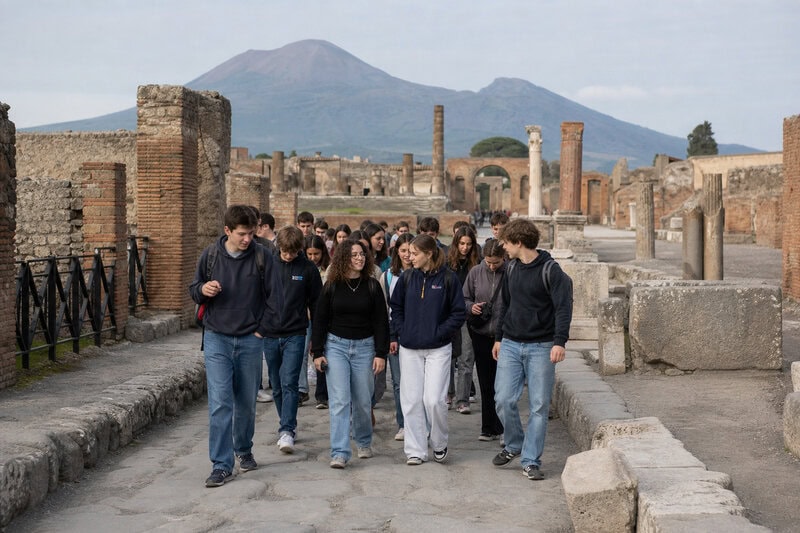
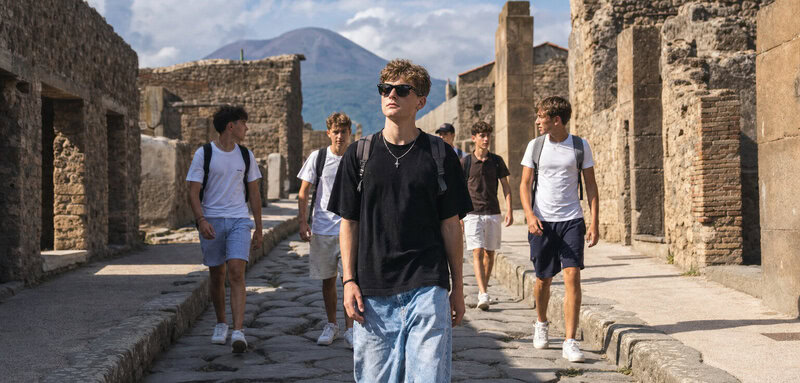
The film follows a group of French high school seniors on a structured class trip taking in Pompeii, Naples, Torre del Greco, and Portici — real towns clustered in the long shadow of Vesuvius, close enough to the volcano that their existence is itself a kind of ongoing wager. The geographical itinerary is accurate to the kind of voyage culturel that French lycées organise, grounding the drama in a recognisable institutional reality before the institution begins to crack.
The choice of locations is itself significant. Torre del Greco and Portici are not tourist destinations in the conventional sense; they are working towns built directly on volcanic soil, their streets laid over the same geology that ended Pompeii. For the students arriving from France, the landscape is both beautiful and subtly disorienting — a place that looks, on its surface, entirely alive, but whose history is one of periodic catastrophic interruption. That structural irony, the thriving town built on destruction, is one the film allows to accumulate quietly rather than state aloud.
The move from classroom discipline to the openness of southern Italy is itself a dramatic trigger. Removed from the hierarchies and routines that organise their days at home, the students find that desires and tensions they had successfully managed in familiar surroundings begin to surface with uncomfortable speed. Southern Italy, it turns out, is not a neutral location for a school trip.
Walking Among the Casts: Students Encounter Pompeii’s Preserved Bodies
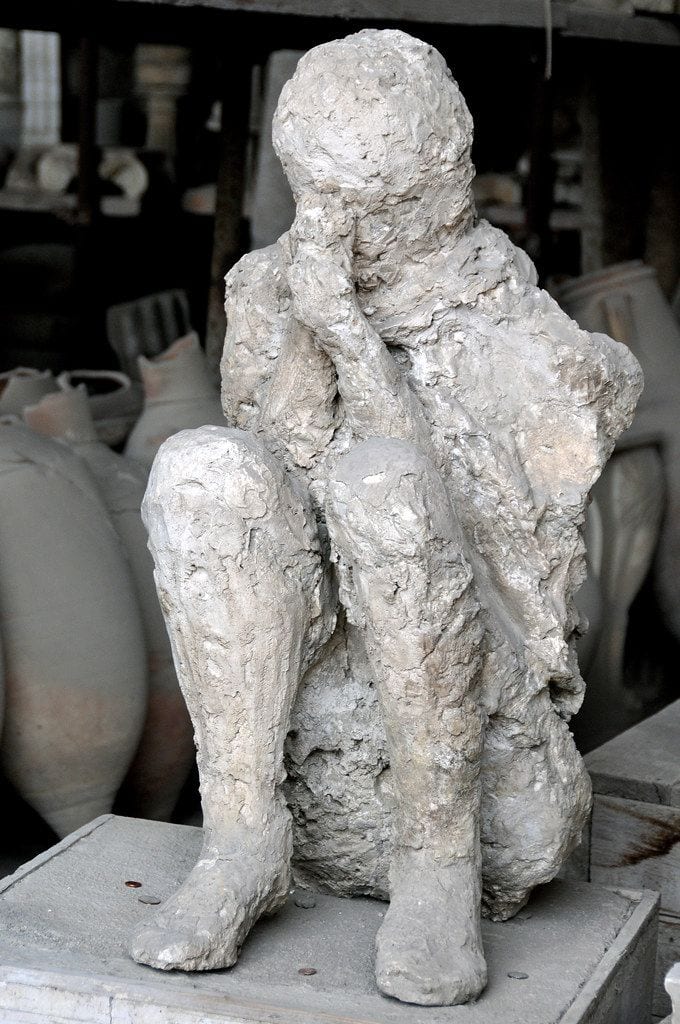
Among Pompeii’s most disturbing and arresting sights are the plaster casts of its victims — figures preserved in the postures they held at the moment of their deaths, produced from the 1860s onward when the archaeologist Giuseppe Fiorelli began injecting plaster into the voids that decomposed bodies had left in the hardened ash. The casts are not sculptures. They are absences made visible, the shapes of people who were alive and then, very suddenly, were not.
The philosophical strangeness of the casts is worth pausing on. They preserve not the bodies themselves but the space the bodies once occupied — a kind of negative sculpture, made from the outline of a life rather than its substance. Each cast is simultaneously intimate and entirely empty, a detailed record of a person from whom the person has been entirely removed. That paradox — presence and absence occupying the same form — gives the casts their uncanny quality, and it is precisely the quality that Atlan’s film imports into its treatment of adolescent identity, which is itself a state of inhabiting a form not yet fully filled.
Atlan uses the students’ encounter with these figures as the story’s psychological hinge. Adolescents who are themselves in a state of becoming — not yet fixed, not yet finished — come face to face with figures permanently fixed at their moment of ending. Where Jensen’s archaeologist projected desire onto a stone relief, Atlan’s teenagers project their fears, jealousies, and longings onto bodies that are simultaneously human and monument, intimate and unreachable.
Desire, Jealousy, and Class Tension Erupt Beneath the Surface — the Film’s Emotional Archaeology
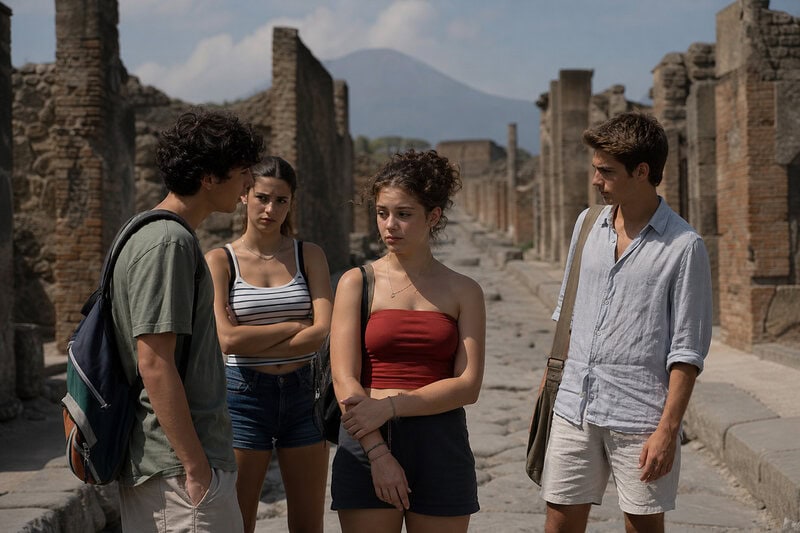
As the trip unfolds, what rises through the group is not new feeling but old feeling — desire, jealousy, passion, and class tension that were already present, already pressurised, waiting only for the right conditions to break the surface. The film’s treatment of class is notably specific: Pompeii’s ruins preserve detailed evidence of Roman social stratification, from the cramped insulae of working people to the elaborate frescoed villas of the wealthy, with slaves’ quarters tucked in between. The film uses this archaeological record as a subtle and pointed commentary on the hierarchies the French students carry with them across the Mediterranean.
The parallel is never forced into explicitness. Atlan trusts her locations to do their work without editorial insistence. The students move through spaces defined by wealth, service, and exclusion, and those spaces quietly inflect the dynamics of the group, shaping who feels comfortable lingering in which rooms, whose knowledge of the site confers status, and whose visibility within the group maps onto older, more durable patterns of social distinction.
In keeping with the Jensen-Freud framework that the title invokes, nothing that surfaces in the group is truly new. It is always something that was already there, buried at a depth that felt safe, until the heat and the ruins and the proximity of mortality made containment impossible. This is the film’s emotional archaeology, and it is conducted with as much care as Fiorelli ever brought to the ash.
Coming-of-Age Drama Tips Toward Modern Tragedy — Innocence Meets Ancient Ruin
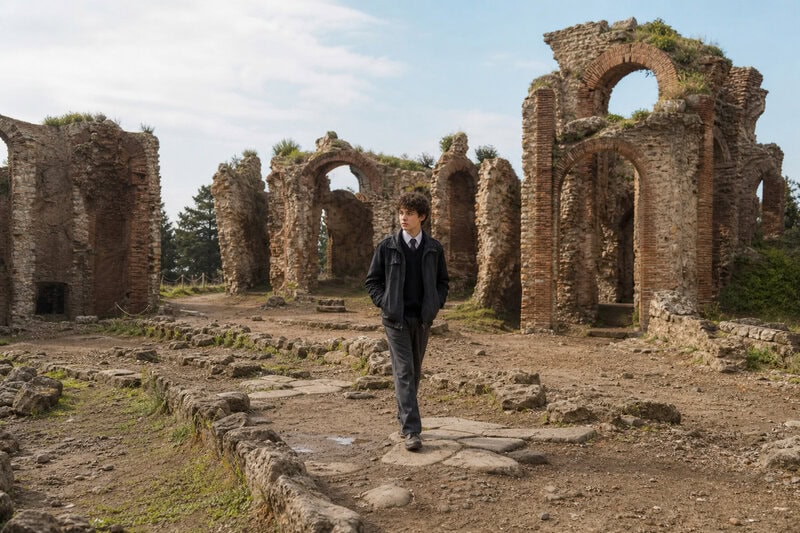
There is a moment in many coming-of-age films where the warmth of adolescent experience curdles into something harder, and La Gradiva earns that moment with unusual patience. The film moves between the register of a tender adolescent portrait and something darker, as youthful innocence is tested not against a single dramatic event but against the accumulated weight of a place where thousands of people died on an ordinary afternoon.
What distinguishes Atlan’s handling of this tonal shift is its refusal of melodrama. The darker register does not arrive with a sudden crisis or a single rupturing incident. Instead it seeps in, the way awareness of mortality tends to arrive in adolescence — not as revelation but as a gradually accumulating pressure, a background frequency that changes the quality of everything else without announcing itself. The ruins do not threaten the students. They simply make certain kinds of innocence no longer entirely convincing.
Pompeii functions in the narrative not as a cautionary tale but as an intensifier — a location where the stakes of ordinary teenage experience, love, humiliation, identity, the terror of being misunderstood, are rendered suddenly and violently legible against a backdrop that has already seen worse. This tonal shift, from coming-of-age warmth to something approaching modern tragedy, is the film’s most ambitious gamble, and the one most directly inherited from the unsettling undertow of Jensen’s original novella.
September 2026: TIFF and BFI London Confirm the Film’s Festival Standing
When La Gradiva reached the 2026 Toronto International Film Festival, the critical response confirmed what the film’s layered ambitions had promised. Reviews praised the film’s ability to hold its dual registers — intimate teenage drama and grand historical backdrop — without either collapsing into the other. That balance, intimate and epic at once, is precisely what the subject demands and what lesser films set against grand ruins so often fail to achieve.
The film subsequently appeared at the 2026 BFI London Film Festival, extending its presence on the international circuit and confirming its standing as one of the year’s distinctive and genuinely considered works. Additional screenings at Cheltenham Film Festival further demonstrated an audience willing to follow the film into difficult, ash-covered terrain. The dual major festival presence — Toronto and London — is a reliable indicator of a work that has found critical traction beyond its country of origin, and in this case the traction seems proportionate to the ambition.
2026: Marine Atlan’s Film Closes the Loop Between Pompeii, Jensen, Freud, and the Present
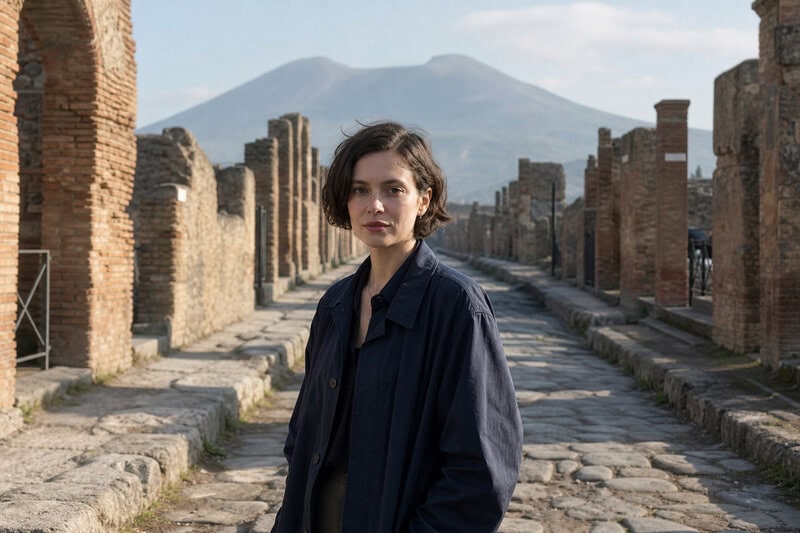
In bringing together a 79 AD eruption, a Roman relief, a German novella, a 1907 psychoanalytic essay, and a 2026 French coming-of-age film, Atlan makes the case that Pompeii has never stopped erupting — culturally, psychologically, imaginatively. Each generation finds in those preserved streets a different mirror, and what they see in it is always, in some sense, themselves.
What gives the film its particular authority is the precision with which it has mapped the connections it inherits. This is not a film that uses Pompeii as picturesque scenery or Freud as fashionable theory. The Jensen-Freud lineage is structural: it determines how the film is built, what it expects its locations to do, and why adolescence and archaeology are not merely analogous but homologous — two disciplines devoted to the same problem of what lies buried, what pressure builds around it, and what happens when it finally breaks through.
The film’s title remains its thesis. By locating the relationship between archaeology and adolescent desire on the same emotional map, La Gradiva joins a long tradition of artists who have understood that what Vesuvius buried was not only a city but a persistent question — about what we carry, what we repress, and what the earth, given enough time and pressure, eventually gives back. Every generation of young people is Gradiva, caught mid-stride, vivid and transient, walking through ruins they did not make and may not survive unchanged.
From the first century to the twenty-first, from Jensen’s dreaming archaeologist to Freud’s consulting room to a school bus pulling into the shadow of Vesuvius, La Gradiva reminds us that the ruins were always waiting, and that the young have always walked among them as though they had all the time in the world.