Somewhere beneath the sun-baked earth of southern Iraq, sealed under nearly five millennia of silence, a room had been waiting — a room with a kitchen, a cooling system, the ghost of a beer recipe, and all the evidence of an ordinary evening that never quite ended.
The Moment the Ground Gave It Up
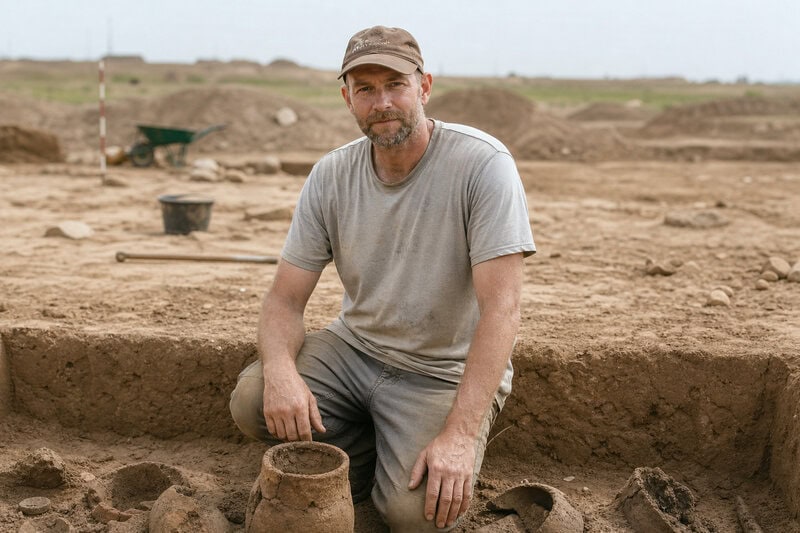
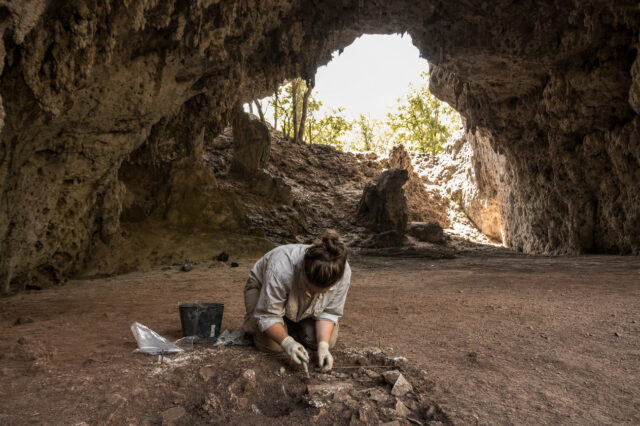
In the fall of 2022, Reed Goodman, a field archaeologist with the Penn Museum, was working a trench at Lagash — one of the great city-states of ancient Mesopotamia, now a low scatter of mounds in the flatlands of southern Iraq. The joint University of Pennsylvania and University of Pisa team had been pushing methodically through the mud-brick strata, season after season, looking for evidence of how ordinary urban Mesopotamians actually lived. What they found that autumn was something that stopped the work and changed the question entirely.
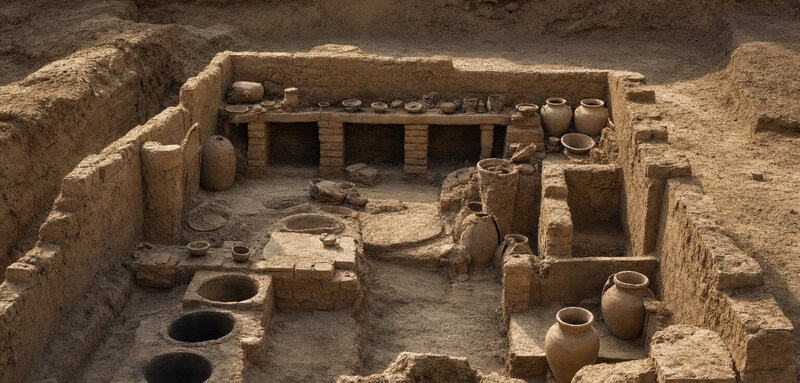
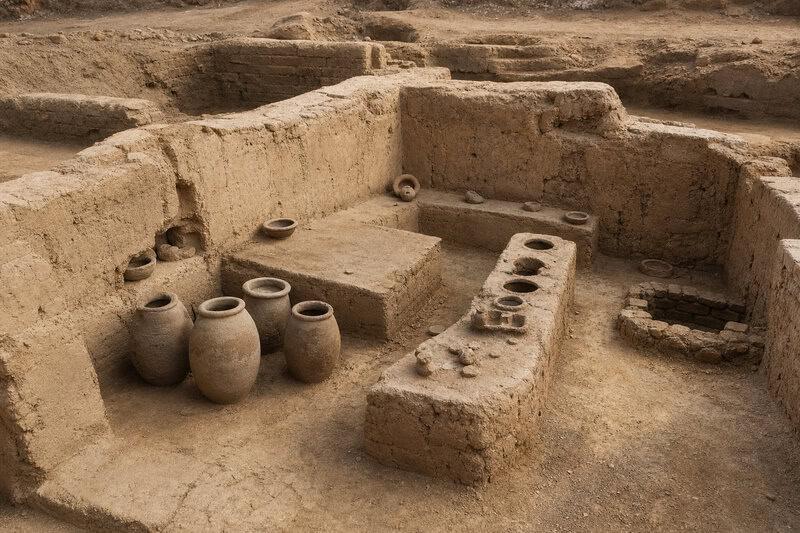
It wasn’t gold. It wasn’t a royal inscription. It was a row of clay pots, arranged in a configuration that any modern caterer would recognize at a glance: a cooling system. The vessels had been positioned to exploit evaporative loss — the same physical principle that keeps a wet cloth cold in a desert wind — keeping perishable food and drink at a survivable temperature through the savage heat of a Mesopotamian summer. The pots were still in rough formation after approximately 5,000 years.
That single detail — the ancient clay-pot refrigerator — was what sharpened Goodman’s hypothesis from “storage facility” to something far more social. Storage rooms don’t need to keep things cold for customers. This one, apparently, did. The Penn Museum team’s subsequent analysis of the full structure would crystallize the picture: an open-air public eating area, a dedicated kitchen, an oven, food remains, and physical evidence of beer production on site. If the dating holds — and the evidence places this firmly around 2700 BC — the mud-brick room Goodman’s team had just walked into is among the oldest known public drinking establishments yet documented anywhere on Earth.
The bar, it turns out, is a very old idea.
What Lagash Was — and Why It Matters
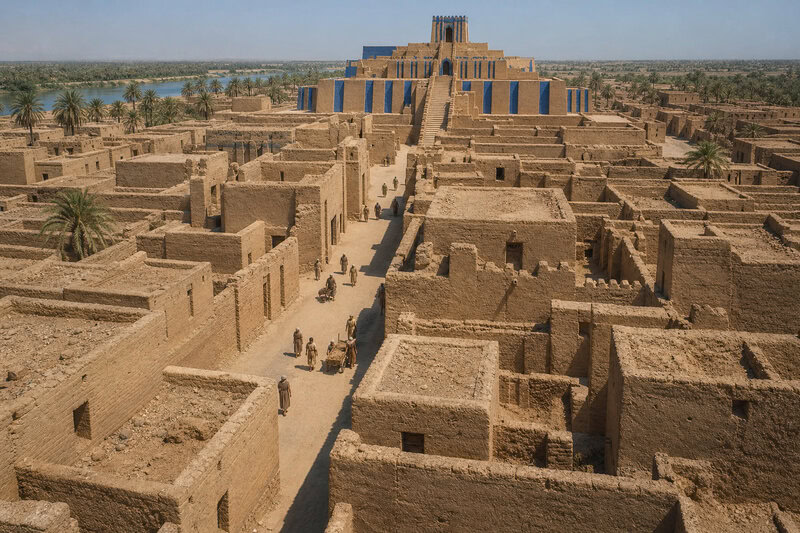
To understand why a tavern here is significant, it helps to understand what Lagash was. Situated in the alluvial plain between the Tigris and Euphrates rivers, in what is now southern Iraq, Lagash was not a backwater settlement. By 2700 BC, it held tens of thousands of inhabitants — a full urban civilization with temples, granaries, administrative bureaucracies, and the dense social texture that only large cities generate. This was Mesopotamia: the civilization that invented writing, codified law, developed mathematics, and apparently also had a well-established tradition of communal drinking.
A tavern in Lagash wasn’t a curiosity at the margins of respectable life. It was, in all likelihood, a civic institution as embedded in daily routine as a temple or a marketplace. People in large cities need places to eat away from home; they need somewhere to sit with strangers; they need, at the end of a long day moving grain sacks or managing irrigation channels, something cold to drink. Lagash, with its scale and its layered urbanism, was exactly the kind of place where such an institution would emerge and thrive.
The US-Italian collaboration between the University of Pennsylvania and the University of Pisa had been drawn to Lagash precisely because its size suggested layers of ordinary life preserved beneath the surface — not just the palaces and temples that dominate the monumental record, but the streets, the kitchens, the gathering places of people who left no inscriptions with their own names. Goodman and his colleagues were specifically interested in the non-elite city — the Lagash that belonged to workers, merchants, and neighbors rather than to kings. The tavern is the most direct answer the site has yet provided.
Inside the Structure: The Physical Evidence
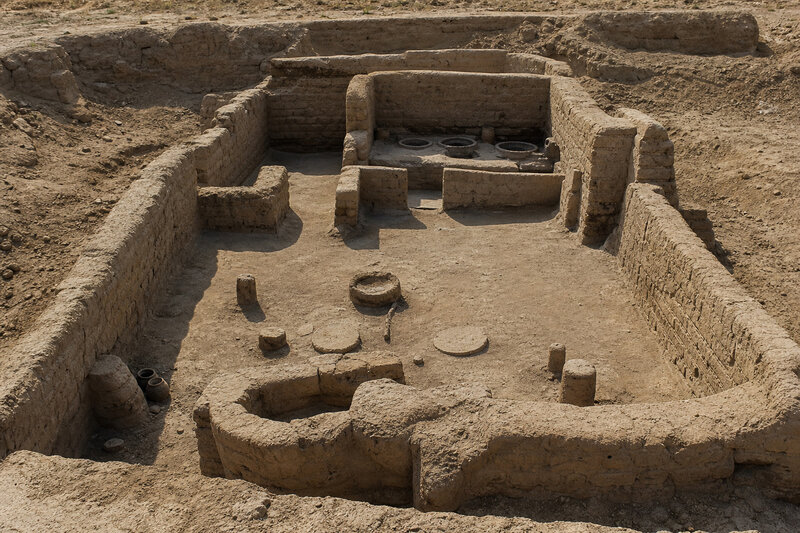
Dating to around 2700 BC, the structure consisted of an open-air public eating area and a dedicated kitchen — a layout that speaks immediately to purpose. This was not a room where someone privately stored provisions. The open courtyard implies patrons, and patrons imply a business. The kitchen implies food prepared for others, not just for a household. Together, they suggest a full-service establishment: somewhere you walked into, ordered, and were served.
The clay-pot cooling system is the detail Goodman’s team kept returning to, and rightly so. The arrangement of vessels to achieve evaporative refrigeration required deliberate design — someone understood the physics well enough to build it on purpose, and built it in a commercial context, which means they needed it to work reliably, day after day, for paying customers. In Mesopotamian summer, with temperatures routinely exceeding 40 degrees Celsius, the difference between a cold drink and a spoiled one was not trivial. The refrigerator was infrastructure.
An oven was recovered from the kitchen zone, and food remains from across the site were still being analyzed at the time of reporting. Most striking for anyone interested in the ancient Mesopotamian food and drink tradition: archaeologists found physical evidence of beer production on the premises. This was not merely a place that received and served beer brewed elsewhere. It may have produced its own — which would place it closer to a brewpub, in modern terms, than a simple inn.
The Beer Recipe Tablet: Drinking by the Book
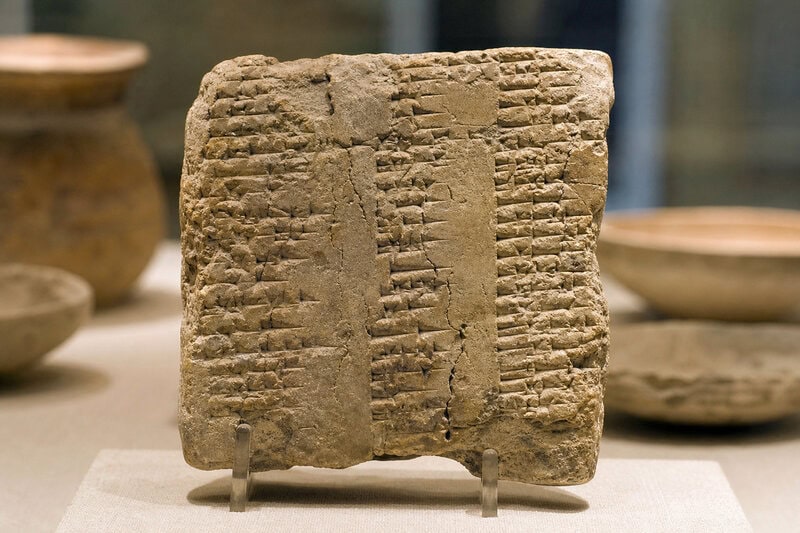
Then there is the tablet. Associated with the site was a document that researchers identified as containing a beer recipe — a detail that transforms the physical remains from an impressive ruin into a named, practiced, literate craft. Someone at Lagash, or closely connected to it, thought the beer recipe worth writing down.
This is worth pausing on. Beer in ancient Mesopotamia was not an indulgence reserved for leisure. It was a nutritional staple — often safer than untreated river water, caloric enough to supplement a laborer’s diet, and distributed as part of workers’ rations on major construction projects. The tavern was, in a real sense, also a feeding station for the city’s workforce. The existence of a written recipe places beer-making firmly in the category of serious, literate knowledge: something worth recording, standardizing, and presumably defending as a trade secret. This was not folk knowledge passed mouth to ear. It was documentation.
For Goodman’s team, the tablet functions as the interpretive anchor that links the oven, the cooling pots, and the food remains into a single coherent picture: not an accidental accumulation of domestic refuse, but a going concern, run by someone who knew exactly what they were doing and had the records to prove it. The beer recipe tablet, combined with the physical evidence of brewing on site, makes the Lagash establishment one of the most completely documented ancient taverns yet found anywhere in the world.
Ancient Mesopotamia Food and Drink: The Broader Context
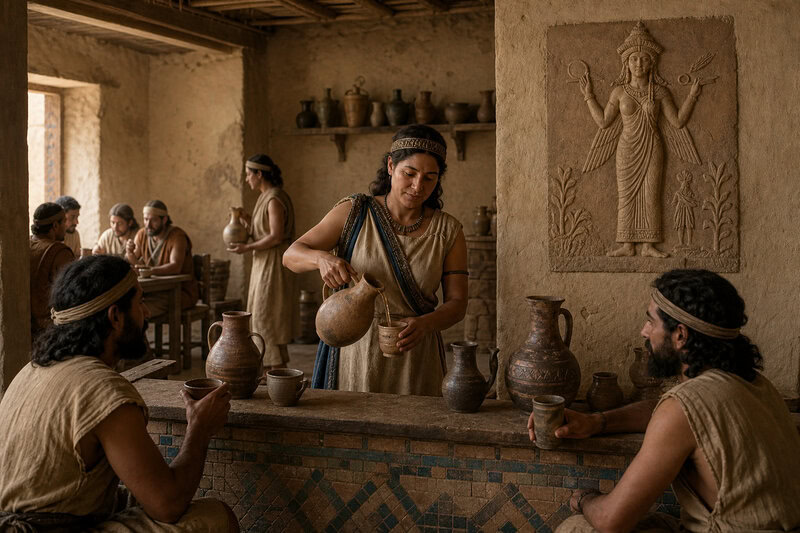
The Lagash tavern does not appear in isolation from the broader historical record — it appears, rather, as a confirmation of it. Mesopotamian texts had long referenced tavern-keepers, often women, as familiar figures in urban life. The goddess Ninkasi was specifically the deity of beer and brewing, and her hymn — one of the oldest religious texts touching on food and drink — doubles as a detailed, step-by-step brewing guide. The tradition of communal drinking was well established in the written record long before this dig season at Lagash.
What the physical site adds is architecture and residue: proof that the textual tradition of communal eating and drinking corresponded to actual built spaces designed for the purpose. It is one thing to know that Mesopotamians wrote about taverns. It is another to stand in one. The open courtyard, the kitchen, the oven, the cooling pots — these are not metaphors from a hymn. They are infrastructure, constructed by people who expected other people to use them regularly.
The food remains, once fully analyzed, could reveal specific grains, fish species, or other ingredients that would allow researchers to begin reconstructing what people actually ate on a given visit — confirming the establishment as a full eating-and-drinking house rather than a single-purpose bar. The discovery reshapes how archaeologists think about the social infrastructure of ancient Mesopotamian cities: alongside the temples and the palaces and the granaries, ordinary urban life had its own dedicated gathering places, with their own architecture, their own equipment, and their own professional knowledge.
Why “Oldest in the World” Is a Claim Worth Examining
The “world’s oldest tavern” label that circulated widely in coverage deserves honest scrutiny, and Goodman’s team offered it. What has been confirmed are remains consistent with a public food-and-drink establishment dating to approximately 2700 BC — which is, on its own terms, a remarkable finding. But archaeology rewards patience over headlines, and the researchers were careful to describe the site as a strong candidate rather than a certified world record.
The case for the designation is nonetheless genuinely compelling. No currently documented site offers the same combination of evidence: an open eating area, a dedicated kitchen, an evaporative cooling system, an oven, food remains, physical evidence of beer production, and a written recipe tablet — all from a single structure, all pointing in the same interpretive direction. Competing sites and future excavations may yet push the record further back; Mesopotamia is vast and incompletely excavated, and southern Iraq in particular has been inaccessible to systematic archaeology for much of the past half-century. But for now, Lagash holds the field among documented examples.
What the find unambiguously establishes, regardless of any superlative, is that by the early third millennium BC, the people of Lagash had developed a recognizable hospitality economy. This was a place you could walk into, order food and beer, and sit down among strangers — which is to say, a place that served exactly the same social function as the pub on the corner, the diner on the highway, the café table where you spend a Tuesday afternoon. The form is ancient. The need it answers is older still.
What Comes Next — and What We’re Still Missing
The work at Lagash is far from finished, and the most viscerally human details may still be ahead. Analysis of the food remains was ongoing at the time of the team’s initial announcement; results could identify specific grains, fish species, or spices that would allow researchers to reconstruct an actual dish from the Lagash menu — to know not just that people ate there, but what they ate, on a particular kind of day, in a city that no longer exists above ground.
The beer recipe tablet requires further translation and contextualization before its full contents are published. It may contain proportions, specific ingredients, or even references to named individuals involved in production. The possibility is not trivial: Mesopotamian administrative texts named workers with surprising frequency, and someone’s professional knowledge may yet emerge from the clay in legible form.
Lagash itself remains largely unexcavated. Goodman’s team has exposed one structure within what may be a much larger social district, and future seasons could reveal neighboring buildings that reframe the tavern as part of a planned market or commercial quarter — a block of urban life rather than a single isolated establishment.
For now, though, the room exists. Reed Goodman and the Penn Museum-University of Pisa team found it in the fall of 2022, in the flat brown earth between the rivers, and what it tells us is both ancient and immediately recognizable: roughly 5,000 years ago, somewhere in what is now Iraq, a person walked into a building, ordered a beer, and sat down to eat. We have found the room where it happened. The pots are still there.