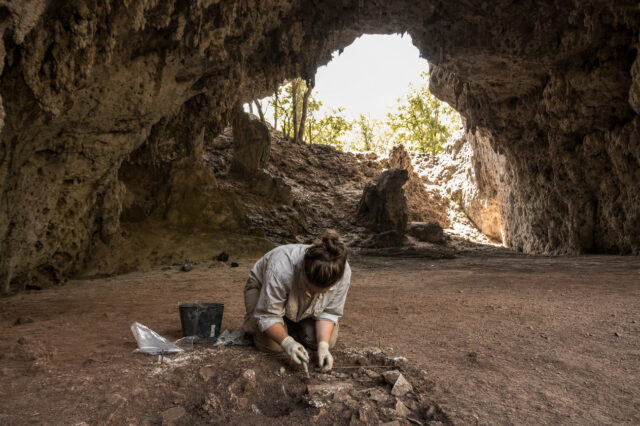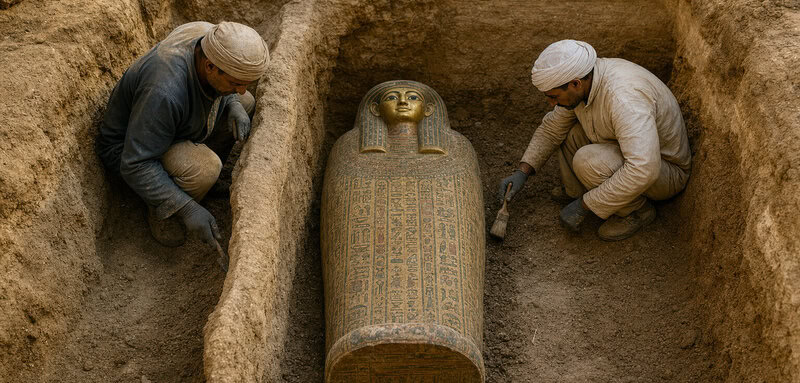
The trowel finds hollow ground before the eye does — a slight give in the resistance, a sound that is almost nothing, and then the particular stillness that settles over a dig site when everyone understands, without being told, that something old has just been opened. That is roughly the texture of what unfolded at Tell Kom Aziza, a low mound rising above the agricultural flatlands of Beheira Governorate in northern Egypt’s Nile Delta, where archaeologists have spent recent field seasons excavating a cemetery so large and so continuous that it is forcing scholars to reconsider what they thought they knew about how ancient Egyptians buried their dead in the Delta.
The Moment the Delta Gave Something Back
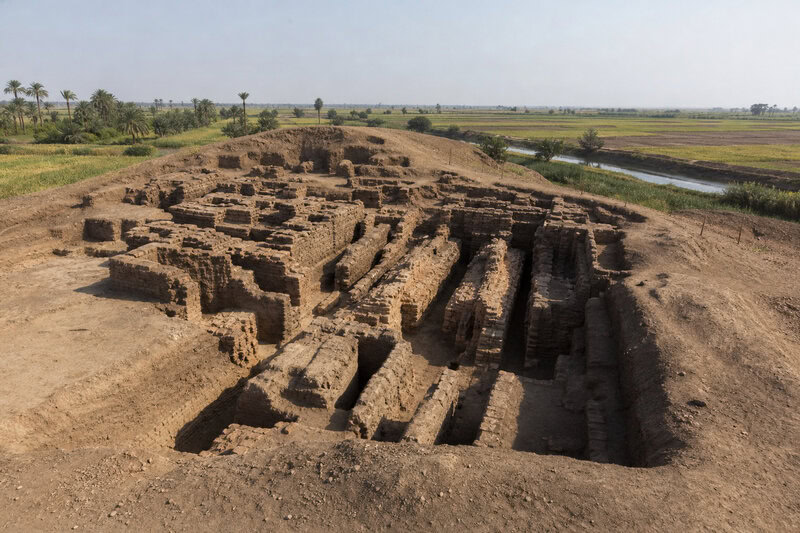
Beheira Governorate sits in the broad western reach of the Nile Delta — the kind of landscape that looks, to the casual eye, like it has always been farmland: flat, green in season, threaded with irrigation channels, unremarkable in every direction. Tell Kom Aziza interrupts that flatness as a tell, the Arabic word for a mound built up over centuries of accumulated human habitation — layer over layer of mud-brick, ash, refuse, and collapsed walls, each stratum a geological record of people who lived and worked and, it now turns out, buried their dead here across an extraordinary span of time.
The excavations at Tell Kom Aziza have revealed a cemetery dated to the Greek and Roman periods, approximately 332 B.C. to 395 A.D. — a span of some 727 years, meaning that great-great-grandchildren may have been interred in ground their ancestors consecrated under the generals of Alexander the Great.
Tell Kom Aziza did not arrive as an isolated announcement. In close succession, Egyptian authorities revealed a second significant discovery: at Tell Atrib Abu Bello, also in northern Egypt, excavators had opened dozens of tombs from the Late Period and the Ptolemaic era, predating the Kom Aziza burials by centuries and reaching back into the last indigenous dynasties before Alexander arrived. Two sites, two sets of excavators, two northern Egypt archaeological finds announced within the same news cycle — together, they extend the known map of ancient Egyptian burial grounds across the Delta in ways that specialists are still absorbing.
What follows traces that map, moving through the evidence from the Tell Kom Aziza site while weaving in the parallel find at Tell Atrib Abu Bello, to build a composite picture of an ancient cemetery discovery in Egypt on a scale that the region’s buried, silt-smothered archaeology has long promised but rarely delivered.
What the Nile Delta Hides — and Why We Keep Being Surprised
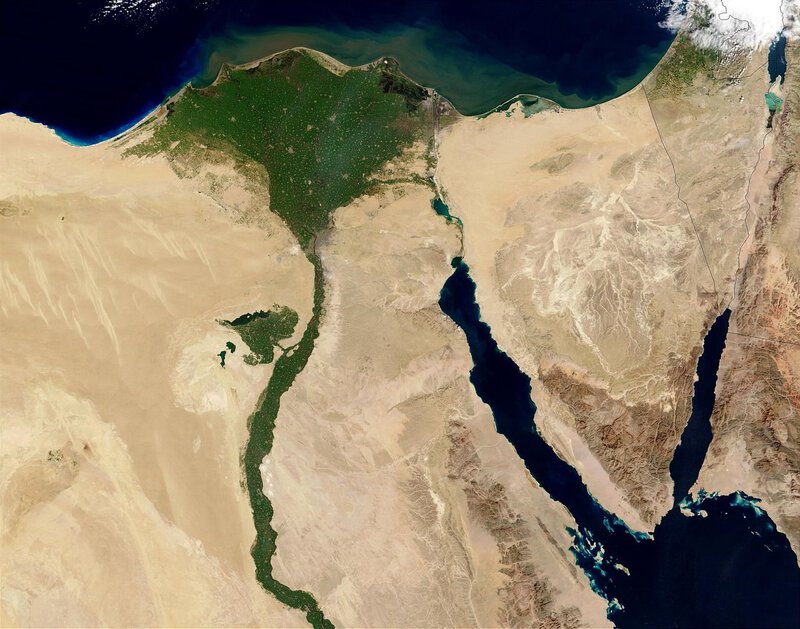
The Nile Delta is one of archaeology’s great paradoxes. It was, for most of antiquity, among the most densely settled and economically productive regions of the ancient world — a place where Greek merchants built trading colonies, where Ptolemaic bureaucrats administered an empire, where Roman grain fleets loaded their holds. And yet it is among the least excavated stretches of ancient landscape anywhere in the Mediterranean world, because millennia of Nile flooding, rising water tables, and uninterrupted modern agriculture have buried entire cities under metres of silt and planted crops on top of them.
Tells like Kom Aziza represent the exception — elevated ground where the floods did not entirely erase what lay beneath, where the accumulated debris of successive occupations pushed the surface high enough to survive. The team chose the site precisely because that elevation suggested layers of occupation worth excavating. What they did not fully anticipate was the scale of what the Greco-Roman stratum would yield. The Delta has been underestimating itself for decades, and the people digging into it keep being surprised by their own surprise.
The cemetery’s date range — 332 B.C. to approximately 395 A.D. — spans the entire Greco-Roman chapter of Egyptian history, from Alexander’s conquest through the final decades of a unified Roman Empire. This was not a stable or homogeneous period. It encompassed the Ptolemaic dynasty, three centuries of rulers who spoke Greek and presented themselves as pharaohs; the Roman absorption of Egypt after Cleopatra’s death in 30 B.C.; and the slow, sometimes violent Christianisation of the late empire. The people buried at Tell Kom Aziza lived through all of it.
The geography of the site matters, too. Burials discovered at Tell Kom Aziza, in the Nile Delta, date to approximately 332 B.C. to 395 A.D. — a span that places this community on the administrative and trade corridors connecting Alexandria to the Egyptian interior, which likely explains both the wealth visible in certain burials and the cultural mixing that makes the site so archaeologically rich. This was not an isolated provincial settlement. It was a community that knew the wider world and left that knowledge in its graves.
Inside Tell Kom Aziza: A Necropolis Across the Centuries
The word necropolis is Greek for “city of the dead,” and it carries a specific meaning: not a scatter of isolated graves but a planned, sustained burial ground implying an organised community with the resources and continuity to maintain sacred space across generations. What the team has uncovered at Tell Kom Aziza qualifies as exactly that.
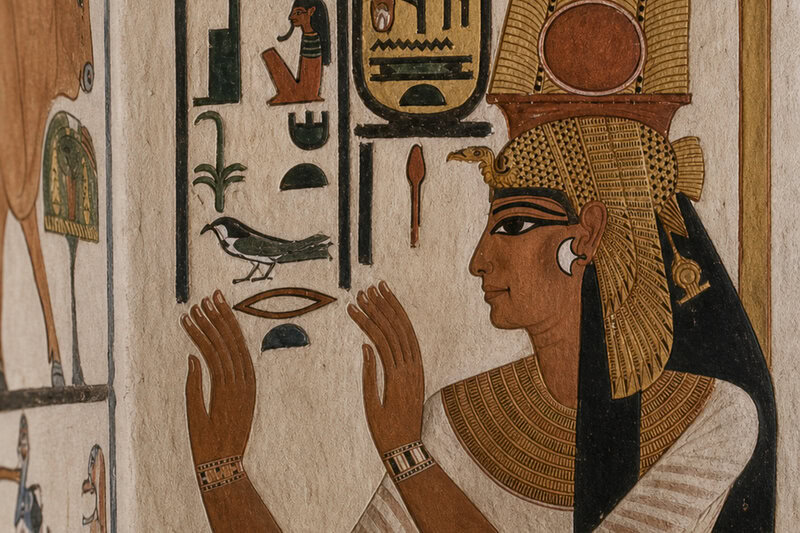
The Greco-Roman stratum at Kom Aziza is distinguished by the coexistence of Egyptian funerary forms with Hellenistic ones — a material record of a population that did not choose one identity or the other but layered them, tomb by tomb. This is the intimate archaeology of cultural negotiation: not the grand declarations of rulers or the official pronouncements of priests, but the private decisions of ordinary families about which gods to invoke, which forms to follow, which language to carve into stone when someone they loved was gone. An ancient Greco-Roman cemetery was discovered at the Tell Kom Aziza archaeological site in Beheira Governorate in northern Egypt, and its contents suggest a community fluent in multiple cosmological languages simultaneously.
The cemetery’s endpoint is itself a historical detail worth pausing on. The year 395 A.D. — the apparent close of burial activity at Tell Kom Aziza — is the year the Roman Empire formally divided into eastern and western halves, and in Egypt it marks the accelerating Christianisation that would, within a generation or two, close the old temple cults and render traditional funerary practices archaeologically obsolete. That the necropolis apparently ceases near this date may be less a coincidence than a material echo of that transformation: the last people buried here in the old way were among the last Egyptians for whom the old way was still available as a choice.
The spatial geometry of the site — which tombs cluster together, which face which direction, where the necropolis edges run — points toward its deepest significance. The relationships between burials are evidence of community: not the objects themselves, however striking, but what it means that certain people were placed near certain others, across centuries of unrecorded grief.
Gold on the Delta: The Tell Atrib Abu Bello Find
At Tell Atrib Abu Bello in northern Egypt, excavators opened dozens of tombs from the Late Period and the Ptolemaic era, reaching back into the last indigenous dynasties before Alexander’s arrival — a stratum older than the Kom Aziza burials by centuries, in some cases predating them by more than three hundred years.
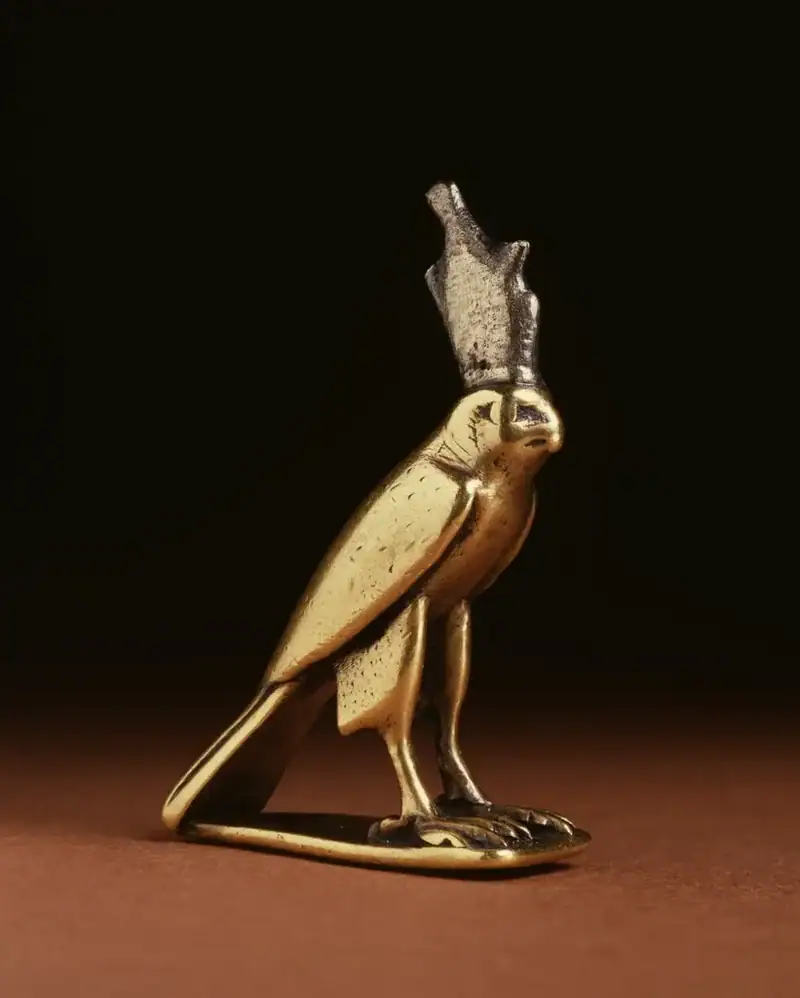
Among the recovered objects: gold amulets and Isis figurines. Small enough to hold in a palm, specific enough to tell a story. Isis — goddess of magic, resurrection, and devoted wifehood — was the deity most invoked to protect the dead on their journey, and her image in gold was not casual ornamentation. It was a theological statement, placed deliberately against the body, a last act of provision by people who believed that what you carried into the grave could matter on the other side.
The gold amulets are not royal treasure. They are personal, portable protection — the kind of object a family of modest means saved for over years, then surrendered to the earth, knowing they would never see it again. This is what distinguishes the Tell Atrib Abu Bello find from a simple inventory of precious objects: it is evidence of ordinary Egyptians who invested real resources, resources they could not easily spare, in the proposition that the afterlife required provisioning. That conviction, stretched across the Late Period and the Ptolemaic centuries, connects these burials to a tradition of funerary belief that was already ancient when the first tomb here was cut.
Taken together with Tell Kom Aziza, the Tell Atrib Abu Bello find extends the continuous record of ancient Egyptian burial practice in the northern Delta across a remarkable span of time — from the Late Period and Ptolemaic era through 395 A.D. — of people burying their dead in this stretch of river-made ground, leaving behind the gold and clay and carved stone of their most private hopes.
What the Bodies Tell Us: Identity, Belief, and the Business of Death
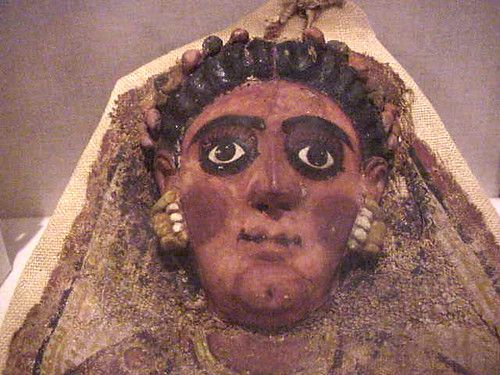
The people interred at Tell Kom Aziza were not simply “Greek” or “Egyptian” but residents of a world where both cosmologies were available simultaneously — where you might pray to Isis and write your name in Greek on the burial marker, where you might follow a pharaonic embalming tradition and place a Hellenistic portrait mask over the face. The grave goods are not evidence of confusion but of sophistication: a population navigating a genuinely pluralist world and doing so with remarkable fluency.
The Isis figurines recovered at Tell Atrib Abu Bello echo this syncretism from an earlier moment. Isis was already a bridge figure long before the Greeks arrived. Her cult was adopted enthusiastically by Ptolemaic Greeks and later by Romans across the empire precisely because her mythology — the devoted wife who searches the world for her murdered husband, the magical resurrector who breathes life back into the dead — translated across cultures with unusual ease. By the time Rome absorbed Egypt, Isis had temples as far afield as Britain and Gaul. That her image in gold was still being placed in Delta graves during the Ptolemaic period is a reminder that the cult’s international career began at home, in the hands of people who believed in her literally, personally, and urgently.
For scholars of these northern Egypt finds, the significance lies not in any single object but in the cumulative weight of ordinary decision-making now made visible: which goddess to carry into death, which language to carve, how much gold a family could spare. These are the choices that centuries of silt had hidden, and that careful excavation is now returning to the record.
Why Now? The Forces Bringing Egypt’s Buried Cities to Light
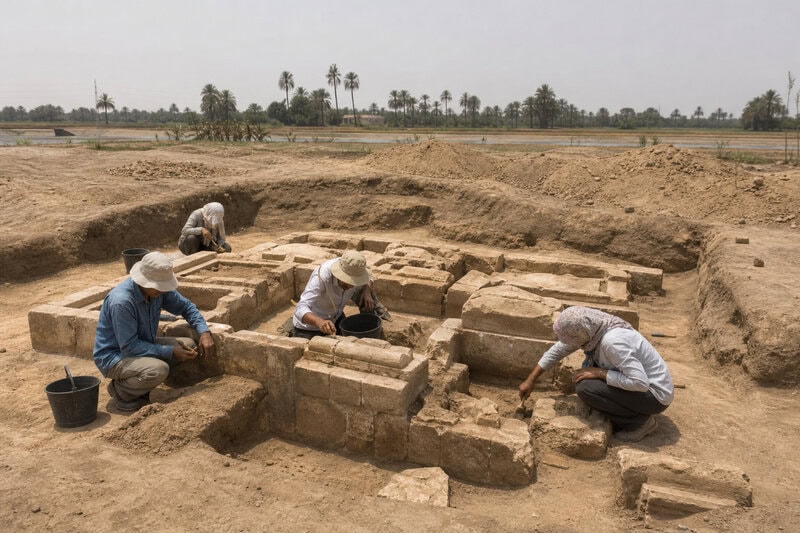
Several converging forces are accelerating discovery in the Delta at a rate that would have seemed unlikely a generation ago. Satellite remote-sensing can now detect subsurface anomalies through metres of accumulated silt. Egyptian authorities have expanded permits for joint international missions, bringing together Egyptian archaeologists and foreign specialists in ways that earlier decades of more restricted access did not allow. Agricultural drainage projects, while sometimes destructive to the sites they accidentally expose, also bring previously waterlogged strata within reach of excavation for the first time.
The team at Tell Kom Aziza represents the collaborative model driving this acceleration: Egyptian archaeologists working alongside specialists in Hellenistic material culture, bringing complementary expertise to a period that has historically fallen between academic disciplines — too Greek for some Egyptologists, too Egyptian for some classicists. The Greco-Roman period in Egypt has long been an orphan in the institutional sense; the finds now emerging from the Delta are helping to legitimate it as a field in its own right.
The Egypt necropolis discovery at Tell Kom Aziza joins a run of significant finds in Beheira and neighbouring Delta governorates over the past decade — a pattern suggesting not that ancient Egyptians suddenly buried more people here, but that the tools to find them have finally caught up with the terrain. What the Delta holds has not changed. What we can see of it has.
Critically, both sites are described as only partially excavated. The maps drawn today will need to be redrawn again. What has been found at Tell Kom Aziza and Tell Atrib Abu Bello is almost certainly a fraction of what remains beneath the fields.
The Living Map and What Comes Next
Both sites — the ancient Greco-Roman cemetery at Tell Kom Aziza and the Late Period and Ptolemaic tombs at Tell Atrib Abu Bello — are now under formal Egyptian Ministry of Tourism and Antiquities protection, with ongoing excavation seasons planned. The discoveries are not endpoints. They are openings into a landscape that has been accumulating evidence of human life, and human death, for longer than most of the cities now sitting above it have existed.
The broader significance for the ancient Egyptian burial site record is geographical as much as historical. Northern Egypt — the Delta, the coastal lowlands, the agricultural provinces that fed the ancient world — has long been treated as a less glamorous cousin to the Luxor-Aswan corridor, where temples are intact and tombs are painted and tourists arrive by the busload. The finds accumulating in Beheira and its neighbouring governorates are beginning to rebalance that picture: the Delta, it turns out, also has its cities of the dead, also has its gold, also has its Isis, also has its centuries of silence waiting to be broken.
The gold amulets of Tell Atrib Abu Bello, the layered tombs of Kom Aziza, the Isis figurines placed against bodies by hands that believed in what they were doing: these are not exotic artefacts from a vanished civilisation. They are evidence of people making the most intimate decisions available to them, in the only language they had, about what happens after the light goes out. And somewhere in the flat, silt-rich ground of the northern Delta, the trench that will add the next chapter to that record is waiting for the next trowel — patient, as buried things always are, and far from finished.