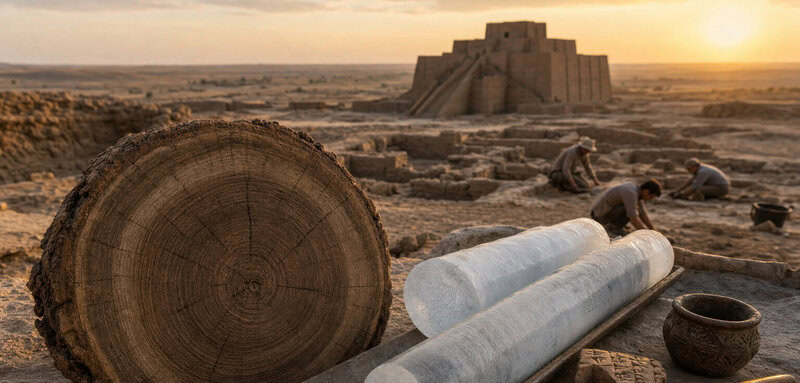
Ancient timelines once rested entirely on clay tablets and king lists — until researchers discovered that trees and ice sheets had been keeping their own meticulous records all along.
One morning in Belfast, a dendrochronologist named Mike Baillie was staring at something that had no business being where it was: a dramatic narrowing in the growth rings of ancient Irish oaks — a biological scream of cold, darkness, and stress — that simply refused to align with the dates chiseled into Mesopotamian clay tablets half a world away. The trees were saying one thing. The historians were saying another. And the trees, Baillie had spent his career arguing, do not lie.
The Moment a Tree Contradicted a King List
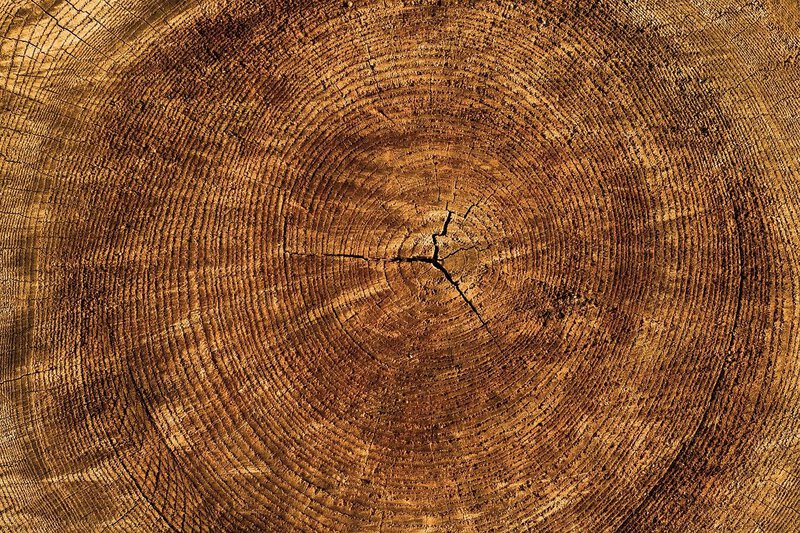
The dissonance Baillie encountered was not the kind that resolves itself with a footnote. It was structural. For more than a century, scholars had assembled Mesopotamia’s ancient timeline from king lists, astronomical diaries, and careful cross-references between neighboring civilizations — a chain of inference that was impressively built and impressively fragile. Every link in that chain was forged by human hands, copied by human scribes, and interpreted by human scholars, each generation inheriting the accumulated assumptions of the last.
What Baillie was holding, by contrast, was a physical archive. The ancient oaks pulled from Irish bogs had been growing, dying, and preserving their yearly diaries in wood for millennia before anyone thought to look at them. No scribe had touched them. No dynasty had reason to adjust them. And certain years in that archive showed something extraordinary: near-zero growth across multiple species, in multiple countries, on multiple continents — the unmistakable signature of a catastrophic event in the upper atmosphere, most likely a volcanic winter powerful enough to dim the sun and wreck harvests from Britain to the banks of the Euphrates.
If the trees were right about when those catastrophes occurred, then some of the most consequential dates in ancient Near Eastern chronology — the reign of Hammurabi, the fall of the Akkadian Empire — might need to shift by decades. That is not a small revision. That is a redrawn map.
Why Mesopotamia’s Timeline Was Always a Negotiation

To understand why tree rings have the power to unsettle ancient Mesopotamian history, it helps to understand how precarious those dates always were. Since the early twentieth century, scholars have recognized not one but three competing frameworks — known as the High, Middle, and Low chronologies — each placing the reign of Babylon’s most famous king, Hammurabi, in a different century. The High Chronology puts him ruling around 1848-1806 BCE. The Middle places him around 1792-1750 BCE. The Low drops him to roughly 1728-1686 BCE. These are not marginal disagreements among specialists quibbling over footnotes. They represent a swing of more than a century in the foundational scaffolding of ancient history.
The entire debate has long pivoted on a single, almost absurdly overloaded document: a set of Babylonian astronomical observations recording the appearances and disappearances of Venus, associated with a king named Ammisaduqa. Because Venus follows a predictable cycle, scholars reasoned, the tablet could be anchored to an absolute calendar date — and from that one anchor, the whole sequence of Mesopotamian reigns could be hung. The problem is that the Venus cycle repeats approximately every sixty-four years, meaning the observations are mathematically compatible with multiple absolute dates. The Venus Tablet of Ammisaduqa is, in essence, an ambiguous clock. A remarkable amount of weight for one piece of baked clay.
Baillie’s career was built on the conviction that biology provides a check on exactly this kind of uncertainty. Living things record events in their tissues without political agenda. The question was whether the two archives — wood and clay — could be made to speak to each other.
What Tree Rings Actually Record — and Why It Matters Here
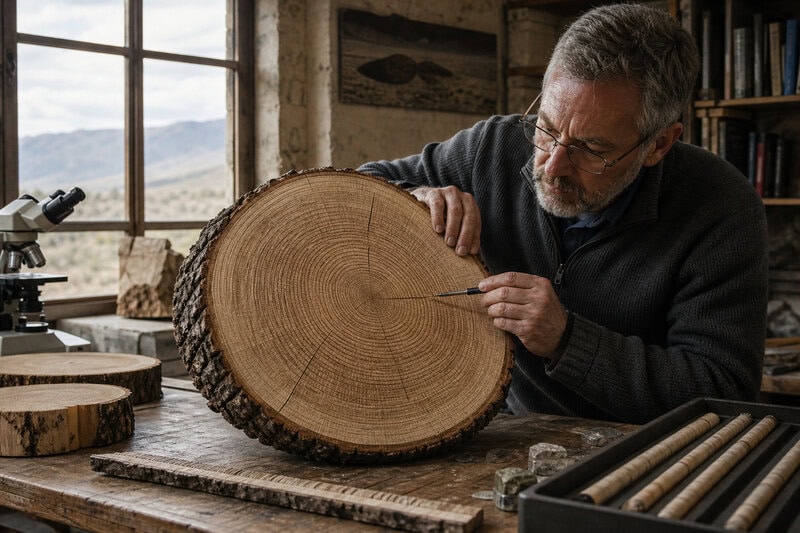
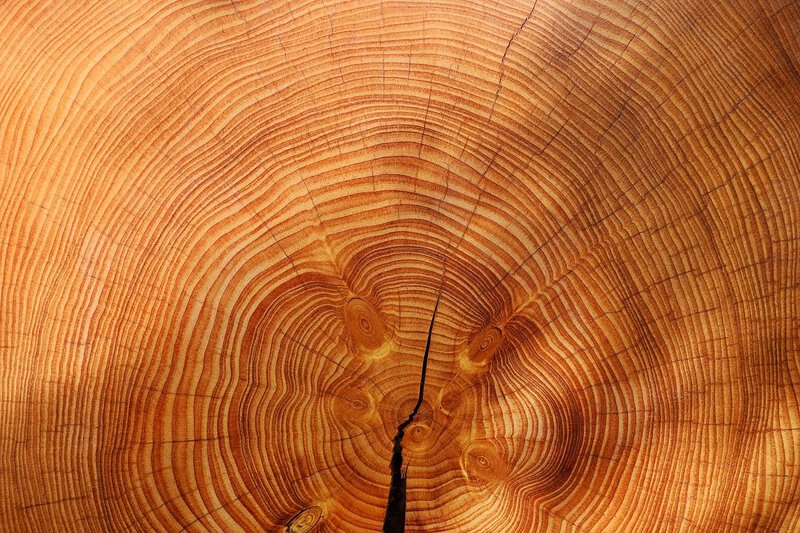
Each annual ring in a long-lived tree is, in the plainest possible sense, a year’s worth of autobiography. Wide rings mean warmth, moisture, and growth. Narrow rings mean stress — drought, cold, disease, atmospheric disruption. When researchers find narrow rings appearing simultaneously across trees in Ireland, Germany, and the American Southwest, they are not looking at local weather. They are looking at something that altered the global atmosphere.
Baillie and his colleagues at Queen’s University Belfast spent decades constructing continuous, cross-dated chronologies from Irish bog oaks and German subfossil timbers, eventually pushing the record back more than seven thousand years without a single gap. This kind of dendrochronological sequence is ruthlessly precise. Each ring is counted and cross-matched against overlapping samples; a misdated ring leaves a signature that statistical analysis will catch. The result is an independent clock accurate to a single year.
Within that clock, certain years stand out like alarm bells. Around 2345 BCE, the rings across Europe tighten dramatically. Around 1628 BCE, another severe narrowing appears. These events would have meant shortened growing seasons, failed harvests, and famine across the agricultural heartland of the ancient world — including the flood plains between the Tigris and Euphrates where Mesopotamian civilization was conducting its extraordinary experiment in organized urban life. The connection between Mesopotamian chronology and tree rings becomes legible here: if a tree-ring-dated catastrophe corresponds to a historically documented political collapse, the biology can pin that collapse to a year with a precision that no king list can match.
Ice Cores Enter the Witness Box
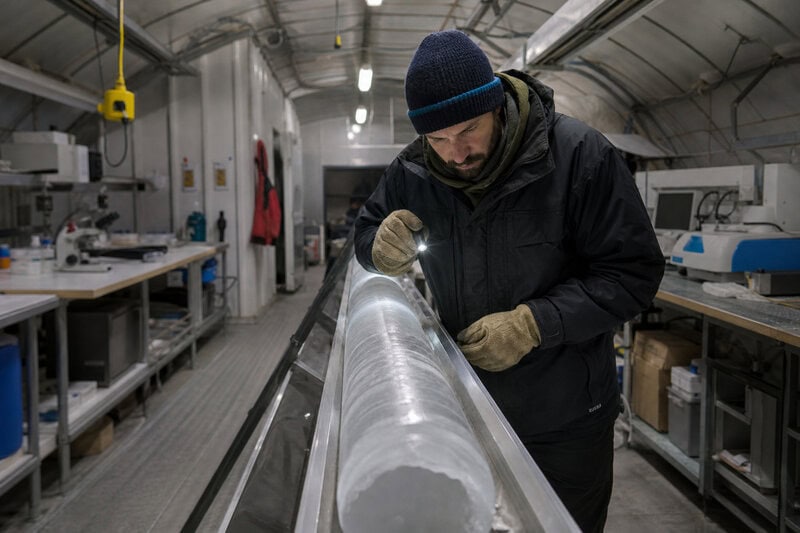
If Baillie’s trees were the first witness, the ice cores drilled from Greenland and Antarctica were the corroborating testimony that made the case difficult to dismiss. Snow falls in Greenland every year, compressing into annual layers of ice that trap, among other things, the chemical residue of whatever was floating in the atmosphere at the time. A major volcanic eruption injects sulfate aerosols into the stratosphere; those aerosols eventually settle out of the air and are locked into the ice at the depth corresponding to that year. Drilling down through those layers is, quite literally, reading the atmosphere backward through time. Those same eruptions that left sulfate spikes in Greenland also left narrow rings in trees across the Northern Hemisphere, which is how ice core data intersects with Mesopotamian dating.
When a sharp sulfate spike in the ice is cross-matched with a severe narrow-ring event in the trees, researchers have something genuinely powerful: two independent, physically preserved, annually resolved records agreeing on the same year. That kind of double witness is extraordinarily hard to argue away. And when researchers began mapping these combined signals onto the ancient Mesopotamian timeline, the results were uncomfortable for the traditional chronology.
The collapse of the Akkadian Empire — the world’s first true empire, which dominated Mesopotamia for roughly a century and a half before fragmenting in what ancient texts describe as a catastrophic reversal — is associated in the textual record with a date somewhere around 2200 BCE. Physical evidence from across the region, including the now-famous Tell Leilan excavation in Syria directed by archaeologist Harvey Weiss, points to a prolonged drought of extraordinary severity striking the ancient Near East at precisely this period. The ice cores and tree rings place a major atmospheric disruption in the same general window. The ice cores do not mention Sargon’s successors by name, but they record, with cool chemical precision, the sky that fell on them.
The Revised Picture — and What Shifts
The emerging picture from this interdisciplinary work is not a wholesale demolition of Mesopotamian chronology — it is a refinement, a retuning of the instrument. The ancient Mesopotamia timeline, as revised by these physical sciences, may shift certain periods by anywhere from a few years to several decades, depending on which event and which anchoring point researchers are using. These sound like small numbers. They are not.
Chronology in the ancient world is a synchronization problem. Egyptian history, Hittite history, Aegean prehistory, and Mesopotamian history are all cross-dated to one another through a web of diplomatic records, trade goods found in datable archaeological contexts, and astronomical references. When you move one node in that web — say, Hammurabi’s reign — the tension ripples outward through every connection. Shifting Hammurabi by thirty years rewrites when his famous law code was inscribed relative to events in Egypt’s Middle Kingdom. It reassigns archaeological strata. It moves ceramic sequences. It changes the labels on museum cases in London, Chicago, and Berlin, and it quietly invalidates portions of thousands of published excavation reports.
Baillie’s most debated specific contribution involves the severe tree-ring event dated to around 1628 BCE. This date has also been proposed — controversially — as the date of the massive Thera eruption in the Aegean, an event whose ash layer and tsunamis would have affected the entire eastern Mediterranean world. If that synchronization is correct, it creates a fixed point of extraordinary leverage. Everything tied to Thera can in principle be retimed, and through Thera’s connections, the whole interlocking system of Bronze Age chronology gets quietly re-surveyed. Some of the reassignments are minor. Some are consequential enough to rewrite textbook chapters — a prospect that makes institutional archaeology understandably uneasy.
The Resistance — and Why It Is Not Entirely Unreasonable
The pushback from textual historians has been substantive, not merely defensive. Tree rings, the critics reasonably point out, record climate. They do not record politics. The interpretive steps required to connect a cold year in an Irish bog oak to the fall of a specific Mesopotamian dynasty are not trivial — they require assumptions about how quickly famine translates into political collapse, about whether Mesopotamia was affected by the same atmospheric event visible in European trees, and about whether the historical record is identifying the right collapse to correlate with. Each of those assumptions carries its own error bar, and stacking them can produce a result that appears more precise than it actually is.
The Thera date in particular remains genuinely contested. The 1628 BCE dendrochronological marker is real. Whether it was caused by Thera, and whether Thera’s eruption is correctly synchronized with Mesopotamian or Egyptian records, involves a chain of argument that Baillie himself presented as a compelling hypothesis rather than a settled conclusion. The ice core evidence for Thera at that date has been both supported and challenged by subsequent drilling and chemical analysis. This is science in progress, not science completed.
What has shifted, though, is the texture of the disagreement. Two decades ago, many textual historians were prepared to argue that physical science had little to contribute to chronological debates best settled by specialists in cuneiform. Today the argument is largely about the size of the revision, not whether revision is warranted at all. That is a meaningful concession, even when it arrives without fanfare.
Sharper Tools, Narrowing Margins
The tools are improving faster than the debates can resolve them. New high-resolution ice core drilling is producing sulfate records with sub-annual precision. Bayesian radiocarbon modeling — which treats multiple radiocarbon dates as a statistical ensemble rather than isolated measurements — is steadily narrowing the error bars on key archaeological transitions. Tree-ring databases are expanding into the Eastern Mediterranean, where subfossil and archaeological timbers from Turkey, the Levant, and Cyprus are beginning to fill geographical gaps that previously limited the analysis. Each new dataset is another voice added to the chorus that Baillie first assembled in Belfast.
It is worth pausing on what this methodological progress actually means in practice. A single radiocarbon date from a charred beam in an excavated palace might carry an uncertainty of plus or minus eighty years — wide enough to accommodate any of the three competing Mesopotamian chronologies. A Bayesian model incorporating thirty radiocarbon dates from the same stratigraphic sequence, constrained by known tree-ring marker years, can shrink that window to under two decades. The difference between those two error ranges is the difference between ambiguity and an answer.
Dendrochronological coverage of the Eastern Mediterranean is itself a rapidly developing frontier. Researchers including Sturt Manning at Cornell University have worked to build tree-ring sequences from long-lived Aegean and Anatolian timbers, with the explicit goal of anchoring Bronze Age chronology more firmly to the absolutely dated European sequences. The geographical extension of the tree-ring record is not merely a technical exercise — it closes the distance between Baillie’s Irish oaks and the palace archives of Ugarit and Hattusa, reducing the number of inferential steps separating the biological record from the historical one.
What It Means to Read the Past in Two Languages
Baillie’s larger legacy may be less about any specific date and more about a methodological proposition: that history written in living matter — in wood, in ice, in pollen preserved in lake sediment — belongs in the same evidentiary conversation as history written in clay and papyrus. The two archives are not in competition. They are witnesses to the same events, speaking in different languages, and the work of scholarship is translation.
That translation is genuinely difficult, and honesty requires acknowledging where it currently fails. Atmospheric events recorded in Greenland ice are global; their effects on specific agrarian societies depend on regional climate patterns that are themselves imperfectly understood. The Fertile Crescent is not Ireland, and a volcanic winter that devastated harvests in the British Isles may have affected the Tigris-Euphrates floodplain quite differently, or not at all in the same year. Responsible chronological revision demands that these regional uncertainties be carried through the analysis rather than quietly dropped at the door.
What cannot be responsibly dismissed, however, is the cumulative weight of convergent evidence. When a sulfate spike in Greenland ice, a narrow-ring event in Irish oaks, a drought horizon in Syrian lake sediment, and an archaeological abandonment layer at Tell Leilan all cluster around the same narrow window of time, the probability that this clustering is coincidental shrinks toward the negligible. The physical record is not telling us exactly who collapsed and why. It is telling us, with increasing confidence, when. And when, in the ancient world, is precisely what has always been in dispute.
For the curious reader, the deeper implication is both vertiginous and wonderful. The ancient Mesopotamians left us their words — their law codes and their lamentations, their astronomical observations and their royal boasts. But the atmosphere they breathed, the volcanic winters they endured, the harvests that failed and the rivers that ran low, are preserved in ice a mile deep beneath Greenland, undisturbed and dateable, waiting patiently to be read. The timeline of one of humanity’s first great civilizations is not a fixed monument carved in stone. It is an ongoing argument between the archive and the earth itself — a negotiation that has been running since Baillie first noticed, in a Belfast laboratory, that an ancient tree was quietly contradicting a king.