It looked like nothing — a fist-sized lump of salt-eaten metal, pulled from a Welsh beach by a detectorist whose machine had registered something worth stopping for. What it actually was, nobody would fully understand for another twenty-seven years.
A Lock With No Key — Found on a Welsh Beach After 400 Years
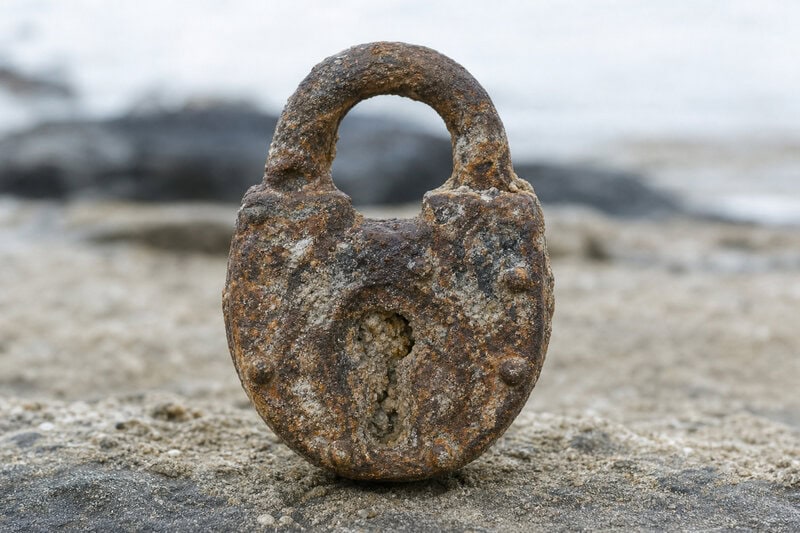
The padlock had been lying in the sand since 1583, the year the merchant vessel Ann Francis went down off the Welsh coast. When the detectorist surrendered the find — and it is worth pausing on that detail, because surrender it he did, rather than pocket it or sell it — the corroded object passed into the care of Amgueddfa Cymru, the National Museum Wales, where it entered conservation storage and sat there, sealed, for the better part of three decades.
Mark Redknap, Head of Collections and Research at Amgueddfa Cymru and lead expert on the Ann Francis project, saw the lock for what it was: not a curiosity to be catalogued and shelved, but a puzzle with an answer still inside it. The lock carried a four-letter combination — four rotating letter-rings that had to align to a specific sequence before the shackle would release. That sequence had not been entered since sometime in or before 1583. Redknap recognised that the object was possibly the oldest combination lock ever recovered from a shipwreck, and that someone, once, had known the word that opened it. The question was whether anyone ever would again.
It was, quietly, one of maritime archaeology’s most patient cold cases — a shipwreck combination lock from the reign of Elizabeth I, waiting for technology that would not exist for another four centuries.
The Ann Francis and the Night the Welsh Coast Swallowed Her

The Welsh coastline has always been unforgiving to ships. Its shallows and storms collected hulls the way a drain collects leaves, and the Ann Francis — a working Elizabethan merchant vessel — was simply the latest victim when she went down in 1583, almost certainly caught in the violent weather that made these waters notorious. Welsh locals, struggling to make sense of catastrophe before the age of meteorology, settled on a more satisfying explanation: a witch had cursed the vessel and dragged it under. That piece of folklore clung to the Ann Francis‘s memory for generations, which is, in its own way, a form of historical record — evidence of how communities narrate disaster when they have no other tools.
The ship herself was the kind of vessel that carried locked strongboxes, personal valuables, and trade goods across waters where piracy and opportunistic theft made security a genuine commercial priority. Redknap and his colleagues at Cardiff University understood that the wreck site represented something rare: an intact window into 16th-century maritime life, the kind that shipwreck archaeology almost never delivers undisturbed. The padlock was not an ornament. It was a working mechanism, set to a code, used to protect something specific, by someone specific, on a vessel that did not reach its destination.
The History of the Combination Lock — Older and Stranger Than You Think
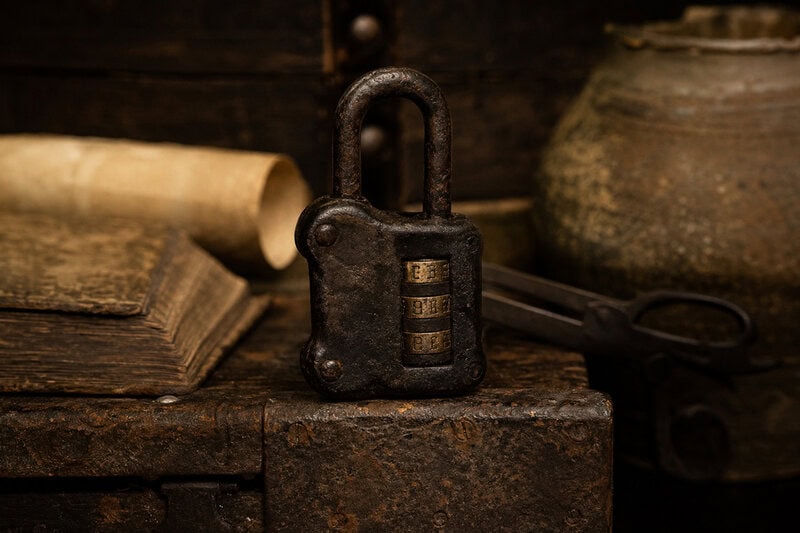
Here is where the Ann Francis lock becomes more than a local story. The documented history of the combination lock in European sources reaches back to at least the early 1600s — which makes a physical example dated to 1583 a candidate for one of the earliest ever recovered. The object in Redknap’s care, in other words, may predate the written record of its own technology.
The practical appeal of a combination mechanism to an Elizabethan merchant was straightforward: no key to lose overboard, no duplicate to steal, no locksmith to bribe. Only a remembered word or sequence stood between a thief and the contents. The Ann Francis lock’s four-ring letter design — sophisticated enough that the team could not simply force it without destroying the artifact entirely — suggests that mechanical ingenuity at sea was not a later innovation but a Tudor-era necessity. The history of combination lock technology, it turns out, has been quietly waiting to be rewritten by a corroded object in a Welsh museum’s storage room.
The CT Scan That Saw Through 400 Years of Silence

The breakthrough, when it came, arrived not from a locksmith’s pick but from a CT scanner — the same technology that reads broken bones and diagnoses tumours in hospital radiology departments, turned here on a fist-sized object encrusted with four centuries of marine corrosion. Experts from Amgueddfa Cymru and Cardiff University used CT scanning technology to map the lock’s internal mechanism in three dimensions without touching a single corroded component.
What the scans revealed was the precise alignment of the internal detents — the small catches that hold each letter-ring in place — allowing researchers to calculate, letter by letter, which four-character sequence would release the shackle. It was, in effect, archaeological safecracking conducted entirely through imaging: not brute force but computation, patience, and the willingness to let the object dictate the method. The lock survived precisely because nobody had forced it. The technology needed to read it non-destructively had simply not existed when it arrived at the museum. Twenty-seven years, it turned out, was not negligence. It was the right amount of time.
Cracking It — What the Four Letters Revealed

When Redknap’s team aligned the four letter-rings to the combination the CT data had identified, the shackle released. A mechanism that had not moved in approximately 400 years responded, at last, to the correct sequence. That the lock opened at all — that its internal components had survived submersion, marine burial, and the passage of four centuries sufficiently intact to function — is itself a detail that stops you short.
The four-letter code represents either a word meaningful to the lock’s original owner — a name, a vessel, a port, a private reference now beyond any personal record — or a chosen sequence that meant something only to the hand that set it. What the find confirms is that the lock was functional and in active use at the time of the sinking: this was not a novelty or a display piece but a working mechanism protecting something its owner valued enough to combination-lock on a sea voyage. The 16th-century lock found by a detectorist on a beach in Wales had, it turned out, been keeping faith with its last owner all along.
For Redknap, the moment of opening collapsed the distance between a Tudor mariner setting a code on the Ann Francis and a museum researcher reading that same code back from an X-ray. It is the most intimate kind of contact maritime archaeology can offer — not the grand sweep of history, but the small, precise fact of a shared sequence, known once and then known again.
What This Changes for Shipwreck Archaeology and Beyond
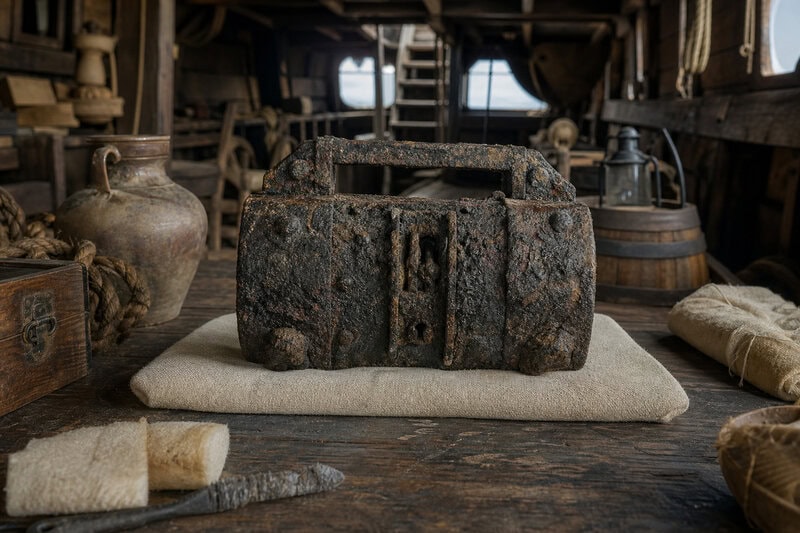
The Ann Francis lock now joins a small and significant category of maritime archaeology finds that redate or reframe the technological history of everyday objects — pushing the confirmed physical record of combination lock design back toward the late 16th century. That is a meaningful correction to the history of combination lock development, delivered by a corroded padlock from a beach in Wales rather than by any archive or document.
The 27-year gap between discovery and unlocking is itself an argument — an unusually persuasive one — for a particular kind of patience in conservation science. The detectorist who surrendered the find rather than selling it, and the museum that held it rather than forcing it, made the eventual discovery possible. It is not the most obvious lesson to draw from an adventure story, but it is the true one.
Redknap has indicated that the Ann Francis site off the Welsh coast likely holds further material, and that the lock — now opened, documented, and preserved — will return to Amgueddfa Cymru’s collection as one of its most significant maritime objects. The wreck that locals once blamed on a witch may yet yield further evidence of the entirely human world that went down with her.
The Witch, the Wreck, and What Locks Keep
The Welsh legend of the witch who sank the Ann Francis will not be overturned by a CT scan — folklore does not yield to radiology, and it was never really trying to explain the same thing. But the lock offers its own counter-narrative: a world of practical, mechanical sophistication aboard a doomed ship, a world in which Tudor merchants and sailors were clever enough to devise combination security and disciplined enough to remember a four-letter code across an open-sea voyage.
Combination locks are, at their core, objects of distrust — built on the assumption that someone, somewhere, will try to take what is not theirs. The Ann Francis‘s final voyage, ending in storm and catastrophe off the Welsh coast, proved that the distrust was sometimes beside the point. The sea does not need a code.
Redknap’s work on the lock is a reminder that shipwreck archaeology is never only about ships. It is about the people who packed their valuables, set their codes, and believed — until the moment they were wrong — that they would reach the other side. The Ann Francis went down with her secrets in 1583. Four hundred and forty-odd years later, one of them, at least, has finally come up.