
In the winter of 1876, a German costume designer named Carl Emil Doepler sat at his worktable and drew a helmet with horns — and in doing so, accidentally rewrote the popular history of an entire civilization.
The Night a Costume Sketch Changed History

Doepler had been hired for the most prestigious theatrical commission in Europe: designing the costumes for Richard Wagner’s monumental opera cycle Der Ring des Nibelungen, set to premiere at the newly built Bayreuth Festspielhaus before an audience that included Kaiser Wilhelm I. The pressure was extraordinary. Wagner wanted grandeur, ancient mystery, the full thunder of Norse myth made visible. Doepler, a serious and well-traveled man who had studied historical artifacts in museums across Europe, reached for the most dramatic visual language he could find. He sketched Wotan — the Allfather of Norse mythology — wearing a great, swept-back horned helmet. The effect was exactly what the opera house demanded: savage, primordial, immediately legible as other.
Doepler’s source material, to his credit, was not entirely invented. He had encountered engravings of Bronze Age Scandinavian artifacts in museum collections — objects that genuinely did feature horns. What he did not fully reckon with, and what would haunt the historical record for the next century and a half, was the timeline. The imagery he borrowed predated the actual Viking Age by roughly two thousand years. He had, in theatrical terms, dressed a ninth-century warrior in a costume from thousands of years earlier — the equivalent of putting a medieval knight in a Roman toga and calling it accurate.
The costume designs were immediately reproduced in illustrated newspapers and programs across Europe and America. Within a generation, the horned helmet had migrated from the opera stage into schoolbooks, political cartoons, nationalist paintings, and eventually the earliest Hollywood epics. The machine of popular culture had long since taken on a life of its own.
Who the Vikings Actually Were — and When
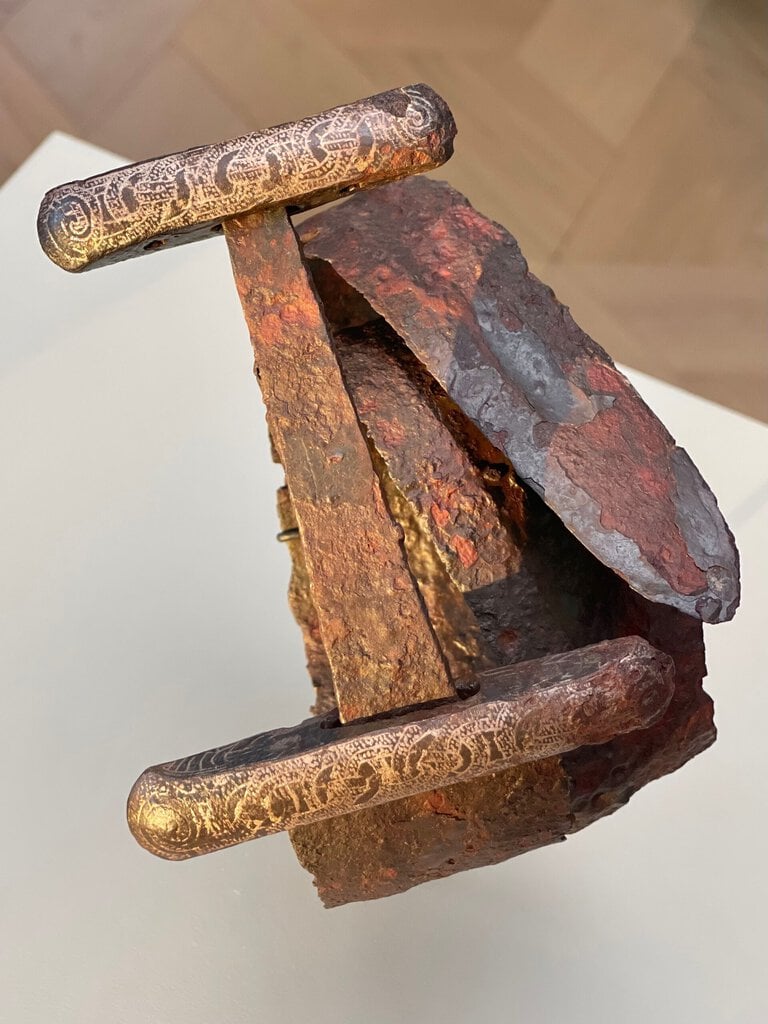
The word “Viking” describes an activity, not a people. It derives from the Old Norse víking — raiding — and the warriors it described were pragmatic, seafaring opportunists who prized functional equipment over theatrical pageantry. Viking society only crystallized in the ninth century C.E., a full two millennia after the Bronze Age cultures that did, occasionally, produce ceremonial horned headgear. Doepler had not merely reached back in time — he had collapsed two entirely separate worlds of northern European prehistory into a single, seductive silhouette.
When archaeologists and historians search for evidence of horned helmets among actual Norse warriors, they find nothing. No grave goods, no saga descriptions, no accounts in the foreign chronicles written by the monks and merchants who encountered Viking raiders and had every reason to document their terrifying appearance in accurate detail. The absence is not a gap in the evidence — it is the evidence.
As Science Norway notes plainly, there is simply no sign that Vikings really wore horned helmets. What they did wear was far less cinematically satisfying and far more telling about who they actually were.
The Only Complete Viking Helmet Ever Found
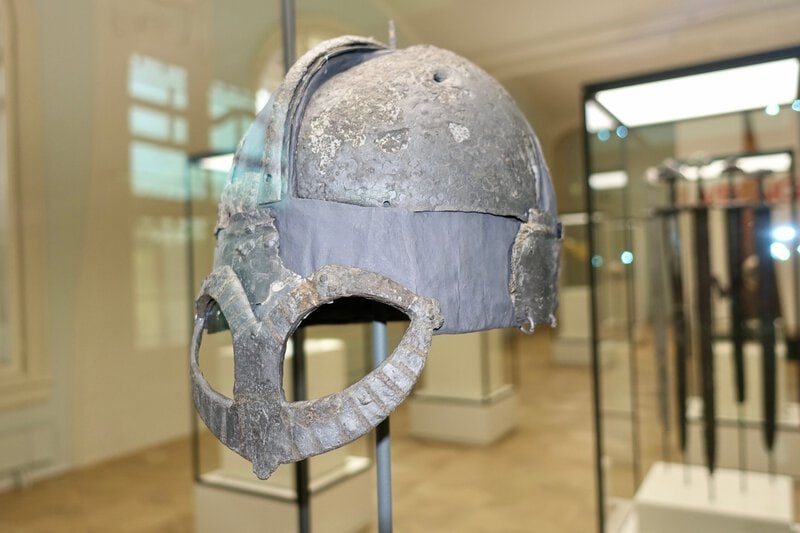
In 1943, a Norwegian farmer working at Gjermundbu in Ringerike unearthed a burial mound containing what remains, to this day, the single complete Viking helmet ever recovered. It is riveted iron, rounded, and fitted with a distinctive guard protecting the eyes and nose — a design historians call a “spectacle helm.” There are absolutely no horns.
The Gjermundbu helmet does not look like an opera prop. It looks like the head protection of a man who expected to be hit. The rivets are functional, the iron is plain, the design is governed entirely by a single priority: keeping its owner alive in a shield wall. Understated in its very ordinariness, the helmet is both the most important and the most anticlimactic object in Viking military history — a fact that would have dismayed Richard Wagner and delighted an archaeologist.
Every other candidate in the surviving record — fragmentary iron pieces, chain-mail neck guards, partial skull caps — tells the same story. No horns have appeared in any confirmed Norse warrior context. The popular image, as the National Museum of Denmark acknowledges with admirable restraint, does not survive contact with the ground.
Horned Helmets Did Exist — Just 2,000 Years Too Early
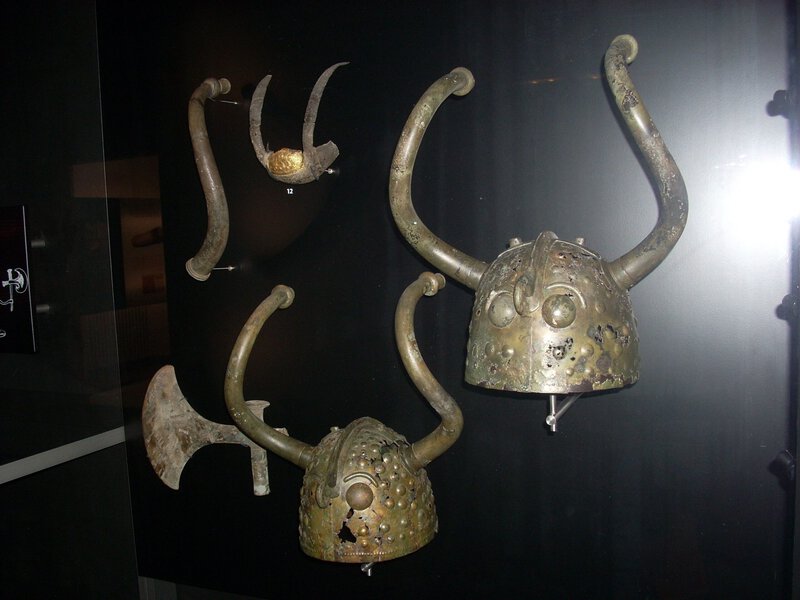
Here is the irony at the heart of this story: horned helmets were real. They were spectacular, deliberate, and extraordinary objects — but they belonged to Bronze Age Scandinavia, approximately two thousand years before the Vikings.
The twin Veksø helmets, discovered in a Danish bog in 1942 and dating to around 900 B.C.E., are the most famous examples — magnificent bronze objects with curving horns and bird-of-prey crests, preserved with uncanny completeness by the bog’s cold chemistry. Almost every scholar who has studied them concludes they were ritual or ceremonial objects rather than battlefield equipment, and the reasoning is not complicated: a warrior charging into a shield wall with two large curved horns projecting from his head would have offered his opponent a perfect handle to wrench his skull sideways. Bronze Age priests, it turns out, understood the practical difference between a ceremony and a sword fight.
Doepler had seen engravings of objects very much like the Veksø helmets in museum collections and had borrowed their visual drama without their temporal context. As Popular Science reports, those Bronze Age horned helmets now shed light on the emergence of warrior cults and religious power in prehistoric Scandinavia — a genuinely fascinating story, entirely separate from, and two thousand years older than, anything a Viking ever did.
How Doepler’s Image Went Viral Before the Internet
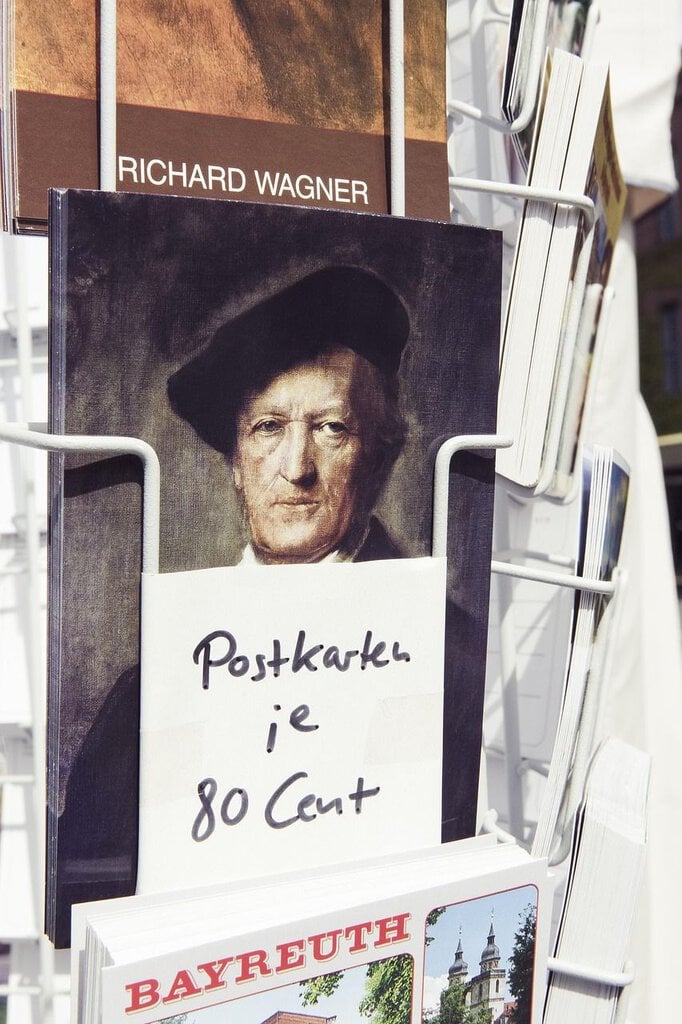
Wagner’s Ring cycle was not a modest regional production. Bayreuth in 1876 was the cultural event of the European calendar, and the illustrated press — the social media of its day — reproduced Doepler’s costume designs with the enthusiasm that the nineteenth century reserved for anything combining celebrity, nationalism, and spectacle. Within two decades, the horned helmet had been absorbed into Romantic nationalist painting and, most damagingly, into the schoolbook illustrations of Norse mythology that shaped the imagination of children across Europe and North America.
Those children grew up to be teachers, illustrators, filmmakers, and advertisers. As Vox’s Almanac series documents, the horned Viking helmet image traces a clean genealogical line from Doepler’s 1876 sketch through the Hollywood epics of the early twentieth century and onward — each generation of storytellers inheriting the silhouette from the last, never pausing to check whether any farmer had actually dug one out of the ground.
The myth also fed into nineteenth-century nationalist projects in Scandinavia and Germany, where romanticized Viking imagery served political purposes that had nothing to do with historical curiosity. By the time scholars began pushing back in earnest, the horned helmet had become culturally load-bearing — a symbol embedded in sports franchises, tourism industries, and Halloween costume catalogs. Displacing it with the plain iron truth of Gjermundbu required something more powerful than evidence.
Why the Myth Refuses to Die — and What the Real Helmet Tells Us

The horned helmet does psychological work that a riveted iron cap simply cannot. It signals “barbarian,” “pagan,” and “dangerous” in a single glance — a visual shorthand that storytellers, from opera directors to studio executives, have found irresistible. Corrections, as Discover Magazine observes, rarely travel as fast as the myths they are correcting. A peer-reviewed paper on Viking military equipment reaches thousands of readers; a horned-helmeted mascot charging across an NFL field reaches millions every Sunday afternoon.
The Gjermundbu helmet now sits in the Museum of Cultural History in Oslo, and historians argue that it is, in its unglamorous plainness, more genuinely awe-inspiring than any opera prop. It was worn by an actual person who actually fought — a man whose name nobody recorded, whose face nobody can reconstruct, but whose priorities are written clearly in every rivet. He wanted to survive. He was not performing anything for anyone.
Real Viking history, followed honestly, leads away from the opera house and toward something more complex and more interesting: a warrior culture that was also a literate one, with its own runic tradition; a raiding culture that was also a trading culture, with commercial networks stretching to Constantinople and beyond; a people who were, in almost every respect that matters, stubbornly and inconveniently human.
Carl Emil Doepler gave the world a Viking it could instantly picture. The Gjermundbu helmet gives us something rarer — a Viking who simply did not care whether you could picture him at all. He had a helmet that worked, and he wore it, and the horns existed only in the imagination of a costume designer who had not yet learned to read the dates on museum engravings. It is, all things considered, a very human mistake. It just happened to fool the entire world.