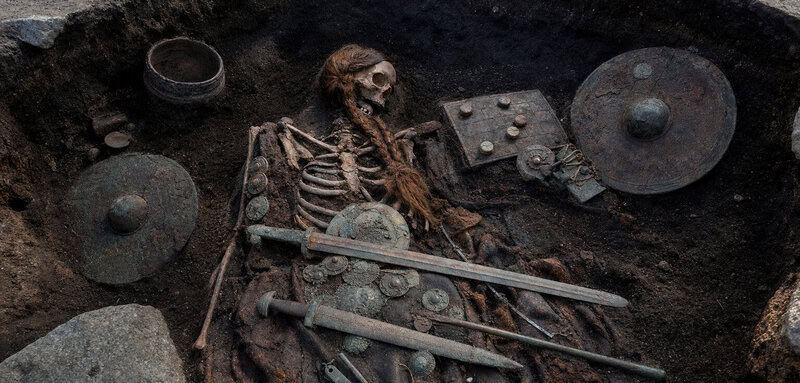
On a gray Swedish morning in 1878, an archaeologist named Hjalmar Stolpe knelt beside an open chamber on the island of Björkö and catalogued what he saw: two horses, a full arsenal of weapons, a gaming board arranged as though the player had only just stepped away. He recorded the grave’s occupant as a high-ranking male warrior, closed his notebook, and moved on. It would take 139 years, a revolution in genetic science, and one quietly extraordinary skeleton to prove him wrong.
The Grave That Started an Argument
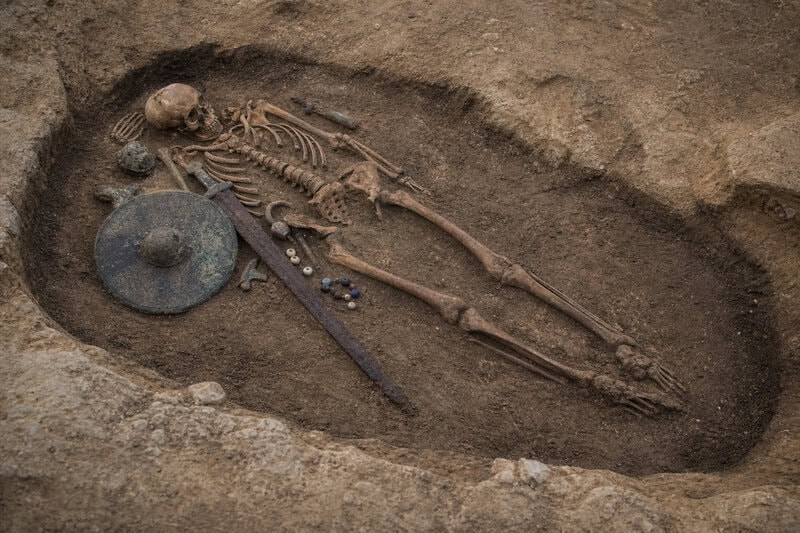
The burial known as Bj 581 sat undisturbed in the archaeological record for well over a century, filed under assumptions that felt so obvious nobody thought to question them. Weapons meant warrior. Warrior meant man. The logic seemed airtight — until 2017, when ancient DNA analysis of the skeleton’s remains confirmed that the occupant of that lavishly furnished chamber was biologically female. The announcement, published in the American Journal of Physical Anthropology by researcher Charlotte Hedenstierna-Jonson and her colleagues, sent a quiet tremor through the archaeology world. If this grave had been misread, how many others had been?
The Birka warrior grave did not emerge in isolation. It sits at the center of a much broader upheaval — one driven by new technology, new questions, and an ever-growing body of evidence from the earth itself. As the Viking Ship Museum notes, burial sites are one of the largest groups of archaeological sources for the Viking Age, and almost every new excavation is revising the picture that generations of scholars thought they had settled.
Reading the Dead: Why Viking Graves Are a Primary Source Like No Other
The window is narrower than most people imagine. Most Viking graves cluster in the mid-9th through the 10th centuries — a tight span of roughly 150 years when Norse culture was simultaneously at its most expansive and its most archaeologically legible. Where written sagas can be embellished across generations of retelling, and rune stones eroded to illegibility by coastal weather, a sealed grave holds something rarer: an unedited snapshot of what a community chose to send with one of its own into whatever came next.
Few sites illustrate this better than the burial ground at Tväåker, in Halland, Sweden. Archaeologists there identified the remains of 139 separate graves, containing animal and human bones, metal brooches, ceramic vessels, cremation sites, and dramatic ship-form stone settings — all in a single location, making it something close to an archaeological library of Norse funerary practice. The sheer variety is the point. Cremation lying beside inhumation, modest metal ornaments alongside fired clay, stone ships traced into the hillside for those who could not afford timber — Viking burial was never one monolithic ritual but a living, locally negotiated conversation with death, different from family to family and decade to decade.
Bj 581 would have understood that conversation. Her own grave was conducted in the language of command: every object placed with her spoke of authority, strategy, and readiness for whatever came next.
Ships for the Dead: The Oldest and Most Spectacular Send-Offs
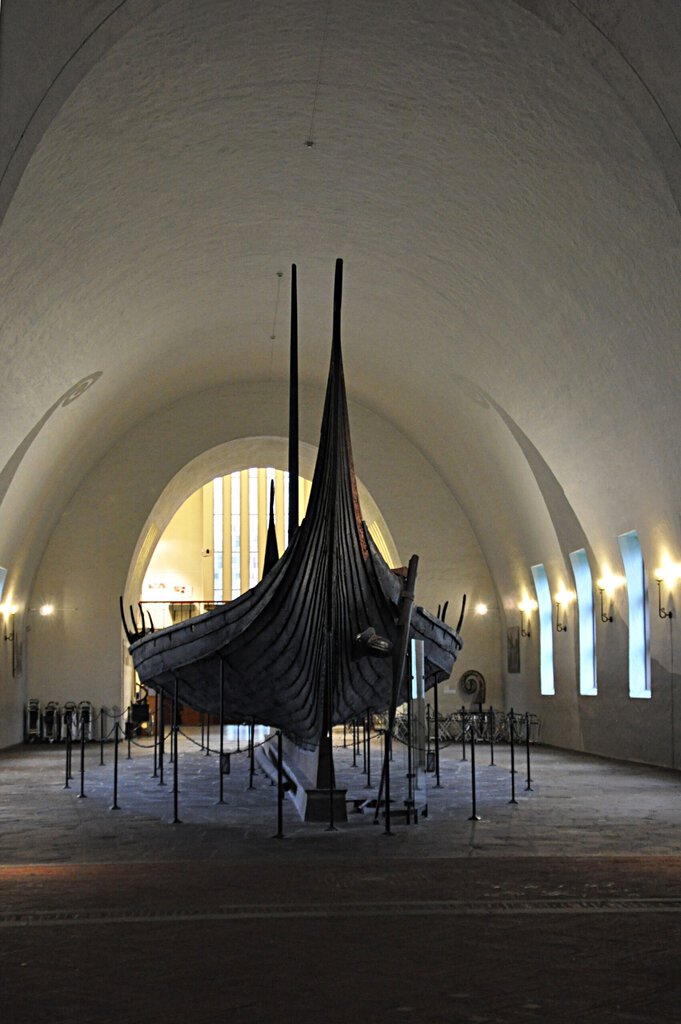
The mythology of the warrior’s sea voyage to the afterlife was, it turns out, already fully formed before the raids that made Vikings famous had even begun. According to the UNESCO Vestfold Ship Burials tentative list, the earliest ship burial graves in Scandinavia were constructed approximately 780-790 C.E. — predating the commonly cited opening of the Viking Age, the raid on Lindisfarne in 793, by the better part of a decade. The ships came before the terror. The theology preceded the history.
A ship burial was not simply a boat in the ground. It was an enormous communal statement requiring the felling of timber, the assembly of craftsmen, the sacrifice of animals, and in the most extreme cases, human companions dispatched to serve the dead in the next world. The logistics alone would have consumed a community for weeks. At Tväåker, the ship-form stone settings offer a glimpse of how that symbolism filtered down to those without the resources for a full vessel — communities that could still trace a ship’s silhouette in standing stones, preserving the idea of the voyage even when they could not replicate its scale.
For Bj 581, there was no ship. But the gaming board, arranged with pieces still in play at the moment of her burial, carries its own peculiar grandeur. Whoever placed it there — a family member, a subordinate, a fellow warrior — was not simply interring a body. They were staging a scene of command, freezing her in a posture of authority that has now survived for more than eleven centuries.
The Warrior Woman of Birka: One Skeleton, a Century of Assumptions
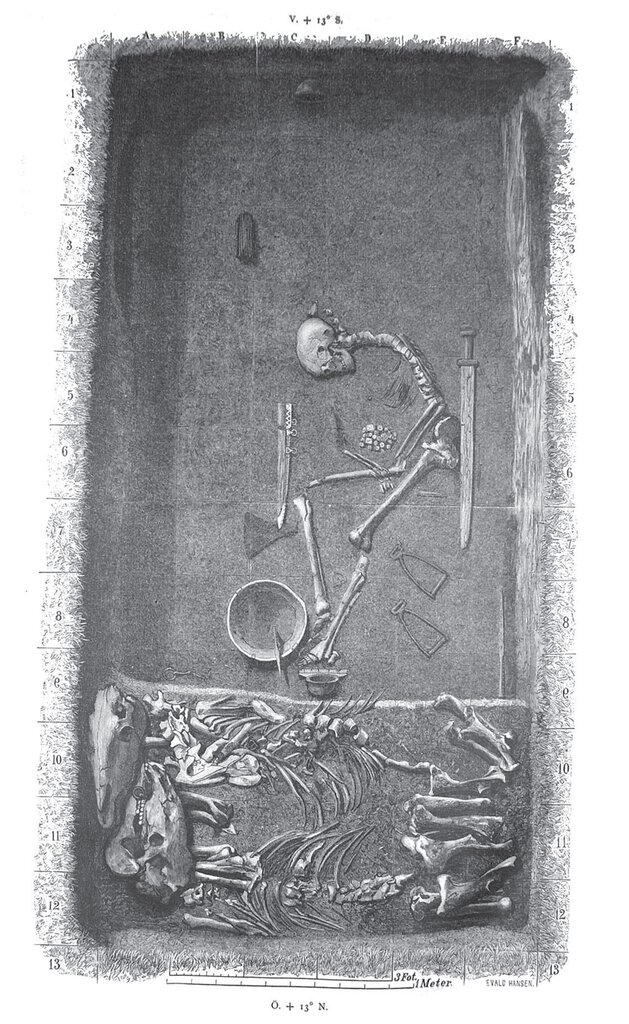
The pushback, when the 2017 results were published, was immediate and predictable. Perhaps she was a shaman. Perhaps the grave goods had been misattributed. Perhaps the symbolism was ritual rather than martial. Hedenstierna-Jonson and her colleagues systematically dismantled each objection, and one detail in particular proved decisive: the weapons in Bj 581’s grave showed use-wear consistent with active combat, not ceremonial display. These were tools that had been used. The tafl gaming board — a set used for strategic military planning, not casual entertainment — only deepened the case. It is, frankly, not the kind of detail anyone invents for a symbolic burial.
The Birka warrior woman burial has since become the anchor of a much wider methodological shift. If the most lavishly armed warrior grave in the Birka cemetery belonged to a woman, how many other burials across Scandinavia and Britain had been assigned a sex based on grave goods alone, before the era of DNA analysis? The answer, emerging slowly from systematic re-examination of skeletal collections, appears to be: more than the textbooks implied. Female-assigned individuals buried with weapon assemblages are not the impossibility the old literature suggested. They are simply a category that nobody thought to look for.
Bj 581’s legacy is as much methodological as symbolic. She is the reason researchers now demand biological sex confirmation before assigning a gender role to any burial — a shift that will echo through Viking graves archaeology for decades to come.
Mass Graves and the Cost of Raiding
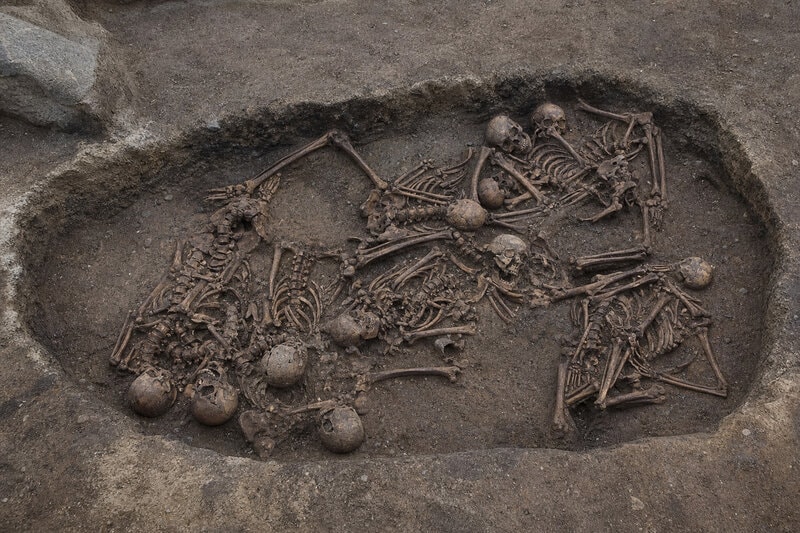
Not every Viking grave tells a story of honor and careful ceremony. Some tell the opposite story entirely. A ninth-century mass grave held the remains of at least 10 different young men, their bones bearing the marks of sudden, violent death rather than a curated send-off. No gaming boards, no horses, no weapons laid out with intention. Just bodies, and the questions they left behind.
Mass graves complicate the romantic narrative that Viking burial archaeology can sometimes generate. They are the physical evidence of raids that went catastrophically wrong, of captives who died far from home, or of violence administered within Viking society itself — scholars continue to debate the specific circumstances of individual finds, and the dead are not always forthcoming with context. At one Viking-era burial site examined by the BBC, more than three-quarters of the skeletons belonged to men — a demographic skew that raises its own unresolved questions about whether these were warrior encampments, seasonal settlements, or trade outposts where women’s remains simply did not survive, or were disposed of differently.
Bj 581’s story sits in sharp relief against these anonymous clusters. She was buried with meticulous, expensive, time-consuming intention. The young men of the mass grave were not. Both silences are data, and both deserve the same careful attention.
Cloth, Colour, and the Mundane Details That Survived
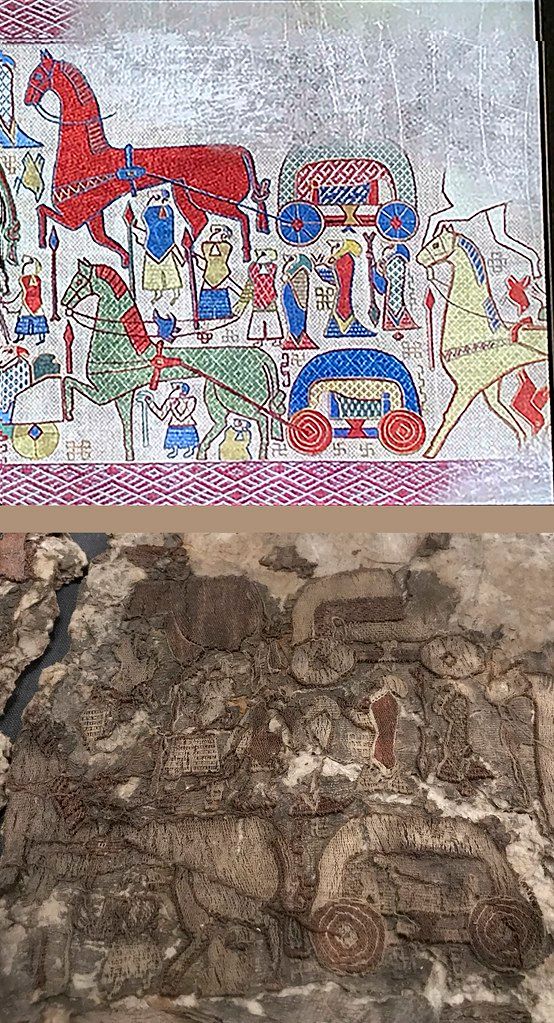
Amid the swords and the ship burials, some of the most startling recent Viking archaeological finds are made of fabric. Archaeologists in Denmark uncovered a Viking Age grave containing clothing fragments that have survived for roughly 1,300 years — textiles so fragile they must be excavated under controlled humidity conditions, yet preserved well enough to reveal weave patterns and, in some cases, traces of original dye. A scrap of cloth from the early Viking Age is, in its own quiet way, as startling as a weapon hoard.
The details encoded in those fibers are unexpectedly rich. Certain dyes came from the Mediterranean, indicating trade networks of extraordinary reach. Finer weaves signaled the wealth and status of whoever wore them. The hands that produced them — almost certainly women’s hands, given what we know of Norse textile labor — were part of an economic system as sophisticated as anything the warriors built with iron. These textile finds are quietly reshaping how researchers understand Viking domestic and economic life alongside the martial culture that still dominates the popular imagination.
For Bj 581, no surviving cloth has been reported from her chamber. Her identity, as it has come down to us across eleven centuries, was constructed entirely in iron and bone — the hard, imperishable record. It is one of archaeology’s smaller ironies that the softer, perishable materials, had they survived, might have settled the debate about her sex a very long time ago.
What the Graves Have Left to Tell Us
Viking burial discoveries are accelerating. Ground-penetrating radar, ancient DNA sequencing, and isotope analysis of teeth — which can reveal where a person grew up, sometimes down to the specific region of origin — are turning old excavation reports into new arguments. The 139 graves at Tväåker represent one node in a Scandinavian network of sites that, taken together, are producing a statistical picture of Viking Age demographics, mobility, and social structure that no single saga could ever provide.
Every time a new technique is applied to old bones, or a plough turns up another stone ship on a Swedish hillside, the Viking Age becomes simultaneously more complex and more recognizably human — full of warriors who were women, of men buried in mass and in haste, of cloth that outlasted the kingdoms that produced it. The comfortable certainties keep dissolving. The graves keep talking.
And somewhere in a museum archive in Stockholm, Bj 581’s bones continue their long, patient argument — the one that began on a gray morning in 1878, when a man with a notebook looked at a gaming board and thought he already understood the story.