Somewhere beneath the Mongolian steppe, workers spent weeks — perhaps months — digging downward, level by level, carving out nine descending tiers of earth and timber for a person of almost incomprehensible importance. When archaeologists finally reached the bottom of that shaft roughly 2,000 years later, what they found rewrote the story of one of antiquity’s most consequential and least understood empires.
The Largest Xiongnu Tomb Ever Discovered in Mongolia
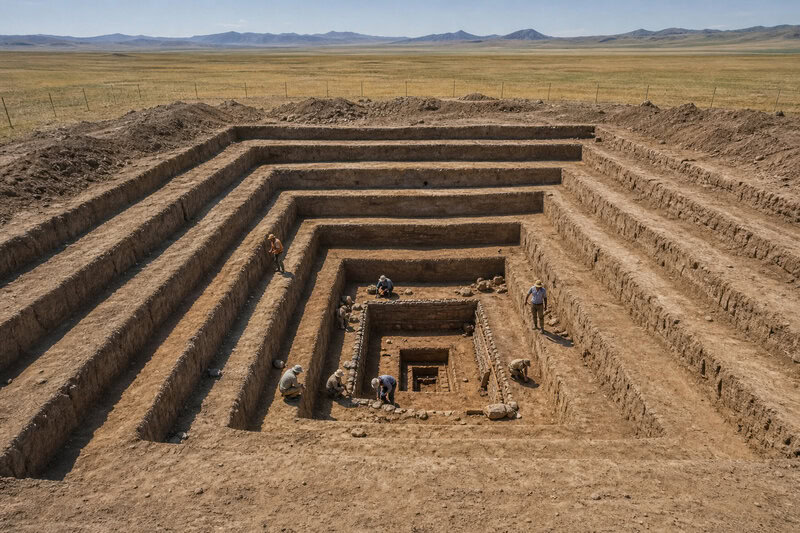
The tomb descends in nine distinct, deliberate levels — a feat of mortuary engineering that makes it the largest Xiongnu burial ever uncovered in Mongolia. The moment excavators grasped its full dimensions, the conclusion was unavoidable: whoever occupied this grave stood at the absolute summit of Xiongnu society, in a rank so elevated it demanded a burial unlike anything previously known from this civilization.
Crucially, the tomb did not sit alone in the landscape. It was unearthed within a larger elite Xiongnu burial ground, strongly suggesting the site functioned as a necropolis — a city of the dead reserved for the empire’s most powerful figures. That context only amplified what the tomb’s scale already implied.
A 2,000-Year-Old Time Capsule from a Nearly Forgotten Empire
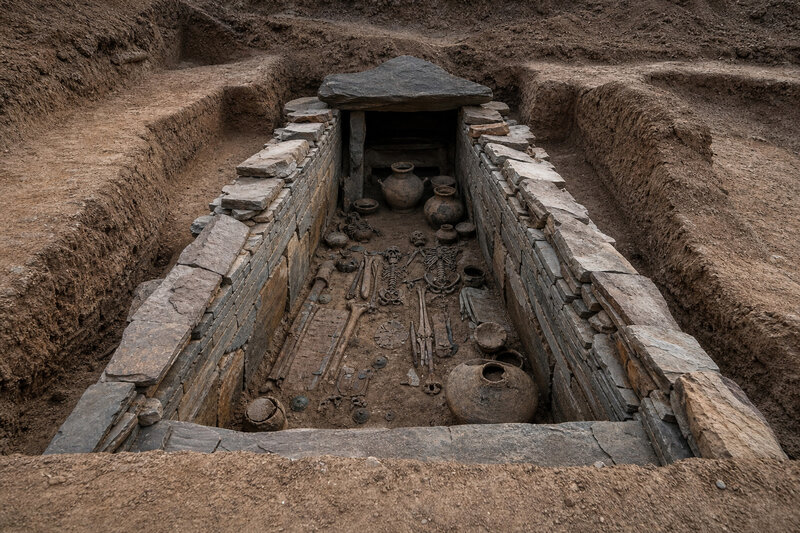
The burial dates to approximately 2,000 years ago, placing its construction squarely during the height of Xiongnu power on the Eurasian steppe. The Xiongnu empire dominated what is now Mongolia for almost 500 years, yet it lingers in relative obscurity compared to the Mongols or the Huns — civilizations that came later and whose names have echoed through Western historical memory far more loudly.
That imbalance makes discoveries like this one extraordinarily valuable as windows into Xiongnu elite life. Here, sealed beneath the steppe for two millennia, was an almost intact record of how the empire’s ruling class chose to represent themselves at the moment of death — and, by extension, in the memory of those they left behind.
The Xiongnu are not merely a footnote to later steppe history. At their peak, roughly from the 3rd century BCE through the 1st century CE, they commanded territory stretching from Manchuria to Central Asia and extracted enormous tribute payments from the Han dynasty — one of the ancient world’s wealthiest and most sophisticated states. That the Han paid rather than simply conquered tells you everything about Xiongnu military and political power. What archaeology has long struggled to match to that written portrait is a physical record of equivalent richness. This tomb begins to close that gap.
413 Artifacts Packed Into a Single Burial Chamber
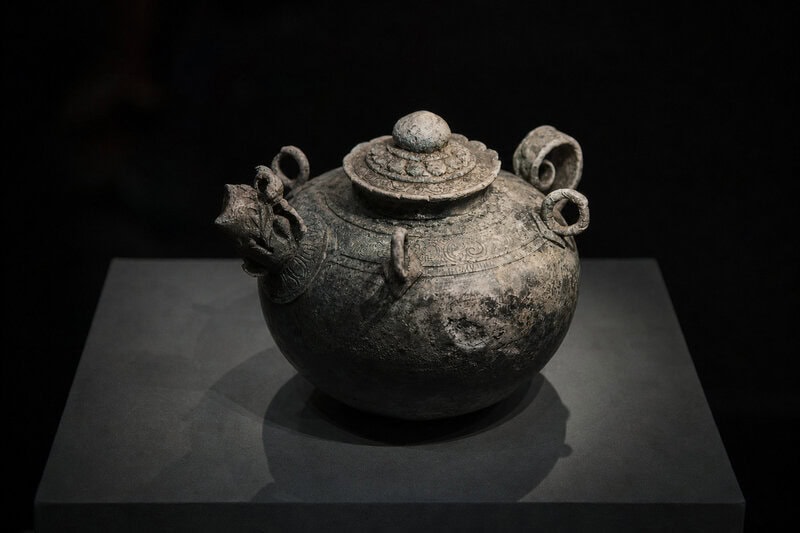
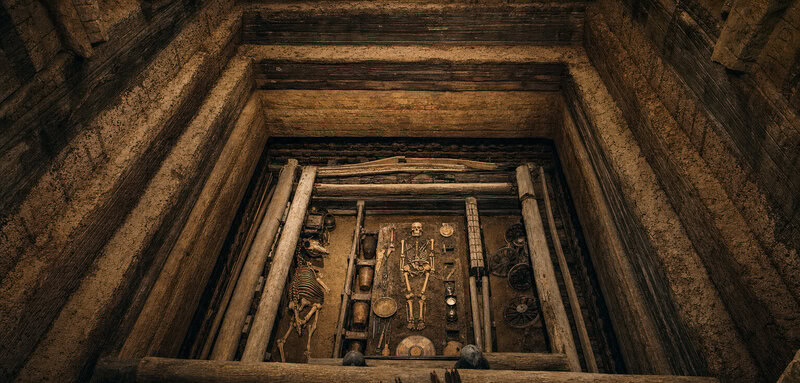
When archaeologists finished cataloguing the grave goods, the count stood at 413 artifacts — a figure remarkable not just for its size but for the sheer variety it represents. The objects appear to have been carefully and deliberately selected, each one presumably chosen to communicate something about the occupant’s wealth, their status, and the breadth of their connections across the ancient world.
Even measured against other elite steppe burials, that concentration of riches in a single grave is unusual. Nomadic cultures are often archaeologically elusive precisely because they moved and left little behind; a burial this richly furnished stands as a rare, tangible counterweight to that invisibility. The variety of materials represented — metals, ceramics, organic goods, and glass — also points toward a burial that was assembled from sources spanning multiple distinct production traditions, not simply drawn from a single regional stockpile.
Possible Roman Glass Found Deep in the Mongolian Steppe

Among those 413 objects, archaeologists identified items that may be Roman glass — luxury goods manufactured thousands of miles away on the shores of the Mediterranean. The qualification “may be” reflects the careful language of ongoing analysis rather than scholarly hedging for its own sake: glass provenance requires specialist examination of chemical composition, and definitive confirmation takes time.
Even the possibility, however, is striking. Roman-crafted objects resting in a Xiongnu tomb on the Mongolian steppe would constitute direct physical evidence of commerce or diplomacy stretching across the full breadth of Eurasia. If the identification is confirmed, this burial would rank among the clearest archaeological demonstrations of the ancient Silk Road reaching nomadic elites at its northeastern edge — not merely a trade corridor for Chinese silk and Roman gold, but a living network that deposited Mediterranean craftsmanship in the graves of steppe rulers.
Roman glass has previously turned up at sites in Han China, suggesting the material moved eastward through established intermediary networks rather than through direct Roman-Xiongnu contact. Whether the glass in this tomb followed a similar chain — passing through Sogdian, Parthian, or other middlemen before reaching Mongolia — or whether it arrived by some more direct route is a question the ongoing analysis may help answer.
A Crossroads Tomb Linking Rome, Han China, and Ancient Korea
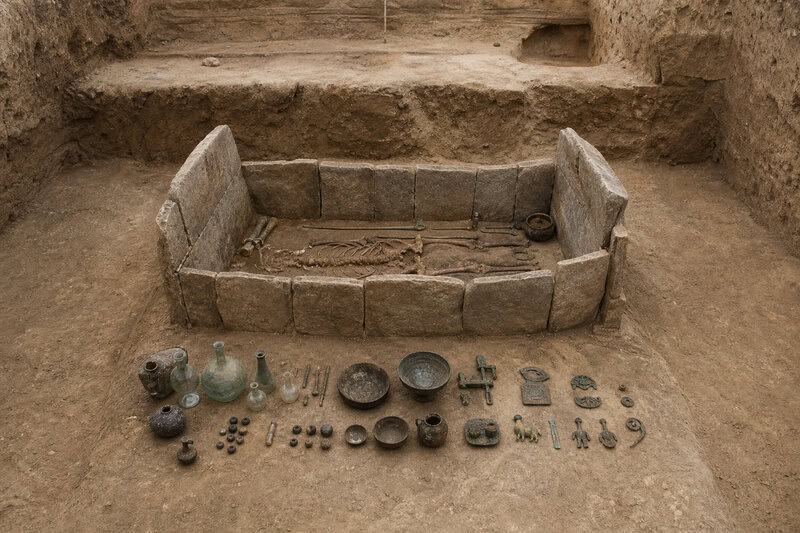
The possible Roman glass does not stand alone. Taken together, the 413 artifacts point toward connections with three distinct civilizations spread across the ancient world: the Roman empire to the far west, the Han dynasty to the south, and ancient Korea to the east. No previously excavated Xiongnu burial had drawn such a wide arc of international contact into a single chamber.
The implication challenges older historical narratives. The Xiongnu, long depicted primarily as raiders and military adversaries of Han China, emerge from this tomb as sophisticated participants in a vast Eurasian exchange network — people who could acquire prestige goods from opposite ends of the known world and who understood precisely what those objects communicated about power. A ruler whose grave contains luxury goods from Korea, China, and the Roman Mediterranean was not operating at the margins of the ancient world. They were, in a meaningful sense, at its center.
The Korean connection is itself underappreciated in popular accounts of Eurasian prehistory. It indicates that Xiongnu elite networks extended eastward beyond Han Chinese territory — into the Korean peninsula, which was itself in contact with Han colonial commanderies during this period. The tomb, in that sense, reflects a node in an interconnected ancient world far more integrated than the conventional image of isolated civilizations suggests.
The Xiongnu’s Direct Link to the Huns Who Terrified Rome
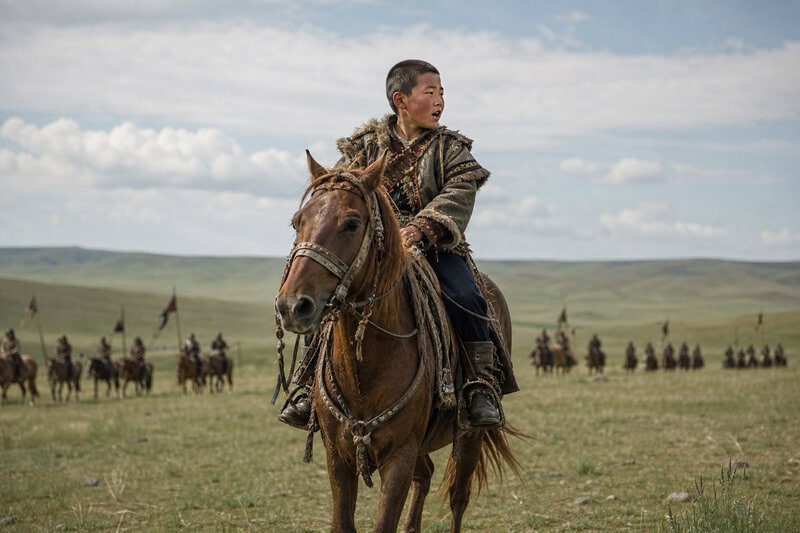
The story does not end with the Xiongnu’s own era. Some members of the Xiongnu are considered ancestors of the Huns — the mounted warriors who swept into Europe in the 4th and 5th centuries CE and destabilized the Western Roman Empire. The connection remains debated among specialists: the linguistic evidence is fragmentary, and the precise mechanisms of continuity between the Xiongnu and the Huns are not settled. What most scholars do accept is that when the Xiongnu empire fragmented in the 1st and 2nd centuries CE, waves of steppe peoples moved westward in a prolonged migration that contributed to the demographic and political pressures eventually associated with the Hunnic confederation.
That genealogical and cultural thread means studying Xiongnu elite culture offers a direct line back toward the origins of one of antiquity’s most feared forces. The tomb does not just illuminate the Xiongnu; it illuminates the world that produced — or at minimum prefigured — the Huns. Understanding what a Xiongnu elite burial looked like, what objects it contained, what connections it encoded, helps historians reconstruct the material and social inheritance that later steppe confederacies drew upon.
Buried in an Elite Necropolis, Not a Lone Grave
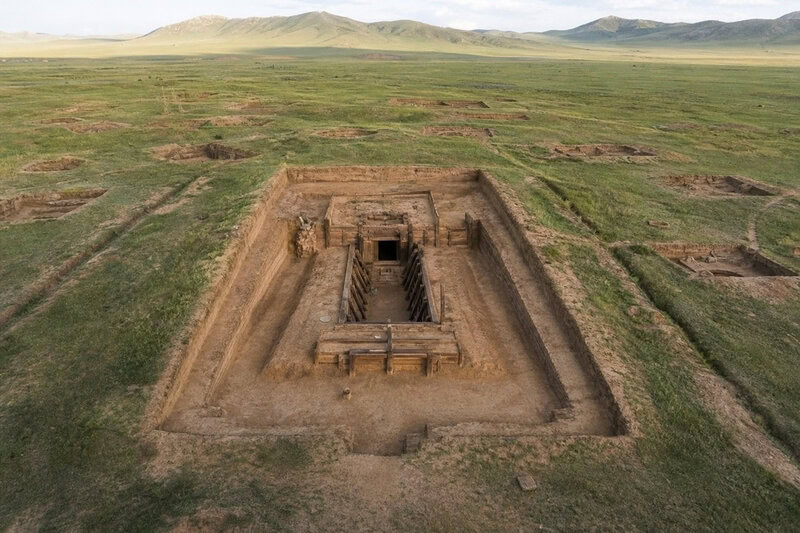
The tomb’s setting within a larger elite burial ground transforms its significance from a single spectacular find into a window onto Xiongnu funerary culture as a system. Cluster burials of this kind — where the most powerful figures of an empire were interred together in a designated sacred zone — reveal how Xiongnu society organized the relationship between death and authority, grouping its ruling class in death as they had presumably been grouped in life.
That spatial logic also carries a direct practical implication for future research. The surrounding cemetery has not been fully excavated. If this tomb’s neighbors were selected by the same principles of rank and wealth, further work at the site could yield discoveries of comparable or even greater significance. The necropolis as a whole, rather than any single grave within it, may ultimately prove to be the more important find — a systematic record of Xiongnu elite succession and social organization written in the language of burial architecture.
Nine Levels as a Statement of Power
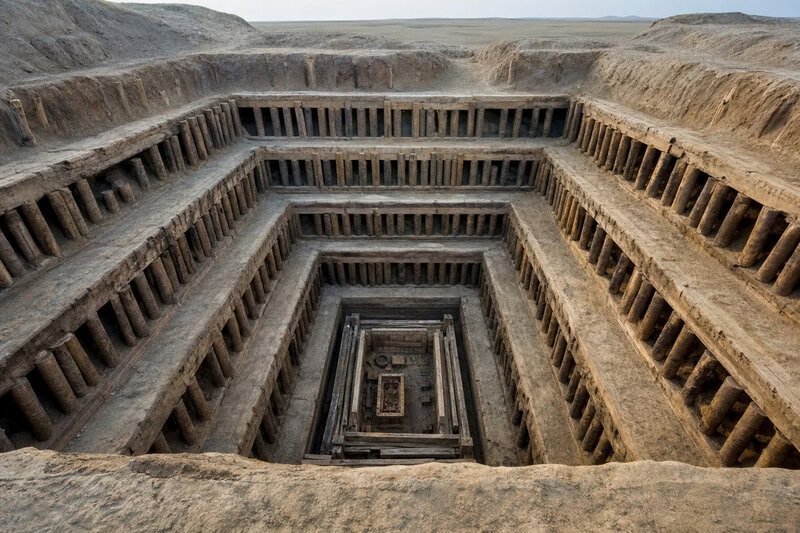
The nine-level architecture was almost certainly not a matter of engineering convenience — it was a declaration. Across steppe burial traditions, depth and elaborateness served as direct expressions of the deceased’s rank: the more levels, the more labor; the more labor, the more power required to command it. No other known Xiongnu tomb in Mongolia reaches nine levels, which places whoever lies at the bottom in a category entirely their own among all excavated Xiongnu burials.
Constructing nine descending tiers would have demanded significant organized manpower over a sustained period — itself a performance of authority visible to everyone who participated in or witnessed the burial. The tomb’s very architecture was an argument about who this person had been, made in earth and timber and collective human effort. The choice of nine levels in particular may also carry symbolic weight: the number nine held significance in various Eurasian traditions as a marker of completeness or supreme rank, though whether that symbolism applied specifically to Xiongnu funerary practice remains a question for further analysis.
The identity of the occupant has not yet been publicly confirmed. Whether they were a chanyu — the Xiongnu title for a supreme ruler — or a high-ranking subordinate king or general is a determination that will likely depend on further analysis of skeletal remains, inscriptions if any are present, and the specific typology of the grave goods. What the architecture alone establishes, unambiguously, is that this person commanded resources and obedience at the very top of Xiongnu society.
Almost 500 Years of Steppe Dominance, Now Backed by Physical Evidence
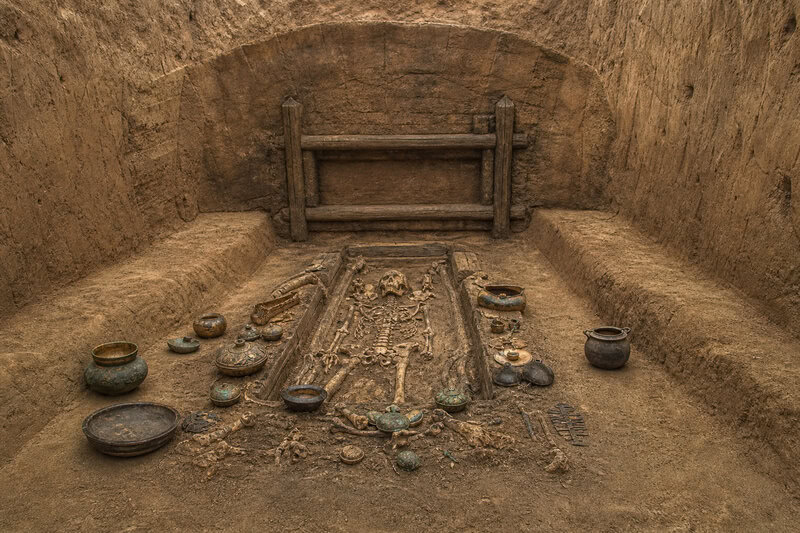
The Xiongnu held the Mongolian steppe for almost half a millennium, yet the physical record of their elite material culture has remained frustratingly sparse. Much of what historians know about them has filtered through Chinese sources — Han dynasty chronicles that described the Xiongnu as a powerful and feared rival empire, wealthy enough and organized enough to demand tribute from one of the ancient world’s great civilizations. This tomb now provides rare, richly furnished archaeological confirmation of exactly that portrait.
The 413 artifacts, the nine descending levels, the possible Roman glass, the traces of contact stretching from Korea to the Mediterranean — all of it transforms the Xiongnu from a civilization known largely through their enemies’ words into one that speaks, at last, through its own buried evidence.
A single grave, sealed for 2,000 years beneath the Mongolian steppe, has done what decades of textual study alone could not: it has given the Huns’ predecessors a face, a reach, and a scale of ambition that demands they be taken as seriously as any empire of the ancient world.