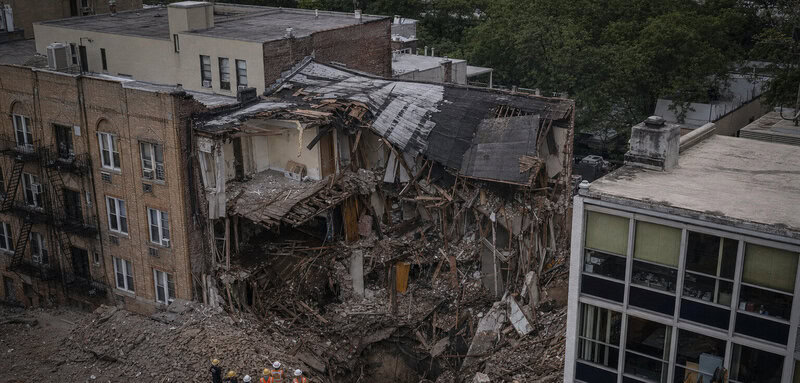
Just after 4 p.m. on a Wednesday, a three-story mixed-use building on Flatbush Avenue in Brooklyn stopped being a building. It did not burn. It did not flood. It simply gave itself back to the ground — and eight people, two of them children, went with it.
The Ground Gives Way on Flatbush Avenue

By Thursday afternoon, rescue operations had concluded and New York City Mayor Zohran Mamdani stood before cameras to confirm what searchers had already feared. Eight people were dead, 17 others injured, and the three-story mixed-use building on Flatbush Avenue had been reduced to a problem for investigators rather than a home for residents. The building had collapsed at the edge of a construction site, and excavation work next door is now eyed as the probable cause.
Mamdani’s confirmation of the toll — eight dead, two of them children, 17 injured — carried the particular weight of official language that mayors have been forced to speak for as long as cities have been built upward and dug downward at the same time. The vocabulary shifts across centuries. The ledger entry does not. A neighbor digs. A foundation shifts. A wall decides it has held on long enough.
What happened on Flatbush Avenue is not, in the long view of urban history, an aberration. It is the latest installment of a catastrophe that cities have been staging, with grim regularity, for roughly two thousand years.
The Roman Insula Problem: When Six Stories Was a Death Sentence
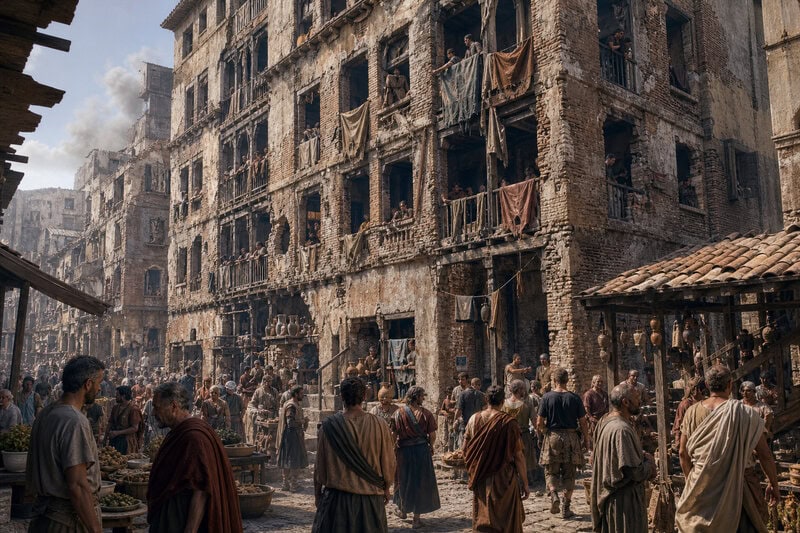
Ancient Rome was arguably the first city to industrialize the act of building collapse. Its infamous insulae — the towering apartment blocks that housed the urban poor in neighborhood warrens like the Subura district — were so routinely deadly that the emperor Augustus issued an edict in 6 CE capping their height at 70 Roman feet, roughly 21 meters. It is, in effect, history’s first high-rise safety code, and the fact that it had to be written at all tells you something about what was happening before it.
The satirist Juvenal, writing around 100 CE, described the terror of Roman tenement life with a precision that reads less like poetry and more like a building inspection report filed in verse. He wrote of a city propped up on thin sticks, of landlords patching cracks and telling tenants to sleep soundly under ruins about to fall. The image is almost too familiar to be funny — which is, one suspects, exactly what Juvenal intended.
The structural villain in ancient Rome was often the same one investigators are now examining in Brooklyn: ground disturbance. Roman builders excavating foundations for new insulae routinely undermined the footings of adjacent buildings on the dense, shared soil of the city. The ambition to build taller collided with the physics of shared earth — a problem no imperial decree ever fully solved. Augustus’s height limit was widely ignored within a generation of his death, and the collapses continued.
Medieval Undercutting: The Collapse Nobody Recorded (Until the Bill Arrived)

Medieval European cities repeated Rome’s mistake with less height but equal density. Timber-framed buildings in London, Paris, and Florence were packed so tightly that a new cellar dug on one plot could quietly hollow out the footing of three neighbors, leaving structures standing on faith and inertia until they were not.
A 1246 assize of London — one of the earliest urban building regulations in English history — specifically prohibited a builder from digging a foundation so deep as to undermine a neighbor’s wall. The specificity of that prohibition is its own kind of archive: the problem had to be common enough, and the complaints loud enough, that a London clerk decided it needed to be written into law. The history of urban construction accidents from the medieval period survives less in dramatic chronicles and more in municipal fine ledgers and parish burial records — a mundane paper trail of masonry that simply, quietly, fell on people.
The pattern that investigators in Brooklyn are now tracing was already old enough in 1246 that a medieval bureaucrat thought it worth codifying. Cities, it turns out, have a very long memory for this particular failure — and a very short one for acting on it.
New York’s Own Long History of Tenements Falling Into Their Basements
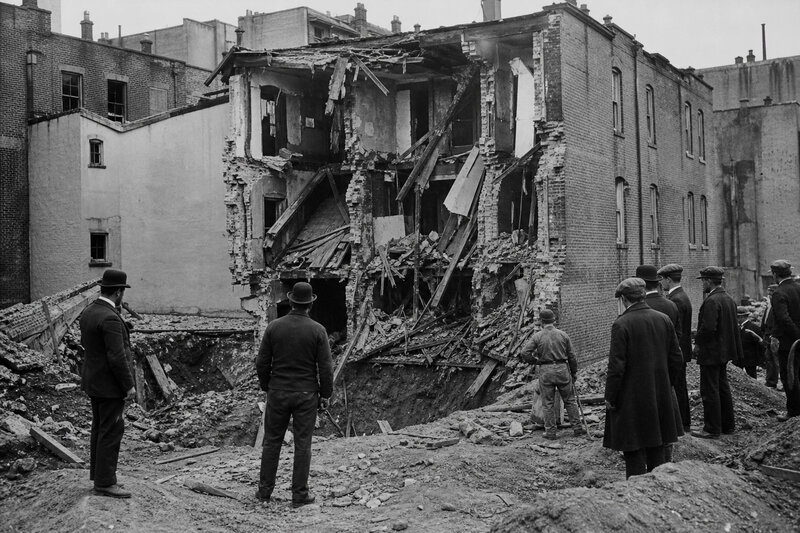
New York City’s tenement collapse history is dense and largely forgotten. Between 1860 and 1900, the city’s newspapers logged dozens of partial and full collapses in lower Manhattan and Brooklyn, most triggered by the relentless churn of construction on adjacent lots as the city rebuilt itself upward, block by block. The Tenement House Act of 1867 — the first major housing reform law in New York State — was partly a response to structural failures, not just sanitation; lawmakers had before them reports of buildings sinking into poorly excavated neighboring lots and walls separating from shared party structures.
By the 1880s, the term “undermining” appeared regularly in New York building department inspection reports as a cited cause of dangerous conditions. Inspectors used it to describe exactly what investigators are now examining on Flatbush Avenue: a dig next door that stole the ground from under a standing wall. The vocabulary was settled. The problem was not.
Mayor Mamdani’s confirmation of the Brooklyn death toll places him in a lineage of New York City mayors who have had to publicly account for the city’s habit of collapsing on itself. That lineage runs from the 19th century straight through to a Thursday afternoon press conference in 2026, without meaningful interruption.
The Science That Keeps Not Being Learned: Soil, Load, and the Adjacent Dig
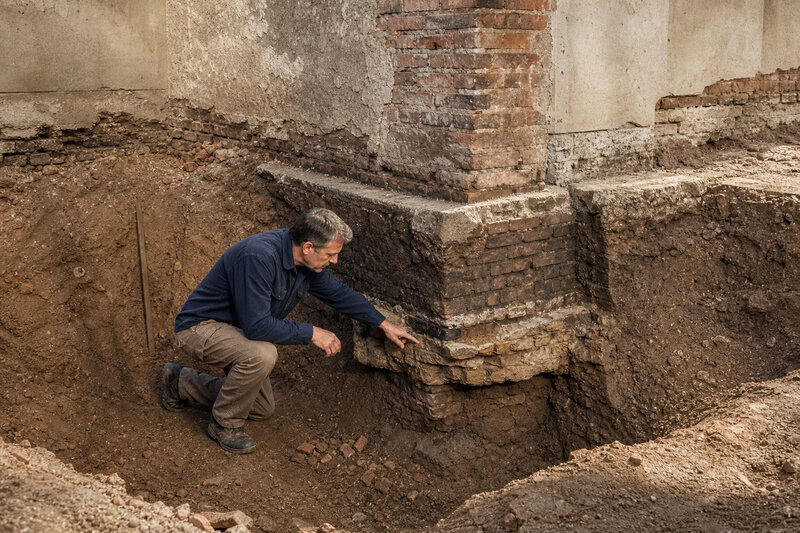
The engineering concept at the center of excavation collapses carries the precise, almost administrative name “loss of lateral support.” When soil is removed from beside or beneath a foundation, the remaining earth can no longer prevent the footing from sliding, tilting, or sinking. The wall above follows. The building above that follows the wall. The people inside follow the building.
What makes this failure mode so persistent across two millennia of building collapse history is that it is invisible in its early stages. A foundation can be fatally compromised for days or weeks before any crack appears above grade. Residents sleep, cook, and go about their lives inside a structure that is, below the surface, already moving toward its end. There is no warning. Then there is a Wednesday afternoon, just after 4 p.m., and there is nothing left to warn.
Modern geotechnical engineering offers real solutions — underpinning, sheet piling, real-time settlement monitoring — that Rome and medieval London obviously lacked. The persistence of the problem into the present is not, therefore, a failure of knowledge. It is a failure of application: of oversight, of enforcement, of the unglamorous administrative work that stands between a permit and a collapse. The building on Flatbush Avenue collapsed at the edge of a construction site where, investigators believe, that gap between knowledge and practice may have opened up one more time.
Regulation Written in Rubble: The Law Always Arrives Late
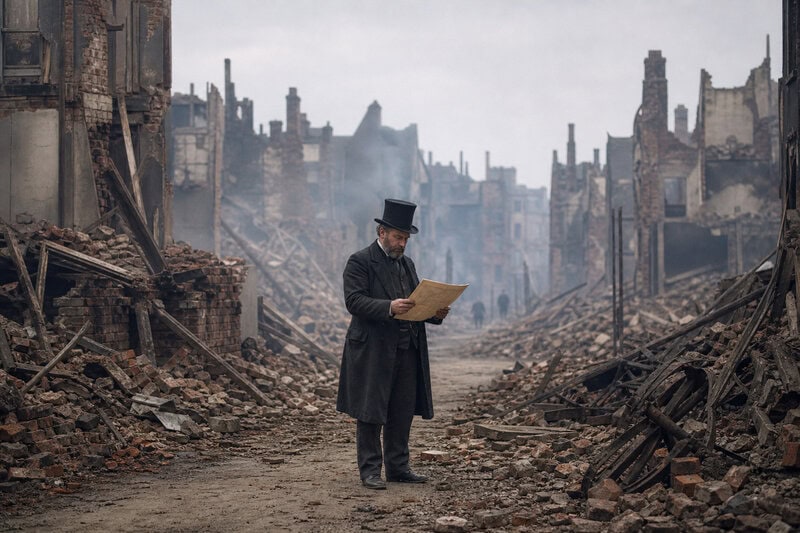
Every significant advance in building regulation — from Augustus’s height limit to London’s 1246 assize to New York’s Tenement House Acts to the modern International Building Code — has been written in rubble. The law arrives after the catastrophe, rarely before it. This is not a cynical observation; it is the documented sequence, repeated across every era and every city that has tried to govern its own vertical ambition.
New York City’s current building code requires protection of adjacent structures during excavation, mandates monitoring of neighboring buildings, and assigns legal liability to the excavating party. Those rules exist precisely because the city’s own tenement collapse history demonstrated, over and over, what happens when neighbors dig without coordination or consequence. The rules are good rules. They were written in the deaths of people whose names have been largely forgotten.
The gap between regulation on paper and enforcement on site has been the constant across every era. Roman landlords ignored Augustus’s height cap. London builders ignored the assize. The pattern does not require elaboration — it simply requires, apparently, repetition.
What Flatbush Avenue Joins
The Brooklyn building collapse joins a catalog of urban construction disasters that is not a list of freak events but a recurring structure: density, plus ambition, plus excavation, plus inadequate protection of what already stands. Two children and six adults died on Flatbush Avenue. Nearly 20 people were injured. Rescue operations ran from Wednesday afternoon until Thursday, when Mayor Mamdani walked to a microphone and confirmed that searching had ended and counting had begun.
What changes across the 2,000-year span of this story is not the physics — soil still behaves as soil, foundations still require lateral support, walls still follow their footings downward when those footings are taken away. What changes is accountability. Today there are cameras, permits, investigators with names, and a mayor on record stating exactly how many people a collapsed building killed. The ancient Romans had none of that. Medieval London had almost none of it. The 19th-century tenants of lower Manhattan had very little of it.
Mamdani now carries the specific, modern weight of that accountability — the confirmed number, the recorded statement, the investigation whose findings will eventually become, if history holds, the foundation for another round of rules. He stands, without perhaps choosing to, in a line that stretches from the Subura district to a street in Brooklyn, connected by the same failure, the same physics, and the same terrible arithmetic of people who were inside a building when the earth beside it moved.
The question that history keeps asking, and that Flatbush Avenue poses again, is not whether new regulations will follow. They will. The question is whether cities will finally commit the resources, the inspectors, and the political will to enforce the rules they already have — before the next wall moves, rather than after.