The Fax Machine Was Patented the Same Year the First Wagon Crossed the Oregon Trail
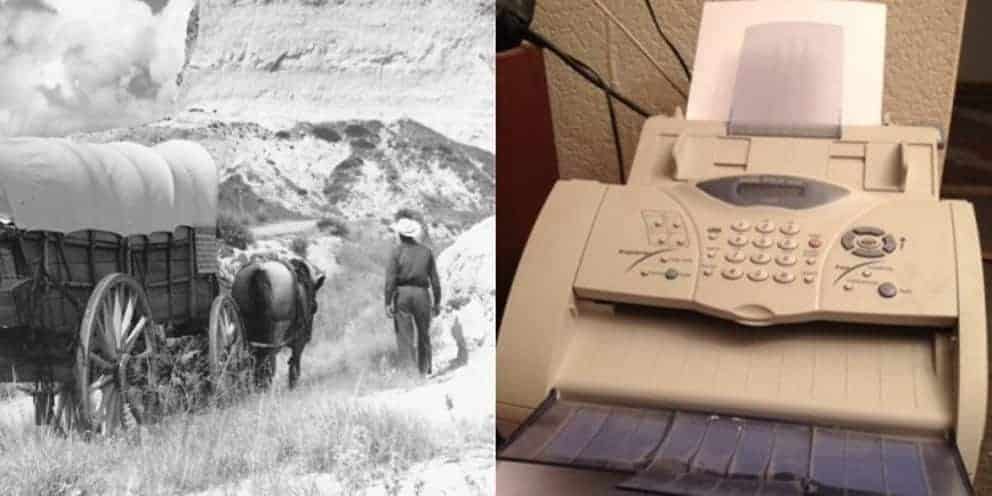
The Oregon Trail is a roughly 2200 mile long wagon route that connected the Missouri River to Oregon. It began as rough tracks and trails blazed and cleared through the wilderness by fur traders, in progressive stages, between 1811 to 1840, and the segments were initially passable only to travelers on foot or horseback. By 1836, the trail section between Independence, Missouri, and Fort Hall, Idaho, had been cleared to accommodate wagons, and the first migrant wagon train made that journey. Thereafter, wagon trails were gradually cleared westward, until, in 1843, they eventually reached the Willamette Valley in Oregon. From then on, the wagon route came to be known as the Oregon Trail.
The trail became one of the iconic symbols of 19th century America, as it pumped a seemingly inexhaustible torrent of land-hungry migrants from the settled east to the open spaces of the west. Wagon trains of pioneers inexorably pushed the new country’s Frontier ever westward, displacing Native Americans from their ancestral lands, and exploiting the newly seized territories for agricultural and mining usages.
Between the 1830s and 1860s, the Oregon Trail was used by about 400,000 farmers, ranchers, miners, and other settlers and their families, who loaded their goods and hopes upon wagon, and trekked west in pursuit of their dreams. The trail’s use finally went into decline when the first transcontinental railway was completed in 1869, as trains made for a faster, cheaper, and safer journey to the west.
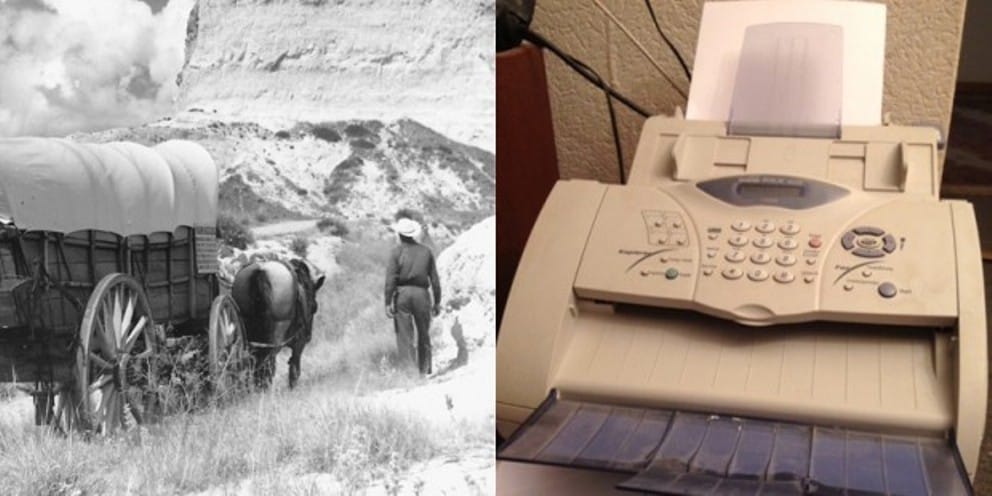
It might seem absurd at first blush, but the fax machine, a ubiquitous presence in modern offices and workplaces, is as old as the Oregon Trail. In 1843, the Oregon Trail was finally completed by an enterprising wagon train of about 1000 migrants. After a difficult trek, they cleared a final segment to make the trail passable by wagon all the way from the Missouri River to Oregon. That same year, a Scottish inventor named Alexander Bains secured a British patent for what he termed the “Electric Printing Telegraph“.
The invention relied on a clock to synch the movement of two pendulums to scan a message line by line. Using a metal pin arrangement in a cylinder, Bain devised a system whereby on-off electric pulses would scan the pins, send a message across wires, and reproduce it at a receiving station far away. That device became the forerunner of the modern fax machine. It eventually led to the first commercially practical telefax service between Paris and Lyon in 1861 – 11 years before the invention of the telephone.


