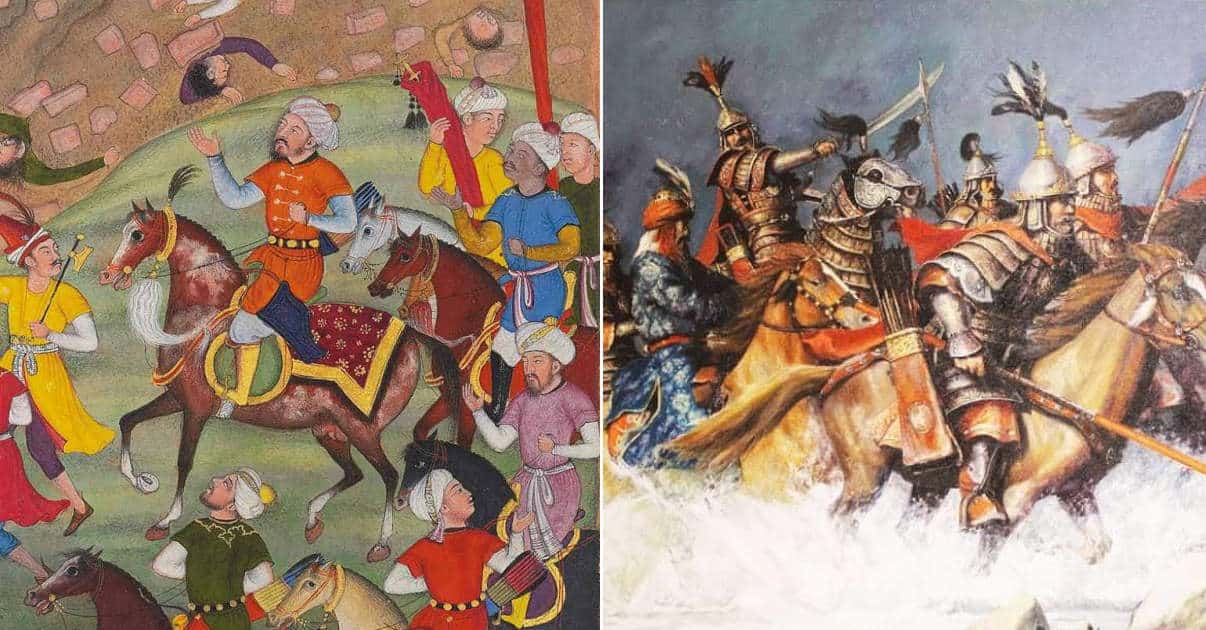

10 – Timur was a Learned Tyrant
It is easy to dismiss Timur as a bloodthirsty tyrant but he was not only extremely intelligent and a military genius, he also had an appreciation for the arts. During his extensive travels, Timur brought distinguished scholars with him and learned the Turkish, Mongolian, and Persians languages, although he was unable to speak Arabic. In one exchange with a Persian poet named Hafez, Timur was astounded by a particularly clever and witty answer and presented the poet with incredible gifts.
In his early campaigns, it was normal for Timur to order the deaths of everyone in a city or town that resisted his rule. He softened his stance as he got older and allowed artisans and other learned men to live. They were typically brought back to Samarkand. One of the earliest examples of this tactic occurred at Isfahan in 1387 where the educated and talented people of the city escaped the pyramid of skulls.
These artisans were put to good use in the Timurid capital as magnificent structures were created by these prisoners. These buildings were gilded with glazed tiles as Samarkand became not only one of the architectural leaders in Central Asia, but also one of the best cities in terms of commerce and learning. Timur’s grandson built an observatory on the city’s outskirts to gaze at the heavens. It led to a giant leap in astronomical knowledge by the standards of the time.
Of course, Timur’s violent nature always came to the fore, even when dealing with artisans. In one case, his favorite wife, Bibi Khanym, commissioned the creation of the mosque that shares her name in Samarkand while her husband was away conquering foreign land. It was meant to be a gift for when he returned home. The architect apparently kissed the queen forcibly, and she reported it to her husband. Timur ordered his men to tie the architect up and throw him from one of the mosque’s minarets which was 150-feet high. The unfortunate architect fell to his doom on the stone-paved courtyard below.
Sources
Banking on Baghdad: Inside Iraq’s 7,000 Year History of War, Profit, and Conflict – Edwin Black
50 Great Military Leaders of All-Time – Jann Tibbets
The Cambridge Illustrated History of the Islamic World – Francis Robinson
History of India – N. Jayapalan
The Knights Hospitaller – Helen J. Nicholson, Helen Nicholson
1001 Battles That Changed the Course of History – R. G. Grant
The Secret History of Iran – Hamad Subani
The Great Events by Famous Historians – Various Authors
Central Asia: A Global Studies Handbool – Reuel R. Hanks
Journeys on the Silk Road Through Ages – Romance, Legend, Reality – Avijeet Bhattacharya


