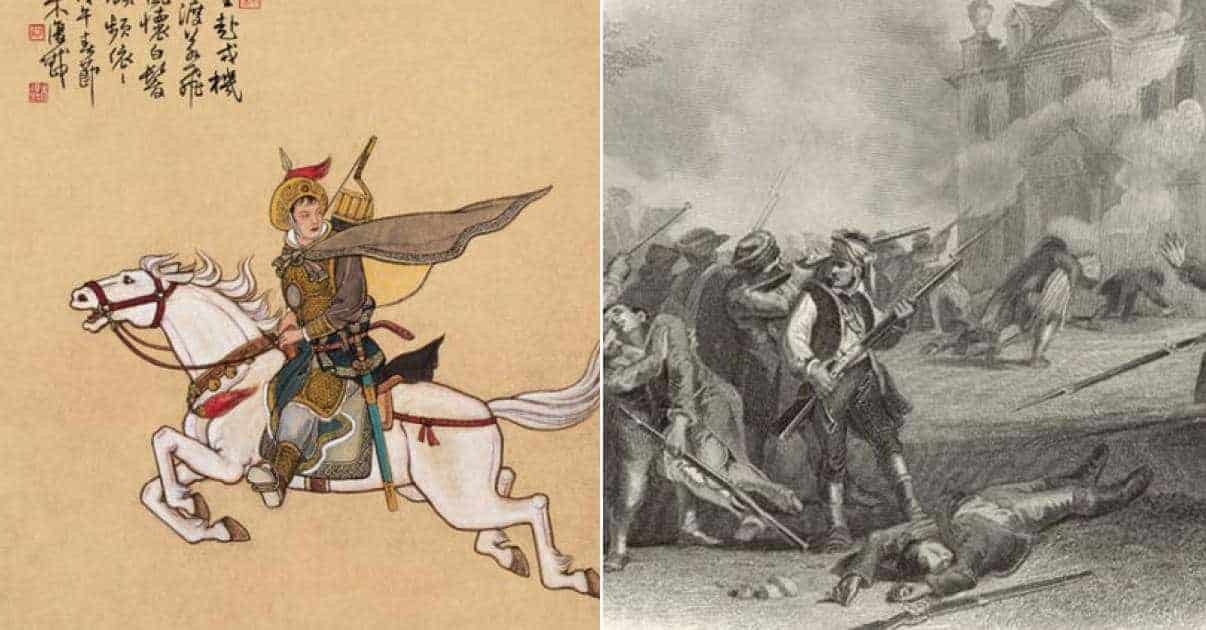

Anna Maria Lane
In the past, as it may be still today, it is not common for wives to accompany their husbands into the army and it was even rare for wives to fight alongside their men in battle. But this actually happened during the American Revolutionary War! Anna Maria Lane and her husband John Lane may have taken their marriage vows quite literally that only death would allow them to part from each other and joined the Continental Army in 1776 and fought together until 1781.
While women often accompanied the army as “camp followers” who provided various services to the soldiers, from cooking to laundering, Anna Maria was believed to have shunned those tasks and taken up arms alongside her husband. Together, they fought in campaigns from New York, New Jersey, Pennsylvania, and Georgia. It was on October 4, 1777, at the Battle of Germantown where Anna Maria was severely wounded in the leg which left her lame for life. John continued to actively serve in the army until he wounded himself at a battle near Savannah, GA.
After the war, Anna Maria worked as a nurse at a military hospital in Richmond, VA. However, due to her wounds received during the war, she was unable to continue working. She petitioned the Virginia government for a pension stating that she was “very infirm, having been disabled by a severe wound, which she received while fighting as a common soldier… from which she never recovered.” In 1808, after several years of petitioning the governor, pensions were granted to several disabled male veterans and a few women. John Lane received a £40 per annum pension but Anna Maria would receive a different amount. Within her pension record, it stated:
In the Revolutionary War, in the garb, and with the courage of a soldier, [she] performed extraordinary military services and received a severe wound at the Battle of Germantown.
For this service, she received a sum of £100 per annum! However, she was only able to enjoy this reward for a couple more years when she died in 1810.


