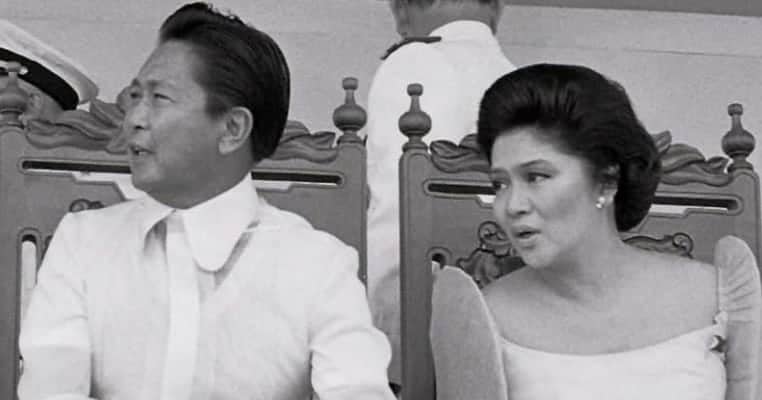

The People Power Revolution and the Overthrow of the Conjugal Dictatorship
The Conjugal Dictators had hoped that the independent commission appointed to look into the assassination of opposition leader Benigno Aquino would whitewash the affair. However, and to the consternation of Ferdinand and Imelda Marcos, the commission actually exercised its independence. In 1984, it investigation concluded that high ranking officers in the Philippines’ military had been responsible for assassinating the opposition leader.
The commission’s findings complicated things for the regime. Under mounting pressure, both domestic and international, the officers accused of Aquino’s assassination were put on trial. The regime had failed to manage the independent commission’s investigation, with disastrous consequences. It learned its lesson, and made doubly sure to manage the trial – no difficult task, as the regime’s corruption and rot had by then spread to and permeated the Philippines’ criminal justice system. In 1985, the accused were duly acquitted, in what was widely perceived as a whitewash and a miscarriage of justice.
Popular protests erupted anew, and to reconfirm his legitimacy and mandate, Ferdinand Marcos called for a snap election in 1986. He was challenged for the presidency by Curazon Aquino, widow of the assassinated Benigno. Unsurprisingly, the election was marred by rampant fraud and violence, and Marcos was “officially” declared the winner, despite the widespread consensus of independent observers that he had lost. Election computer technicians walked out to protest the manipulation of the results in favor of Marcos, and they were protected by a faction of reformist military officers who had finally had enough of the Conjugal Dictatorship.
Massive protests, which came to be called the People Power Revolution, swept the Philippines. The military fractured, and a faction sided with the public against the higher ups who had hitherto defended the regime. When Marcos’ defense minister jumped ship and sided with the protesters, the jig was up, and the kleptocrat couple were forced to flee the country. By then, they had stashed enough wealth overseas, that they were able to afford a comfortable retirement in Hawaii. However, they were unable to take everything with them, and when protesters stormed the couple’s palaces, they found evidence of an extravagant and opulent lifestyle.

After the regime, Imelda Marcos’s shoes were publicly displayed as a symbol of the regime’s corruption. Hundreds of her shoes found a permanent home in the Shoe Museum, in the northern city of Marikina, and the collection became a symbol of excess in a country where many walked barefoot in abject poverty. However, because life is often unfair, neither of the Conjugal Dictators ever paid for their misdeeds. Ferdinand Marcos died in comfortable exile in Honolulu, in 1989, and Imelda Marcos was eventually allowed back in the Philippines. She was elected to the national legislature, and as of 2018, she was one of her country’s wealthiest women. She even turned the shoe scandal into an asset, and has been a frequent visitor to the Shoe Museum. There, Imelda Marcos routinely signs autographs and proudly poses for photos next to the display cases.
____________
Where Did We Find This Stuff? Some Sources & Further Reading
Culture Trip – 11 Bizarre Things You Didn’t Know About Imelda Marcos
Encyclopedia Britannica – Ferdinand Marcos
Philippine Canadian Inquirer – Reminiscing the 1986 EDSA People Power Revolution
ThoughtCo – Ferdinand Marcos, Dictator of the Philippines


