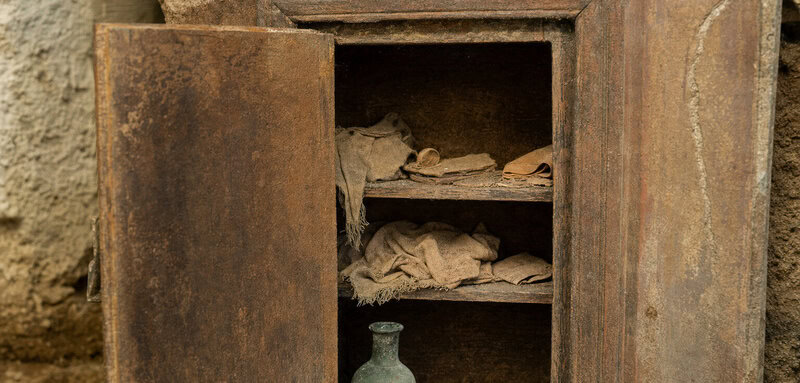
The wardrobe door had not moved in nearly two thousand years. When archaeologists finally eased it open, they found the inside exactly as one woman had arranged it on an ordinary morning in August of 79 CE — and then walked away, not knowing she would never come back to collect her things.
The Wardrobe That Waited 2,000 Years
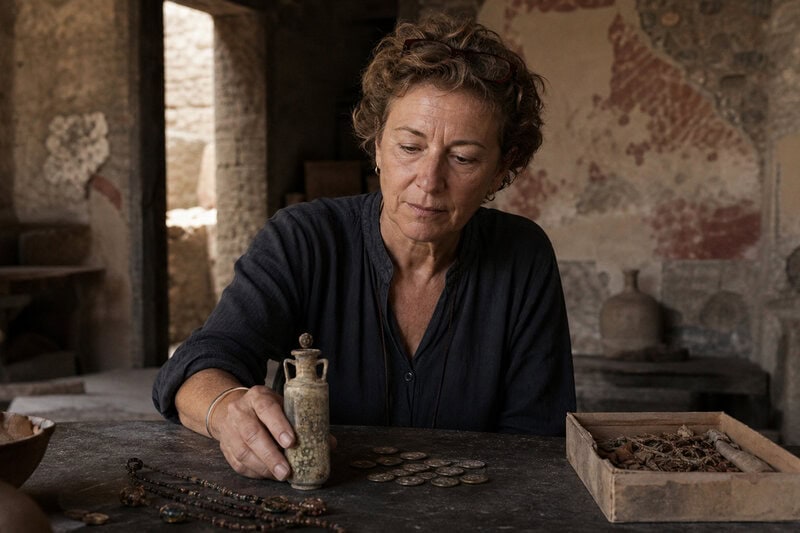
It was the perfume bottle they noticed first. Small, deliberately positioned, the kind of object you set down with the unconscious confidence that you will pick it up again in an hour. Beside it, counted out in a neat group, lay 38 bronze coins — not a fortune, not a hoard, just the kind of petty cash a household manager might set aside before heading to market. The wardrobe that held them had been sealed since the eruption of Vesuvius, its wooden walls carbonized and compressed by pyroclastic debris into a kind of accidental time capsule.
Archaeologists working at Pompeii — a site that continues to yield the unexpected, season after season — formally reported the discovery in the E-Journal degli Scavi di Pompeii, the official publication of the ongoing excavations. The wardrobe’s contents were described as a woman’s keepsakes: makeup tools, a perfume bottle, the coins, and one object that stopped everyone in the room — a child’s charm necklace, coiled among the other things as though it had been folded carefully away.
She is known only by implication. No name survives, no epitaph, no wall graffiti to say she lived here. Archaeologists identify her by the location of the find: the woman of Insula 10, after the household block where the wardrobe was recovered. What she left inside that locked wooden chest is more articulate than any inscription: a private archive of sentiment and practicality, preserved by catastrophe, opened at last by curiosity.
What Is a Crepundia — and Why Did She Keep It?
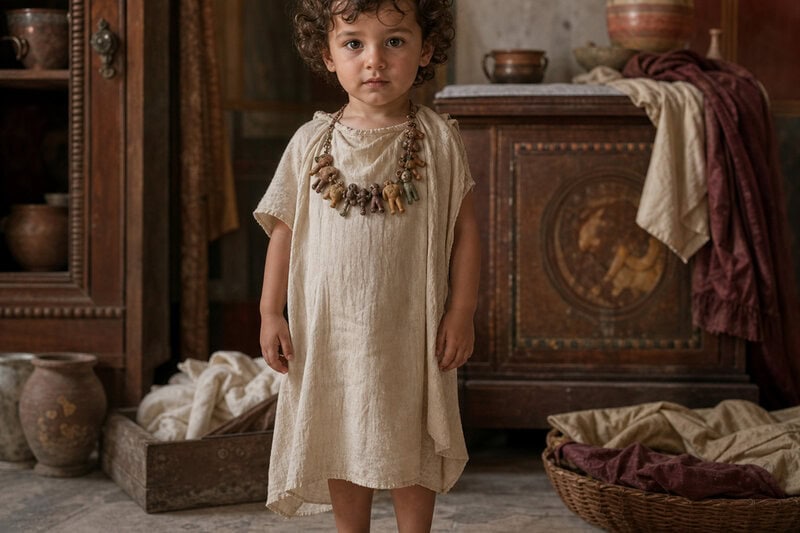
The most arresting object in the wardrobe is the crepundia. The word comes from the Latin crepare — to rattle — and that is exactly what these necklaces did. This one had more than 20 individual charms made from different materials, small enough that an infant wearing it would produce a soft, percussive sound with every kick and turn. The rattle was partly the point: the charms announced the baby’s presence, delighted it, and, according to Roman belief, kept malevolent spirits at a noise-repelled distance.
But the crepundia had a second, more pragmatic life in Roman culture. Beyond their apotropaic function — warding off evil — these necklaces served as identity objects: a legally recognized means of identifying freeborn children and, for infants who had been abandoned or enslaved, potential proof of origin. Each charm was distinctive; the assemblage as a whole was unique. In a world without birth certificates, the necklace was the record.
Among the more than 20 charms recovered from the wardrobe were depictions of the god Bes — a deity borrowed from Egyptian tradition, squat and fierce-faced, and precisely the figure a Roman mother might reach for when ordinary prayers felt insufficient. Bes was a specialist: a protector of children, of women in labor, of the terrifyingly fragile first months of life. His presence on the crepundia is a small window into real Roman spiritual anxiety, the kind that no official state religion fully addressed.
That the woman of Insula 10 kept this necklace in her wardrobe rather than around a child’s neck is the detail that transforms it from artifact to story. The crepundia had been outgrown. She had saved it anyway — the Roman equivalent of a baby shoe on a mantelpiece, or a first tooth wrapped in cloth at the back of a drawer. Sentiment, it turns out, is not a modern invention.
The Perfume Bottle and the Roman Art of Self-Presentation
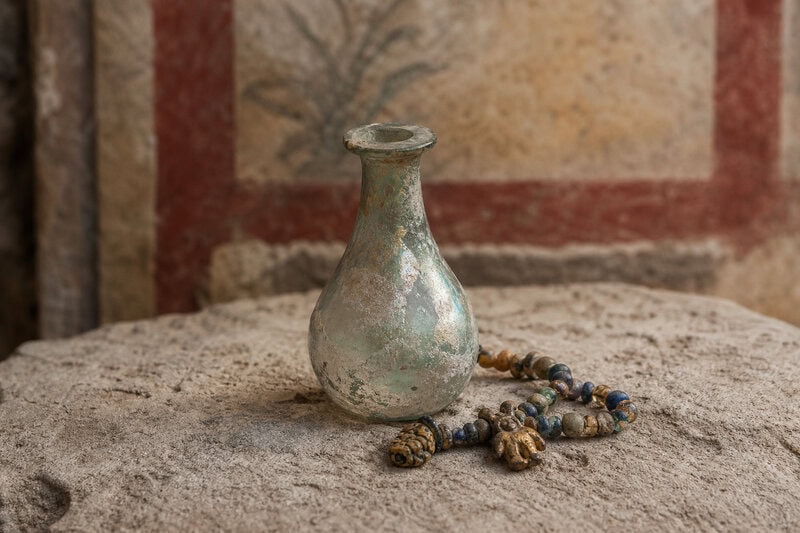
The perfume bottle found beside the necklace connects the woman of Insula 10 to a vast and surprisingly well-documented Roman economy of scent. Unguentarii — perfume traders — operated across Pompeii, and surviving price records from the Roman world suggest that quality perfumes could cost more per ounce than wine. Scent was not frivolous; it was social currency, a marker of status and care, the kind of thing a woman of a respectable household would consider as much a necessity as bread.
The wardrobe also contained makeup tools alongside the perfume bottle, placing the woman of Insula 10 squarely inside a well-documented Roman female practice. Roman writers, medical texts, and the painted portraits found across Pompeii all document the morning beauty routine as something close to a ritual — methodical, purposeful, and conducted in a private space before the public day began. The cosmetics and the perfume bottle together suggest that this wardrobe was that private space: the place she returned to each morning, the last door she closed before stepping out into the city.
Pompeii’s volcanic preservation means the perfume bottle is one of a class of objects that reveal daily life more honestly than any literary source. It was used, not displayed. It still bears the marks of an ordinary life rather than the curated grandeur of an official monument — and that is precisely what makes it irreplaceable.
One irony of Vesuvius, not lost on archaeologists, is that the disaster that ended these lives is also the reason we can read them so clearly. The eruption was not a slow abandonment but a sudden interruption, which means wardrobes were not emptied before evacuation, coins were not spent, and perfume bottles were not finished. What we have is the archaeology of a single morning rather than the archaeology of a civilization’s long decline.
Thirty-Eight Coins and What They Measured
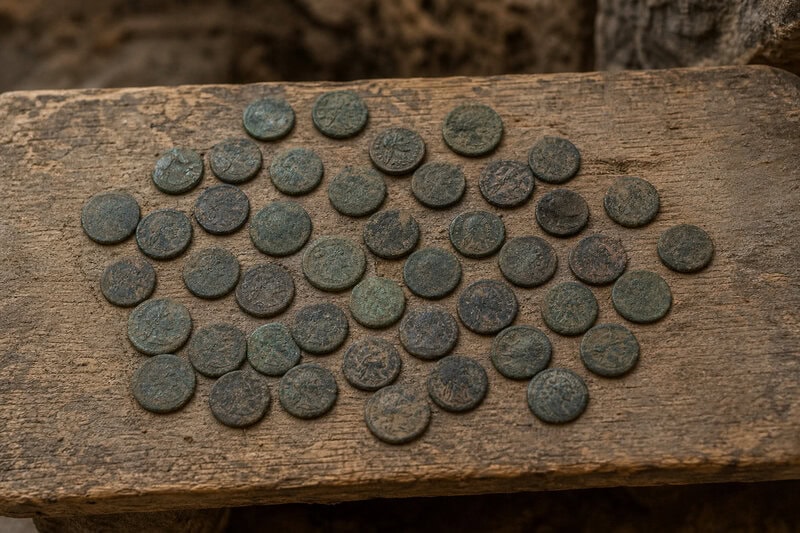
And then there are the 38 bronze coins. It is a number that resists romanticizing, which is part of why it is so useful. Bronze coinage was everyday money — the denomination of bread, fish sauce, and small transactions at the market stalls that lined Pompeii’s streets. It was not savings in any aspirational sense. Its presence in a locked wardrobe suggests petty household cash kept separate from larger funds: money earmarked for a specific purpose, perhaps for the morning market run that the eruption interrupted.
Pompeii’s archaeological record is unusually rich with this kind of economic texture. Prices are scratched into walls; electoral endorsements identify the trades and businesses that funded them; graffiti preserves the arithmetic of everyday commerce. The bronze coins found in this wardrobe can be cross-referenced against that graffiti record, anchoring the woman of Insula 10 not just in time but in a specific economic stratum — a household with sufficient means to maintain a locked personal wardrobe, to buy quality cosmetics, and to possess a crepundia of more than 20 charms. Not the wealthiest household in Pompeii, in all likelihood, but a comfortable one.
Read together, the coins, cosmetics, and perfume bottle sketch a person managing a household with both sentiment and practicality: the crepundia saved for memory, the coins saved for the next morning’s errands. The find’s formal reporting in the E-Journal degli Scavi di Pompeii anchors it in active, ongoing archaeology rather than the realm of sensationalized discovery — a precise scholarly address for a very human set of objects.
Roman Family Life: The Private World Behind the Public City
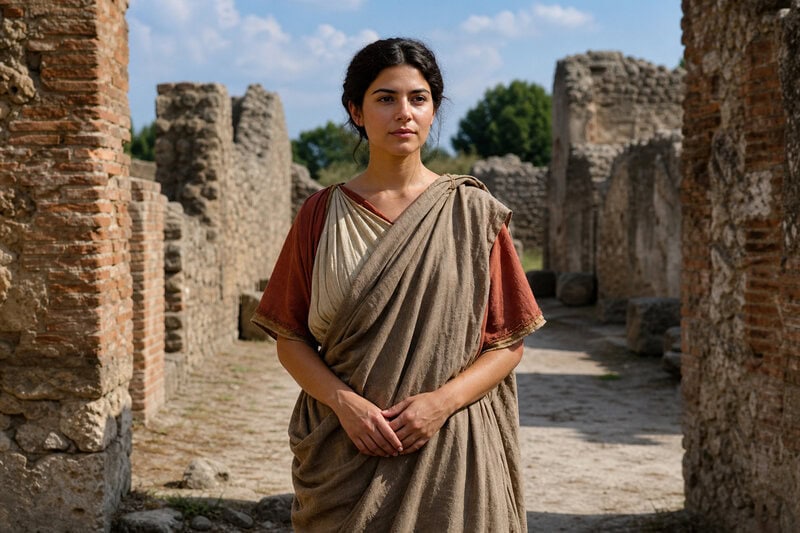
Pompeii’s famous public spaces — the forum, the amphitheater, the baths, the painted electoral slogans that plaster every available wall — are the city most people know. But discoveries like the woman of Insula 10’s wardrobe push into a different interior: the woman’s quarter, the locked chest, the objects no one else was meant to see. This is where Roman family life actually happened, and it is a space the archaeological record has only recently begun to read with sustained attention.
Roman family life in Pompeii encompassed an extended household — the familia — that could include blood relatives, freed persons, and enslaved workers under one roof. The crepundia‘s original wearer might have been a child of any of several statuses: a freeborn daughter, the child of a freed woman who had joined the household, or an enslaved infant whose identity the necklace was meant to preserve. The charm itself cannot resolve that ambiguity. What it can say is that someone cared enough to keep it.
The presence of Bes among the charms is a reminder of how permeable Roman religious life was. The woman of Insula 10 could reach across the Mediterranean for an Egyptian deity she believed would guard her child — a god with no official place in the Roman state religion, borrowed freely from a culture the Roman Empire had absorbed — and nobody would have found this remarkable. Roman religion was less a fixed system than a practical toolkit, and you used what worked.
The wardrobe’s contents reframe Roman family life in Pompeii not as marble and rhetoric but as scent, small coins, and a mother’s decision to keep a necklace her child had long since outgrown. It is a reframing that the literary sources, written almost exclusively by men about public life, rarely permit.
What She Left Behind
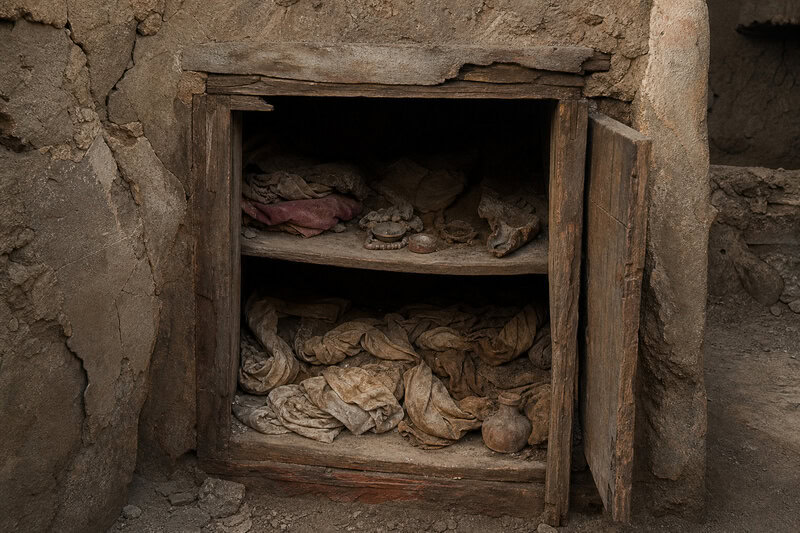
The woman of Insula 10 did not survive to retrieve her things — or if she did escape the eruption, she never came back, and the objects in that wardrobe passed out of her life at the moment the door swung shut in 79 CE. Buried under volcanic ash for almost 2,000 years, the wardrobe waited in sealed darkness while the city above it was excavated, theorized, romanticized, and gradually understood.
What she left behind is not a treasure hoard in any dramatic sense. There is no gold, no gemstone cache, no evidence of desperate last-minute valuables-gathering. What there is, instead, is proof of a specific person’s specific attachments: a child remembered through more than 20 small charms, a scent kept in a bottle, a handful of coins for ordinary spending. Historians sometimes call such a grouping a biographical assemblage — objects that, read together, outline a life even when no name survives to label it.
The crepundia, the perfume bottle, and the 38 bronze coins will not tell us her name. They will not tell us whether she survived, whether the child who wore that necklace grew up, whether she grieved or fled or waited too long. But they do something almost as remarkable: they confirm that she was, in the ways that matter, recognizable. She kept things. She saved money. She held on to objects that meant more than their material weight. Two thousand years later, the wardrobe has been opened, the journal entry written, and the woman’s private morning — interrupted, preserved, and finally witnessed — is part of the public record of Pompeii at last.