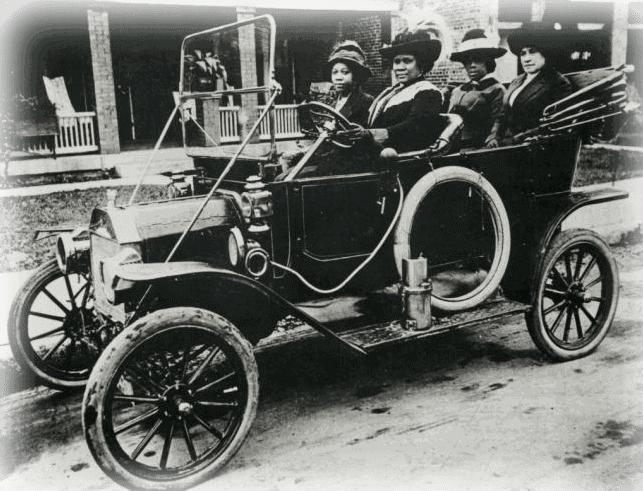

The First National Beauty Culturist Convention in 1917
Sarah Breedlove not only transformed herself in Madam C.J. Walker, but she also had a direct hand in training other black women in sales. She showed them how to budget their income and build their own businesses. Like herself, she wanted them to be financially stable and independent.
This passion for sharing her talents and the inspiration model of the National Association of Colored Women, she founded local and state clubs for her sales agents. Then she established the National Beauty Culturists and Benevolent Association of Madam C. J. Walker Agents (predecessor to the Madam C. J. Walker Beauty Culturists Union of America).
Over 200 women met in 1917 for the first annual conference in Philadelphia.

Madam Walker herself happily awarded prizes to the hardworking women. Some awards included the one who recruited the most sales agents or who had sold the most products.
Being a philanthropist herself, Madam Walker also took the time to recognize the women who made the largest charitable donations to their communities. The convention was one of the first of its kind; it was a national gathering for women to discuss and celebrate business.
Walker’s Estate: Villa Lewaro
That same year Madam Walker commissioned New York’s first licensed black architect, Vertner Tandy, to design a home. The luxurious estate, called Villa Lewaro, is located in Irvington-on-Hudson, New York.
It cost the first self-made female millionaire about $250,000, but it became so much more than just a house. She hosted gatherings for community leaders to inspire other young black entrepreneurs to pursue their dreams.

Her home was completed in May 1918, and her first party was honoring the Assistant Secretary for Negro Affairs of the U.S. Department of War, Emmett Jay Scott.
Continued Civil Rights Work
New York definitely had an influence on Madam Walker; she became more involved with politics. Not only did she associate with W.E.B. Du Bois, Booker T. Washington, Mary McLeod Bethune, and others, but she delivered her own lectures about social and economic issues.

In 1917, Madam Walker became a member of the executive committee of the New York chapter of the NAACP. Together, they organized a Silent Protest Parade, which took place on Fifth Avenue in New York City. Over 8,000 African-Americans joined to protest an East St. Louis riot that left 39 black Americans dead.
As the United States became enthralled with World War I, Madam Walker was no longer just a wealthy, famous businesswoman. She advocated for a training camp establishment for black officers in the Army. She also used her powerful voice as a leader in the Circle for Negro War Relief.
The National Association of Colored Women’s Clubs (NACWC) honored Madam C.J. Walker in 1918 for making the largest contributions to help keep the Anacostia home of Frederick Douglass.
Her Legacy
On May 25, 1919, Madam C.J. Walker passed away at her estate at Irvington-on-Hudson, New York. It was due to complications of hypertension, or high blood pressure; she was only 51 years old. She was the sole owner of her business, which was valued at over $1 million.
Her funeral service was held at the Mother Zion African Methodist Episcopal Zion Church in New York City; it was similar to the one she used to sing for in the south so many decades ago. Mary McLeod Bethune, who rose to become a noted African-American educator, delivered the eulogy.
You can visit Madam C.J. Walker’s grave at the Woodlawn Cemetery in the Bronx, New York.

Naturally, A’Lelia took control of the business and became the president of the Madam C.J. Walker Manufacturing Company. Villa Lewaro, her estate, later became a National Historic Landmark.

In her will, she left one-third of her estate to her adored daughter, A’Lelia. The remaining two-thirds of her future net profits would continue to be donated to charity.
Before her death, Madam C.J. Walker began building an arts center in Indianapolis known as the Walker Building. It officially opened in 1927. It, too, was registered as a National Historic Landmark after decades of significant cultural growth took place in the art center, especially for African-Americans. The United States Post Office issued Madam Walker her own stamp in honor of its ‘Black Heritage’ series in 1998.

Madam C.J. Walker, the first free-born of her siblings on a plantation in Louisiana, was the first American women to become a self-made millionaire. She is remembered for her savvy business sense along with her philanthropic generosity.


